
Pega vs. Salesforce: Which One Actually Fits Your Business?
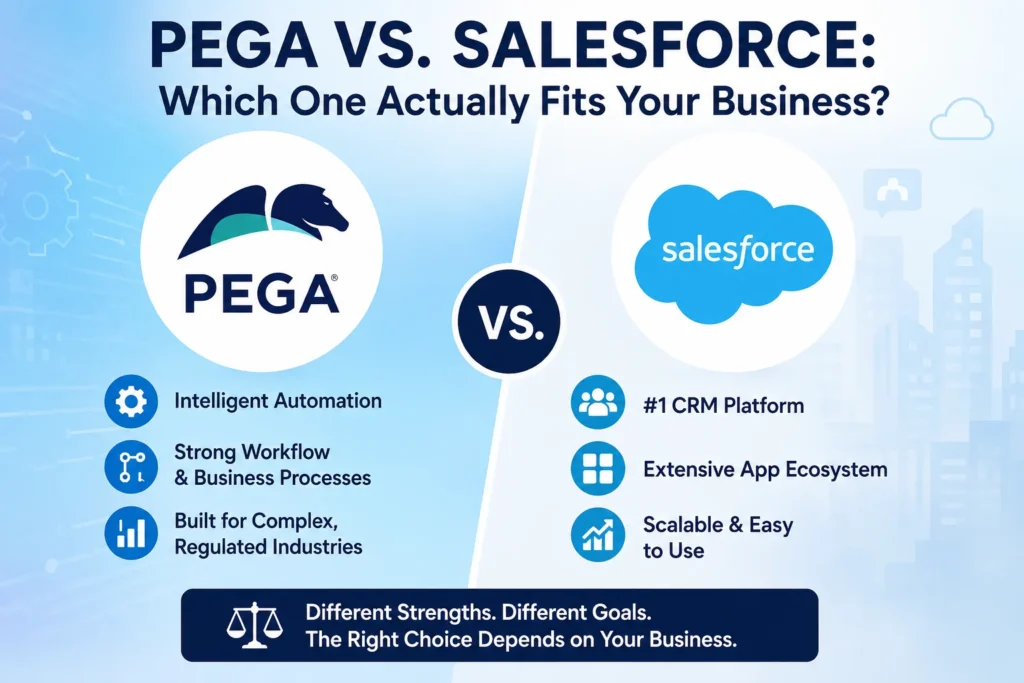
If you’ve spent any time researching enterprise CRM or workflow automation, you’ve probably noticed that Pega and Salesforce keep showing up in the same breath, even though they were built to solve different problems. That mismatch is exactly why so many buyers get stuck comparing them feature by feature and still end up unsure which one to pick.
Here’s the short version: Salesforce is a cloud-native CRM built around accounts, pipelines, and a massive app marketplace. Pega is a business process management and case management platform built around orchestrating complex, rule-heavy work, often inside banks, insurers, and government agencies. They overlap at the edges, but they’re not really competing for the same job most of the time.
This guide breaks down where each platform wins, what they actually cost, and how to figure out which one your organization needs.
Pega vs. Salesforce at a Glance
| Pega | Salesforce | |
|---|---|---|
| Core focus | Case management, business process automation, real-time decisioning | CRM, sales pipeline, service, marketing, commerce |
| Starting price | Around $90-$97 per user/month, plus consumption-based case pricing | Around $25 per user/month for Sales Cloud entry tier |
| Deployment | On-premise, private cloud, or Pega Cloud | Cloud-only (SaaS) |
| Best for | Regulated industries with complex, multi-step workflows | Revenue and service teams that want speed and a wide app ecosystem |
| AI approach | Governed, workflow-bound agents (Agentic Process Fabric) | Autonomous, action-oriented agents (Agentforce) |
| App marketplace | Fewer than 500 apps/integrations | 9,000+ apps on AppExchange |
| G2 rating (Pega Platform vs. comparable Salesforce product) | 4.2-4.5 stars | 4.1-4.4 stars |
What Pega Actually Does Well
Pega is a low-code platform built around case management and real-time decisioning, and it’s designed to fit complex, multi-step processes rather than simple record-keeping. Think loan approvals that touch six departments, insurance claims with dozens of conditional branches, or compliance workflows that regulators will eventually audit line by line.
Its Customer Decision Hub handles real-time next-best-action decisioning, and Pega’s “center-out” architecture is built so companies can modernize gradually instead of ripping out legacy systems all at once. That matters a lot if you’re a bank or insurer with decades of infrastructure you can’t just switch off overnight.
On the AI side, Pega’s newer Agentic Process Fabric orchestrates multiple AI agents inside existing governed processes, so agent actions stay tied to defined workflows rather than improvising. For industries where every automated decision has to be explainable to a regulator, that constraint is a feature, not a limitation. Pega has said this architecture can cut costs dramatically compared with more open-ended, LLM-heavy setups for certain customers.
The trade-off: Pega requires specialized developers, carries meaningful cloud minimums, and implementation timelines tend to run long. Enterprise deployments often land in the $300K to $1M+ range once you factor in customization and onboarding, and smaller businesses will likely find it out of reach.
What Salesforce Actually Does Well
Salesforce built its reputation as one of the earliest SaaS companies, and it never really moved off the cloud-first playbook. It’s the world’s largest CRM by market share, serving well over 100,000 companies across sales, service, marketing, commerce, and industry-specific “clouds.”
Where Salesforce pulls ahead is breadth and speed to value. With over 9,000 apps on AppExchange and pre-built solutions for nearly every function, teams can often get running in weeks rather than months. Its Agentforce AI agents lean autonomous: they’re designed to perceive a situation, plan a response, and act without constant human sign-off, which is a very different philosophy from Pega’s governed, workflow-bound approach.
For pricing, Salesforce leans on per-user subscriptions for its core clouds, layered with newer consumption-based credits for AI features like Agentforce and Data 360. That separates your seat costs from your AI usage, which adds flexibility but also adds a variable line item you’ll need to forecast carefully.
The catch: that breadth brings pricing complexity. Add-ons, clouds, and AI credits stack quickly, and a “simple” Salesforce rollout can balloon once departments start requesting more modules.
Pricing: The Real Numbers
Neither vendor publishes a simple price list, but the pattern is consistent across research firms. Salesforce’s entry-level Sales Cloud tier starts around $25 per user per month, while Pega’s listed starting price sits closer to $90-$97 per user per month, before you add case-based consumption charges. One pricing analysis put the gap at roughly $65 per user per month in Salesforce’s favor at the entry tier.
Pega’s own pricing tends to scale with case volume rather than seats alone, which can work in your favor if you have predictable, high-throughput processes but makes budgeting harder if volume is unpredictable. Enterprise buyers should also expect negotiation room: benchmark data suggests large deals ($1M+ list price) can see discounts of 40-50% once territory VPs get involved, so the sticker price is rarely the final number for either platform.
Where Each Platform Wins by Use Case
Choose Pega if:
- You’re in banking, insurance, healthcare, or government, where every automated decision needs an audit trail
- Your biggest problem is orchestrating complex, multi-department workflows, not managing a sales pipeline
- You have (or can hire) developers comfortable with a low-code, rules-heavy environment
- You want to modernize legacy systems gradually instead of replacing them outright
Choose Salesforce if:
- Your priority is managing customers, deals, and revenue, not internal case workflows
- You want to move fast and lean on a large ecosystem of pre-built apps and integrations
- Your team doesn’t have the bandwidth to manage a heavy custom-development platform
- You need something that scales from a small sales team up to a full Customer 360 deployment
Implementation and Learning Curve
This is where the two platforms diverge sharply. Salesforce, for all its complexity, is built for admins and “clicks, not code” configuration in a lot of common scenarios. You’ll still want certified consultants for anything nontrivial, but a mid-sized team can often get core CRM functionality live in a matter of weeks.
Pega’s learning curve is steeper. It’s genuinely a developer’s platform underneath the low-code layer, and most organizations bring in Pega-certified engineers or a systems integrator for anything beyond a pilot. That’s not a knock on the product. It’s a reflection of what Pega is built to do: manage genuinely complicated processes, not simple data entry.






1 thought on “Pega vs. Salesforce: Which One Actually Fits Your Business?”