
What Is BidPay and How Does Its Payment Platform Work?
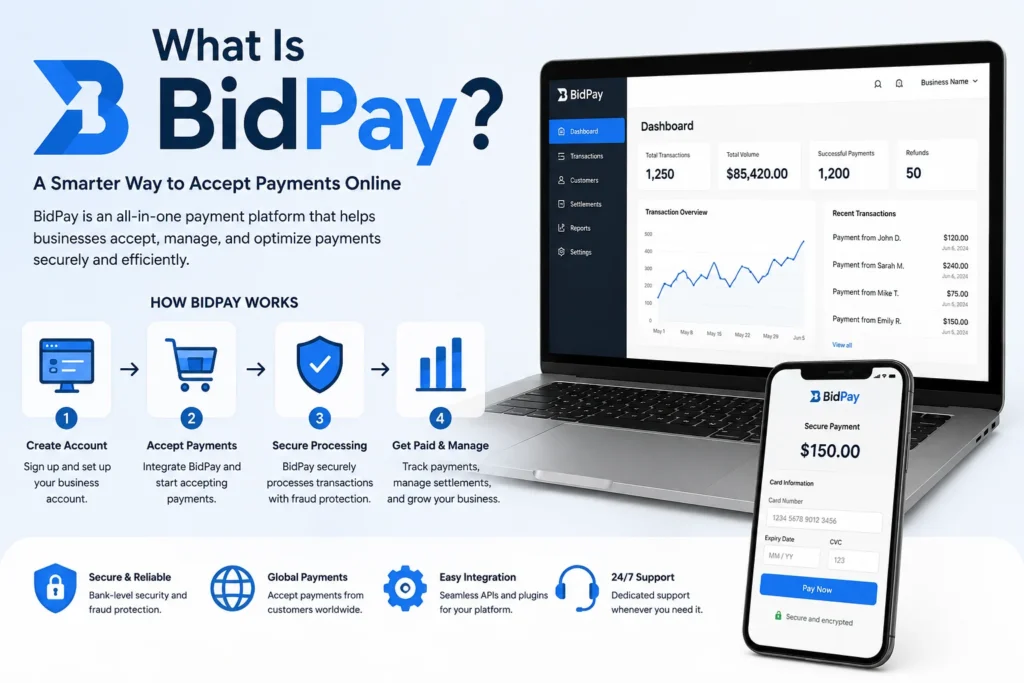
If you’ve landed here after seeing “BidPay” mentioned in a supplier email or a procurement conversation, you’re probably picturing the wrong company. There used to be a BidPay that handled eBay auction payments back in the early 2000s. That service shut down in 2008. The BidPay operating today is a completely different business, and it has nothing to do with online auctions for consumers.
This BidPay is a supply-chain fintech company founded in 2013 by Tony Furman, headquartered in Santa Teresa, New Mexico. It runs a cloud-based platform that lets large buyers pay their suppliers early, in exchange for a discount the supplier sets themselves. Below, we’ll walk through what the platform actually does, how the payment auction works, and who it’s built for.
What Is BidPay, Exactly?
BidPay is an accounts payable auction platform. Large companies (retailers, manufacturers, and distributors) use it to offer their suppliers the option of getting paid before an invoice is technically due, at a small discount the supplier chooses. Instead of suppliers borrowing against unpaid invoices or waiting out 30, 60, or even 120-day payment terms, they can bid for faster payment directly from the buyer.
Tony Furman, who also co-founded the Interstate Capital Group, built the company around a fairly simple observation: suppliers that are short on cash tend to get distracted from things like quality control and on-time delivery. Giving them a faster path to payment, funded by the buyer’s own surplus cash rather than a bank, was the pitch.
Industry trackers list BidPay under “accounts payable dynamic discounting,” alongside firms like Taulia, FundThrough, and Billie. It’s a small player in that space; it hasn’t taken outside funding, and it operates more like a specialized tool than a broad financial platform.
How the BidPay Auction Actually Works
The mechanics are worth spelling out, because this isn’t a standard early-payment discount program with a fixed rate.
- A buyer connects its ERP system. No major integration work is required; the buyer exports a file of approved, “vouchered” payables that BidPay is allowed to include in an auction.
- Suppliers get an auction notice. Once a week (Tuesdays, based on the company’s own materials), eligible suppliers see a list of their approved invoices that qualify for early payment.
- Suppliers bid a discount. Each supplier decides what discount, if any, they’re willing to offer in exchange for immediate payment. Nobody is forced to bid; a supplier can simply wait for the invoice’s original due date instead.
- The buyer’s algorithm accepts or declines. Using criteria the buyer sets ahead of time, such as a minimum acceptable yield, BidPay’s system decides which bids to accept.
- Winning suppliers get paid at the end of the 24-hour window. Everyone else is paid on the invoice’s normal terms, or they can try again in the next auction.
That structure is the company’s main differentiator from a static early-payment program. Because the discount isn’t fixed or predictable, suppliers can’t simply bake the cost of discounting into their pricing ahead of time, which is the outcome BidPay’s founder has pointed to as a problem with older models.
Who Benefits, and How?
Buyers get to put idle cash to work. Retiring a payable early at even a 1-2% discount, annualized, can beat what a company earns parking that cash elsewhere, and it comes with no added credit risk since the buyer already owed the money.
Suppliers, especially smaller or credit-constrained ones, get a way to convert an approved invoice into cash without going through a factoring company or a bank loan. That matters most for businesses that are already waiting 60, 90, or more days to get paid under standard net terms.
There’s a related product, BidPay Freight, aimed specifically at shippers, freight brokers, and motor carriers. Truckers often need cash quickly after delivery, and the freight version of the platform runs the same bidding logic for freight bills instead of standard trade payables.
How BidPay Compares to Similar Platforms
BidPay sits in a crowded corner of B2B fintech that includes dynamic-discounting and supply-chain-finance platforms such as Taulia, C2FO, PrimeRevenue, and FundThrough. Most of these tools solve a similar problem (getting cash to suppliers faster) but differ in how the discount is set:
- Static early-payment discounts (the traditional “2/10 net 30” model) lock in one fixed rate regardless of market conditions.
- Dynamic discounting platforms, including BidPay, let the rate move with the invoice’s remaining time and the buyer’s cash position.
- Third-party supply-chain finance brings in an outside funder (often a bank) instead of using the buyer’s own cash.
BidPay’s auction format, where suppliers actively bid rather than accept a sliding scale set by the buyer, is closer to what a handful of niche AP platforms do, but it’s not the dominant model in the category. Larger competitors with outside funding, like Taulia, have far more market share.
Is BidPay Legitimate?
Yes. BidPay is a registered operating company, not a scam or a rebrand of the old auction-payment BidPay.com. It has an established relationship history that includes work with subsidiaries of larger public companies, and it’s tracked by standard company databases as an active, if small, player in the accounts-payable-technology space. That said, it’s a niche vendor. If you’re a supplier who received a BidPay auction notice, it’s reasonable to verify the request directly with your buyer’s accounts payable department before bidding.







1 thought on “What Is BidPay and How Does Its Payment Platform Work?”