
What Country Has the Healthiest Food?
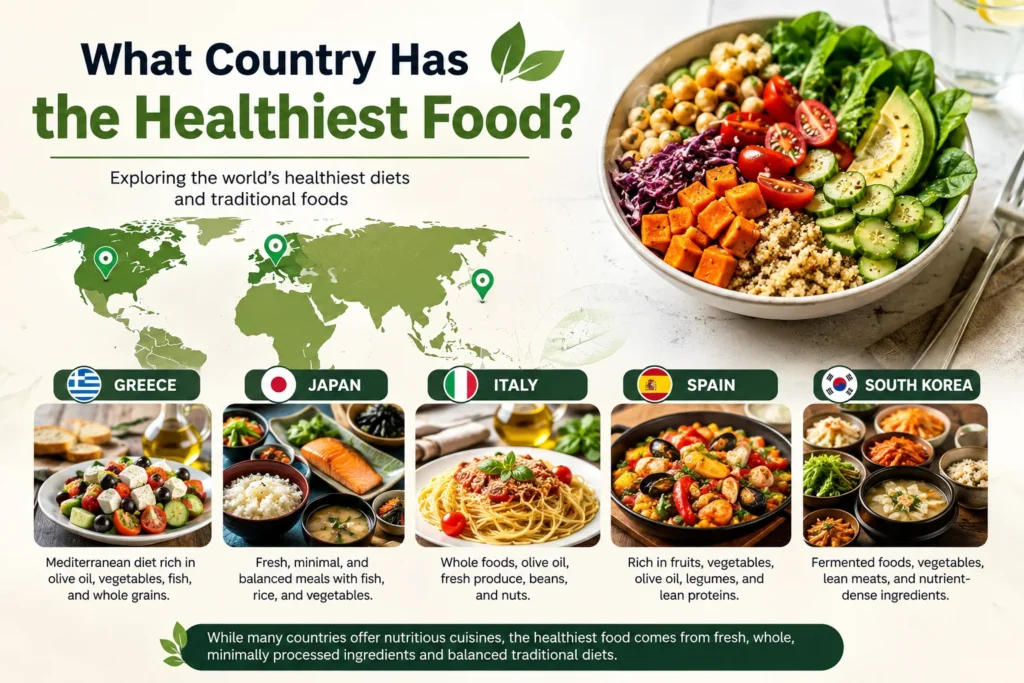
Japan usually tops the list of countries with the healthiest food, followed closely by Greece, Spain, Italy, and South Korea. These aren’t random picks. Researchers keep landing on the same handful of places when they study life expectancy, low rates of heart disease, and diet quality together. So what’s actually going on in these kitchens?
Japan: Portion Control and Ocean-Based Protein
Japan has one of the longest life expectancies in the world, and food is a big part of the story. Meals lean on fish, seaweed, rice, and vegetables, with meat and dairy playing a much smaller role than in Western diets. Fermented foods like miso and natto show up constantly, and they’re linked to better gut health.
Portion size matters here too. Traditional Japanese meals are served on small plates, which naturally limits how much people eat in one sitting. There’s also a cultural habit called hara hachi bu, eating until you’re about 80% full instead of stuffed. Small thing, big effect over a lifetime.
Greece and the Mediterranean Approach
Greece, along with Spain and Italy, follows what’s commonly called the Mediterranean diet. Olive oil replaces butter as the main fat source. Meals center on vegetables, legumes, whole grains, and fish, with red meat saved for occasional meals rather than daily ones.
Olive oil deserves a mention on its own. It’s rich in monounsaturated fats, and multiple studies have connected regular olive oil use to lower rates of heart disease. Greeks also eat a lot of leafy greens that don’t get much attention outside the region, like horta, which are packed with fiber and antioxidants.
South Korea: Fermentation and Vegetable-Heavy Meals
South Korean meals typically include several small side dishes called banchan, and most of them are vegetables. Kimchi, a fermented cabbage dish, is on the table at nearly every meal. It’s low in calories, high in fiber, and full of probiotics from the fermentation process.
Korean cooking also uses less oil overall compared to many Western cuisines, favoring grilling, steaming, and quick stir-frying instead. Meals tend to be balanced rather than centered around one large protein and a side.
What These Diets Actually Have in Common
Strip away the geography, and a pattern shows up fast:
- Plants dominate the plate. Vegetables, legumes, and whole grains take up more space than meat.
- Fat comes from good sources. Olive oil and fish rather than processed oils and fried food.
- Portions stay reasonable. Nobody’s clearing giant plates piled with food.
- Fermented and probiotic foods show up often. Miso, kimchi, and yogurt all support gut health.
- Processed food isn’t the default. Meals are cooked from real ingredients, not packaged and reheated.
None of this requires moving to Tokyo or Athens. A person in Ohio can eat more like someone in Crete just by shifting the ratio of vegetables to meat on their plate and swapping vegetable oil for olive oil.
Does Ranking Even Matter?
Honestly, the “which country wins” question is a little beside the point. These diets share the same underlying logic: more plants, better fats, smaller portions, and less processed food. Pick whichever cuisine you actually enjoy eating and lean into its healthier habits. You don’t need to eat exactly like a Japanese grandmother to get most of the benefit.