How Helium Is Produced: From Underground Rock to Gas Tank
Helium isn’t made in a factory. It’s found, trapped underground, and separated from natural gas. That single fact surprises most people, because we treat helium like a manufactured product, the way we treat oxygen or nitrogen. We can’t manufacture it in any practical way. We can only collect what the Earth has already made over hundreds of millions of years.
Here’s the full journey, from a decaying uranium atom to the balloon at a birthday party.
What Is Helium, and Where Does It Come From?
Helium is the second-lightest element, with atomic number 2. Almost all of it in the universe formed in the Big Bang or inside stars through fusion. The helium on Earth has a different origin story.
It comes from radioactive decay. Uranium and thorium, found in granite and other rocks in the crust, slowly break down and shoot out alpha particles. An alpha particle is two protons and two neutrons. Once it slows down and picks up two electrons, it’s a helium-4 atom.
The process is painfully slow. A single gram of uranium produces only a tiny amount of helium over millions of years. But rock is enormous, and time is long.
Why Helium Collects Underground
Helium is the second-lightest element and chemically inert, so it doesn’t bond with anything. Once it forms, it drifts upward through cracks and pores in the rock, and if nothing stops it, it reaches the atmosphere and escapes into space. Earth’s gravity can’t hold it.
So where does it end up trapped? Beneath layers of dense, sealed rock such as salt beds or shale caps, the same geology that traps natural gas. Helium rides along with methane, nitrogen, and carbon dioxide, and the whole mixture sits in a reservoir waiting for someone to drill.
Step 1: Finding Gas Fields With Enough Helium
Not every gas field is worth the trouble. Most natural gas contains almost no helium. Producers generally look for fields where it makes up at least a few tenths of one percent of the gas, and some richer fields run higher.
Geologists use seismic surveys, well data, and gas sampling to estimate concentrations before committing money. Helium usually isn’t the primary target. Methane pays for the drilling, and helium is a valuable byproduct, though a few exploration projects now target helium-rich gas directly.
Step 2: Drilling and Collecting Raw Gas
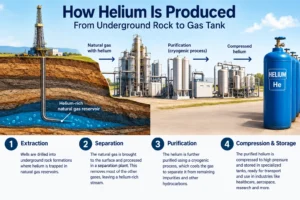
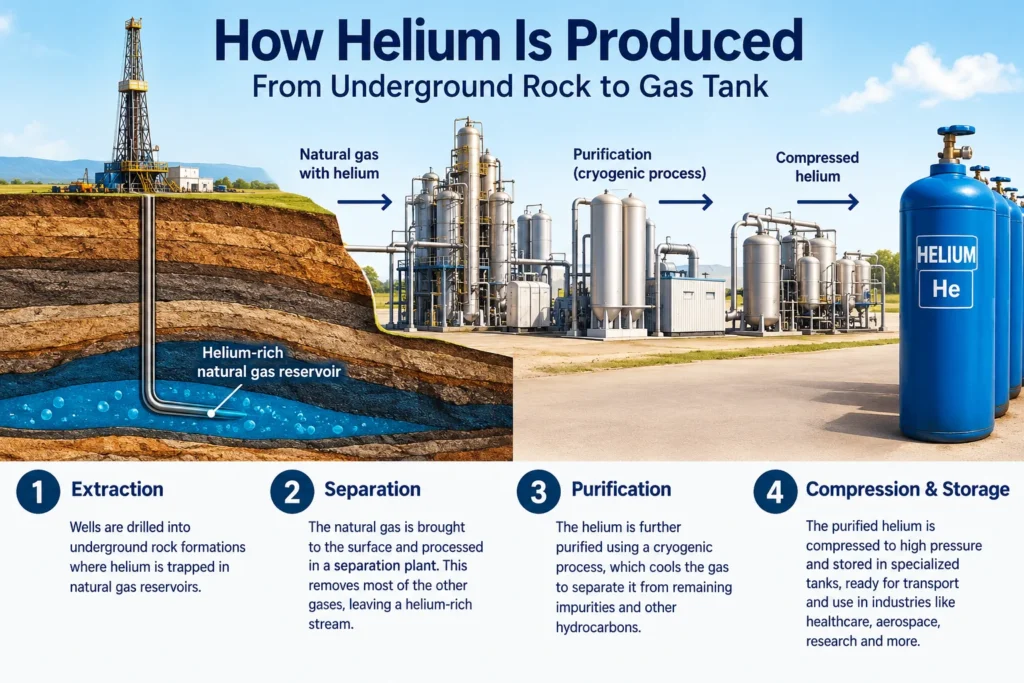
The drilling looks the same as any gas well. A well reaches the reservoir, raw gas flows up, and pipelines carry it to a processing plant.
At this point it’s a messy mixture. It might contain methane, ethane, nitrogen, carbon dioxide, water vapor, and sometimes hydrogen sulfide, with helium as a tiny fraction.
Step 3: Cleaning the Gas Stream
Before anything gets separated, the plant strips out contaminants. Water, carbon dioxide, and sulfur compounds would freeze or corrode equipment in the next stage, so they go first.
What’s left is mostly methane, nitrogen, and a small share of helium.
Step 4: Cryogenic Separation
This is the core of the process, and the idea is simple. Every gas turns to liquid at a different temperature, and helium refuses to liquefy until it’s extremely cold.
Methane liquefies at roughly minus 162 degrees Celsius. Nitrogen follows at about minus 196. Helium stays gaseous all the way down to about minus 269, close to absolute zero.
So the plant chills the gas stream in stages. Methane condenses first and is drawn off, and nitrogen follows. What stays gaseous at the end is a helium-rich stream called crude helium, usually somewhere between 50 and 70 percent pure
Step 5: Purification to Commercial Grade
Crude helium isn’t ready for MRI machines or labs. A purification step follows, typically pressure swing adsorption. Gas passes through beds of material that trap leftover nitrogen, hydrogen, and other impurities while helium slips through.
The result is Grade A helium at 99.995 percent purity or better. Some applications, like semiconductor manufacturing, want even cleaner.
Step 6: Liquefying and Shipping
Helium gas takes up a lot of space, so shipping it as gas is expensive. Most producers liquefy it, cooling it to about 4 kelvin (minus 269 Celsius), and load it into insulated cryogenic containers.
Those containers cross oceans by ship and travel by truck to customers. Even with excellent insulation, some liquid slowly boils off during transit, which is one reason helium logistics are tricky and costly.
Where Most Helium Comes From
A handful of countries supply most of the world’s helium. The United States has long been a major producer, with fields in Kansas, Texas, and Wyoming. Qatar produces large volumes as a side stream of its liquefied natural gas operations. Algeria, Russia, and Canada also contribute, and Russia’s Amur facility has been expanding its output.
Supply depends on a few big plants. When one shuts down for maintenance or politics gets in the way, prices swing and hospitals feel it. Check current supplier data before you publish specific market shares, because that picture changes quickly.
Can Helium Be Made Artificially?
Technically, yes. Scientists can make helium in a nuclear reaction or by fusing hydrogen. Practically, no. The energy and cost required would make each balloon worth a fortune. Nobody has a commercial method that competes with simply separating it from gas that’s already coming out of the ground.
This is also why helium is considered a non-renewable resource. We use it far faster than the crust produces it, and what escapes into the atmosphere is gone for good.
Common Misconceptions
People often assume helium comes from the air. It’s present in air, but only about 5 parts per million, so extracting it that way costs far more than pulling it from gas wells. Another myth is that helium is manufactured from other gases. It isn’t. And plenty of people believe supplies are infinite because the universe is full of it. The universe has plenty, but the usable stuff on Earth is limited.
FAQ: Helium Production Questions
Q: How is helium produced naturally?
A: Radioactive decay of uranium and thorium in rock releases alpha particles, which become helium atoms. The gas then migrates upward and gets trapped under sealed rock layers.
Q: How is helium extracted from natural gas?
A: Plants clean the gas, then cool it in stages. Methane and nitrogen liquefy first, leaving crude helium, which is purified afterward.
Q: Can we make helium in a lab?
A: Yes, through nuclear reactions, but the cost is far too high for commercial use.
Q: Why is helium so expensive?
A: It’s a byproduct of a few gas fields, needs extreme cooling to process and ship, and can’t be recycled easily once released.
Q: Which countries produce the most helium?
A: The United States and Qatar have led production, with Algeria, Russia, and Canada also supplying meaningful volumes.
Q: Will we run out of helium?
A: Not completely, but the accessible supply is finite, and better recovery and recycling are becoming more important.
Wrapping Up
Helium production comes down to geology and cold. Radioactive rock makes the gas, sealed formations trap it, and cryogenic plants pull it from natural gas. If you want to go deeper, the next questions worth exploring are how MRI machines use it and whether recycling can ease shortages.