RFK Jr.’s Carnivore Diet: What He Eats and What Experts Say
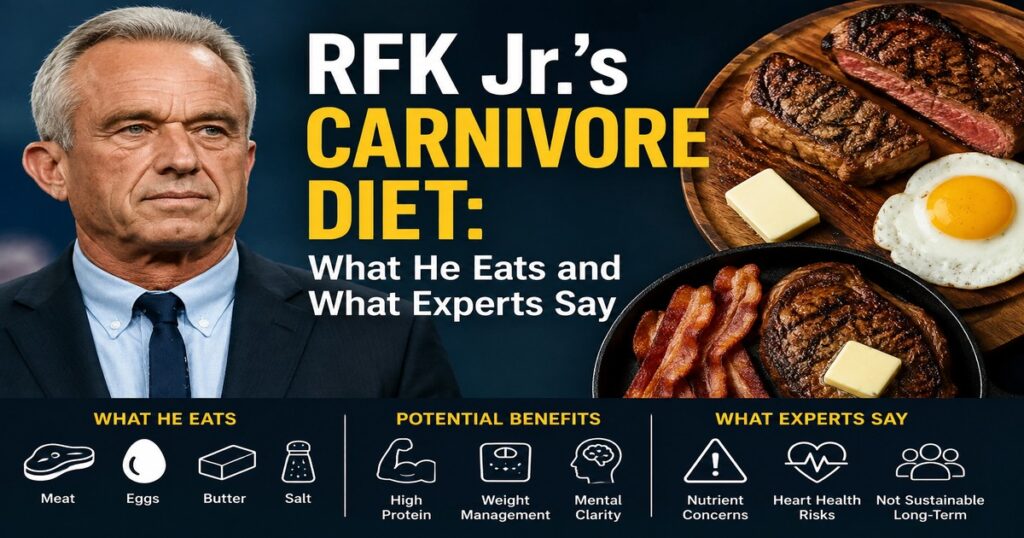
Robert F. Kennedy Jr., the U.S. Secretary of Health and Human Services, has made his eating habits part of the national conversation. He’s said it plainly on more than one occasion: he eats meat and fermented foods, and nothing else. No bread, no fruit, no vegetables outside of the occasional pickled variety.
That’s an unusual thing for a sitting health secretary to say out loud, especially one whose department just rewrote the federal dietary guidelines. So here’s what’s actually going on: what Kennedy eats, what he claims it’s done for him, who else in Washington has joined in, and what the research says about following a diet built almost entirely on animal products.
What RFK Jr. Actually Eats
Kennedy has described his routine the same way multiple times. On USA Today’s “Extremely Normal” show, he put it simply: “I am on a carnivore diet. I only eat meat or fermented foods.” He’s repeated versions of that line elsewhere, including telling Fox News he follows the plan “the whole day,” every day.
In practice, that means steak, beef (he’s said he eats it once or twice a day), and other meats sit at the center of every meal. The fermented side of his plate includes sauerkraut, yogurt, and kefir, foods that go through a process where bacteria or yeast break down natural sugars over time. He turned 72 in January and marked the occasion with candles stuck into a steak instead of a cake.
He’s also talked about eating roadkill. “I’ve been picking up roadkill my whole life. I have a freezer full of it,” he told reporters back in 2024, a comment that resurfaced widely once his diet became national news.
The Results He’s Claiming
Kennedy has credited the diet with two things: rapid weight loss and mental clarity. He’s said he lost 20 pounds in 20 days after adopting the plan and that he cut his visceral fat, the fat that surrounds internal organs, by roughly 40% in a month. To his credit, he’s also acknowledged that some of what he’s feeling could be the placebo effect at work.
Those numbers are self-reported, not the result of a clinical trial, so there’s no way to independently verify them. Rapid early weight loss is common on very low-carb diets generally, largely because the body sheds water weight quickly once carbohydrate and fiber intake drops. Whether that continues, and whether it’s healthy long-term, is a separate question.
The “Living Diet” Spreads Through the Cabinet
Kennedy isn’t eating this way alone anymore. According to reporting in The New York Times Magazine, Vice President JD Vance, Commerce Secretary Howard Lutnick, and Transportation Secretary Sean Duffy have all adopted a similar approach, sometimes called the “Living Diet.” It was developed by Dr. Sean O’Mara, an emergency medicine physician who champions grass-fed ruminant meat (beef, bison, elk, and venison) alongside fermented foods and wild-caught seafood.
O’Mara’s argument is that ruminants “ferment what they eat in their many stomachs,” and that eating them, paired with fermented foods, helps repopulate gut bacteria in a way that improves metabolism. President Trump has reportedly noticed the change in Vance’s appearance.
Not every claim attached to the diet has landed well. O’Mara has also made some eyebrow-raising statements in interviews about digestive side effects of eating this way, comments that generated plenty of mockery online. Worth noting: those claims aren’t backed by peer-reviewed research and shouldn’t be treated as medical fact.
How This Lines Up With the New Federal Food Guidelines
Kennedy’s department released updated U.S. dietary guidelines that flip the traditional food pyramid, putting protein and red meat near the top instead of grains. There’s some overlap with his personal diet: both push back against ultra-processed foods, seed oils, and refined carbohydrates. Kennedy has said people can eat things like buffalo wings, so long as they check the label for corn syrup, seed oils, and artificial ingredients.
But the overlap only goes so far. The official guidelines still recommend fruits and vegetables for overall health. His personal diet doesn’t include them at all. So the guidelines his agency publishes and the plate he actually eats from aren’t quite the same thing, a gap that hasn’t gone unnoticed by nutrition writers and researchers.
What the Research Actually Shows
This is where things get more concrete. A scoping review published in the journal Nutrients in January 2026 pulled together nine human studies on the carnivore diet and found a mixed picture. Some participants reported weight loss, better satiety, and improvements in inflammatory markers. But the same review flagged real risks: shortfalls in vitamin C, vitamin D, calcium, magnesium, and iodine, plus elevated LDL and total cholesterol. Its authors concluded that long-term adherence to the diet “cannot be recommended” based on current evidence.
Dietitians outside the study echo that caution. Jamie Nadeau, a registered dietitian who spoke with USA Today, they called the diet “extremely restrictive” and noted it “isn’t evidence-based,” pointing out there’s no research proving it outperforms a diet built around whole foods. Columbia dietitian Jamie Leskowitz raised a related concern: cutting out fiber entirely affects digestion, heart health, and long-term weight management, not just in the short term.
The elimination of plant foods matters here specifically because of fiber. Large-scale microbiome research, including the ZOE PREDICT study published in Nature Medicine, has tied fiber-rich, plant-forward eating patterns to a healthier balance of gut bacteria. A diet with zero fiber removes the main fuel source those bacteria depend on. There’s also a practical land-use angle: agricultural researchers have pointed out that scaling a meat-heavy diet like this across the country would require a large amount of additional farmland, something critics have raised as a broader concern with the new federal guidelines.
Should You Try It?
That’s a personal decision, and not one this article is going to make for you. What’s clear from the research so far is that a carnivore diet may produce short-term results for some people, largely tied to cutting processed food and simple carbohydrates, but it comes with real trade-offs: nutrient gaps that typically require supplementation, a cholesterol profile that needs monitoring, and a complete loss of dietary fiber. If you’re considering a major dietary shift like this one, that’s a conversation for a doctor or registered dietitian who knows your health history, not something to decide based on a cabinet secretary’s personal routine.