
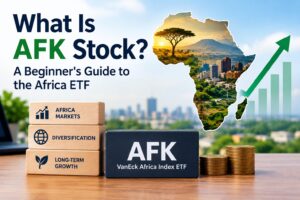
What Is AFK Stock? A Beginner’s Guide to the Africa ETF
Search “AFK stock,” and the first surprise is that AFK isn’t a company. It’s the ticker for the VanEck Africa Index ETF, a fund that trades like a single stock but holds dozens of them. A separate firm, AFK Sistema, trades on the Moscow exchange under the ticker AFKS, so if that’s what you wanted, this isn’t your page.
Still here? Good. I’ll walk through what the fund owns, what it costs, how it has behaved, and how a beginner can buy it. I’m not a financial advisor, and nothing below is a recommendation.
What Is AFK Stock?
AFK is an exchange-traded fund, or ETF. It aims to match the price and yield performance of the MVIS GDP Africa Index, which covers companies incorporated in Africa plus companies elsewhere that earn at least half their revenue from the continent. The fund started trading on July 10, 2008, and its expense ratio is 0.76%.
It’s passive, too. The fund follows its index rather than relying on a manager’s stock picks. One share gets you a small slice of roughly 80 businesses at once. If you’ve never bought an ETF before, the SEC’s Investor.gov has a plain-English primer worth reading first.
What Does the Fund Actually Hold?
As of August 31, 2026, the fund held 80 securities, with the top ten making up about 38% of assets. That’s moderately concentrated, not a spread-everything portfolio.
Geography matters more than the name suggests. South Africa alone accounted for about 32% of net assets. Because the index includes companies that earn most of their revenue in Africa but list elsewhere, a third-party breakdown of a June 2026 SEC filing also showed sizable slices tied to Canada and the UK, which are mostly miners listed in those markets. By sector, financials, materials, and communication services led the way earlier this year.
Names change as the index rebalances, but recent holdings lists included Capitec Bank, Equity Group of Kenya, Airtel Africa, and Impala Platinum. You won’t recognize most of them, and that’s normal.
How the Index Picks and Weights Companies
Most stock indexes weight companies by size. This one leans on economic output. It emphasizes each country’s economic footprint over equity market value, caps any single holding at 8%, requires at least 25 constituents, reviews quarterly, and updates GDP figures every June.
That design tilts the portfolio toward larger economies and away from whatever happens to have the biggest stock market. It also means the mix can look odd next to a typical emerging-markets fund, and that’s by design.
How Has AFK Performed?
Bumpy is the polite word. In VanEck’s July 2026 performance table, the one-year NAV return was 31.45%, yet the ten-year annualized figure was only about 5.3%, and the latest one-month figure was a loss near 7%.
Share price tells a similar story. NAV was $25.98 on July 27 and $28.10 by August 14. By my own arithmetic, that’s a swing of roughly 8% in about three weeks.
What should a beginner take from this? A great trailing year can sit on top of a mediocre decade. Don’t buy it because last year’s number looked good.
Risks Beginners Tend to Underestimate
Currency. Your returns are in dollars, but the underlying companies earn rand, dirhams, shillings, and naira. When those currencies slide, the fund can lag even if the businesses do fine.
Commodities. Gold and platinum miners sit in the portfolio, so metal prices can drive results more than African economic growth does.
Concentration. One country is about a third of the fund, and ten stocks make up over a third. A bad stretch in South Africa hurts.
Size and trading. Total net assets were about $96 million in late July. That’s small. Small funds can have wider gaps between buy and sell prices, and some get closed. If a fund shuts down you’d get your cash back, but maybe at a bad moment for taxes.
Cost. At 0.76%, you’d pay many times what a broad US index fund charges. For access to a hard-to-reach region, some people accept that. Just make the choice on purpose.
Who Might Consider AFK?
Honestly, I’d treat a fund like this as a spice, not the meal. If you already hold a broad US or global index fund, a small AFK position (many planners cap this kind of satellite holding at a low single-digit share of a portfolio) adds exposure you wouldn’t otherwise have. As someone’s only investment, I’d steer away from it, since the swings and concentration are too much for a first holding.
I can’t tell you your right amount. That depends on your timeline, your other holdings, and how you’d feel watching a position drop 15% in a few months. Be honest with yourself about that last one.
How to Buy AFK
- Open a brokerage account. Any major US broker works. Funding takes a few days at some firms.
- Search the ticker AFK. Confirm the name reads VanEck Africa Index ETF, not something similar.
- Check the bid-ask gap. A wide gap is a hidden cost.
- Place a limit order. This sets the highest price you’ll pay, which protects you in thinly traded funds.
- Decide on whole or fractional shares. Fractional buying depends on your broker.
Before you click buy, read the fund’s current fact sheet and prospectus on VanEck’s site. Also keep in mind that trading ETFs creates transaction costs and potential tax consequences.
Mistakes to Avoid
Chasing the one-year return is the big one. Another is assuming “Africa” means one economy when the continent spans very different markets. People also forget to look at the expense ratio, or they skip the fact sheet and never learn how much sits in one country. Finally, don’t confuse AFK with AFKS. They’re unrelated.
FAQ: AFK Stock Questions
Is AFK a stock or an ETF?
It’s an ETF that trades on an exchange like a stock. Each share represents a basket of African-linked companies.
What index does AFK track?
The MVIS GDP Africa Index, which weights countries by economic output instead of stock market size.
What is AFK’s expense ratio?
0.76%, per VanEck’s fund page. Check for any change before buying.
Does AFK pay dividends?
Yes, though the yield is modest and can vary. Confirm the current figure on VanEck’s page, since it changes.
Is AFK the same as AFK Sistema?
No. AFK Sistema is a Russian company with the ticker AFKS. The ETF is a US-listed fund.
Is AFK a good investment?
That depends on your goals and risk tolerance. It offers rare regional exposure, but with currency swings, concentration, and higher fees.
The Bottom Line
AFK gives you one-ticker access to African-linked businesses, which is useful and not easy to get elsewhere. It also comes with currency risk, commodity swings, and a fee well above plain index funds. If you’re curious, start small, read the fact sheet, and decide based on how it fits your whole portfolio, not on last year’s chart.


1 thought on “What Is AFK Stock? A Beginner’s Guide to the Africa ETF”