What Is VXUS? Vanguard Total International Stock ETF
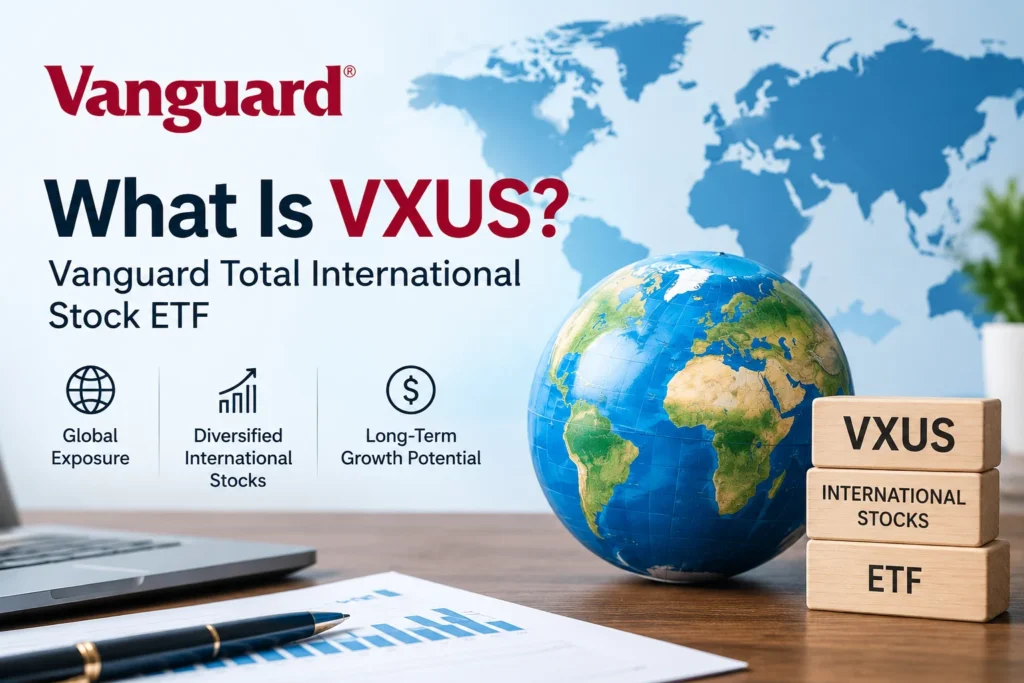
What Is VXUS?
VXUS is the ticker for the Vanguard Total International Stock ETF. It’s a single fund that gives you a slice of thousands of companies outside the United States, spanning both developed markets like Japan and the UK and emerging markets like Taiwan and India. If you already own a US-focused fund and want exposure abroad without picking individual countries, this is the kind of fund people reach for.
It’s not a new product. VXUS launched on January 26, 2011, so it’s been through more than one full market cycle at this point.
How the Fund Works
VXUS tracks the FTSE Global All Cap ex-US index, which is about as close to “everything outside America” as an index gets. The official fund description explains that this benchmark is a float-adjusted, market-cap-weighted index covering developed and emerging market companies outside the United States.
In practice, that means bigger companies (by market value) get a bigger slice of your investment, the same logic behind most total-market US funds. The fund holds thousands of individual stocks, so no single company moves the needle much. As of early 2026, the top 10 holdings, including names like Taiwan Semiconductor, Samsung Electronics, and ASML, made up around 15.7% of total assets, which tells you the fund is broad, not concentrated in a handful of mega-caps the way a US large-cap fund often is.
What’s Actually in VXUS
Sector-wise, the fund leans toward financials, industrials, and technology, with smaller allocations to healthcare, consumer goods, and energy. Geographically, you’re getting a mix of Europe, Asia-Pacific, and emerging markets, not just one region. That’s the whole point: one ticker instead of juggling separate regional funds.
Cost: Why the Expense Ratio Matters
VXUS charges an expense ratio of 0.05%. On a $10,000 investment, that’s $5 a year. It’s cheap by any standard, and it’s one reason the fund has attracted a lot of money over the years; it doesn’t eat into returns the way a 0.5% or 1% fund would over a couple of decades.
VXUS vs. Similar Funds
People often compare VXUS to VEU (Vanguard FTSE All-World ex-US) or VT (Vanguard Total World Stock). The differences are small but worth knowing:
- VXUS vs. VEU: Very similar funds. VXUS includes small-cap stocks that VEU leaves out, and its expense ratio runs slightly higher at 0.05% versus 0.04% for VEU.
- VXUS vs. VT: VT bundles US and international stocks into one fund. VXUS is international-only, so it’s typically paired with a separate US fund rather than used on its own. Investors comparing the two have noted that VXUS carries a marginally lower expense ratio and a somewhat higher dividend yield than VT.
Which one fits depends on whether you want to control your US/international split yourself (VXUS + a US fund) or let one fund handle both (VT).
Who Tends to Use VXUS
This fund shows up most often in portfolios built around a “three-fund” or “two-fund” approach: a US total market fund, an international fund like VXUS, and sometimes a bond fund. It’s a building block, not usually someone’s only holding, since it deliberately excludes the US market entirely.
Risks Worth Knowing
International funds carry currency risk. When the dollar strengthens against foreign currencies, returns on foreign holdings can look weaker in dollar terms, even if the underlying companies performed fine locally. There’s also less regulatory uniformity across the dozens of countries represented, and emerging-market holdings can be more volatile than developed-market ones.