
Square Area Formula: How to Calculate It
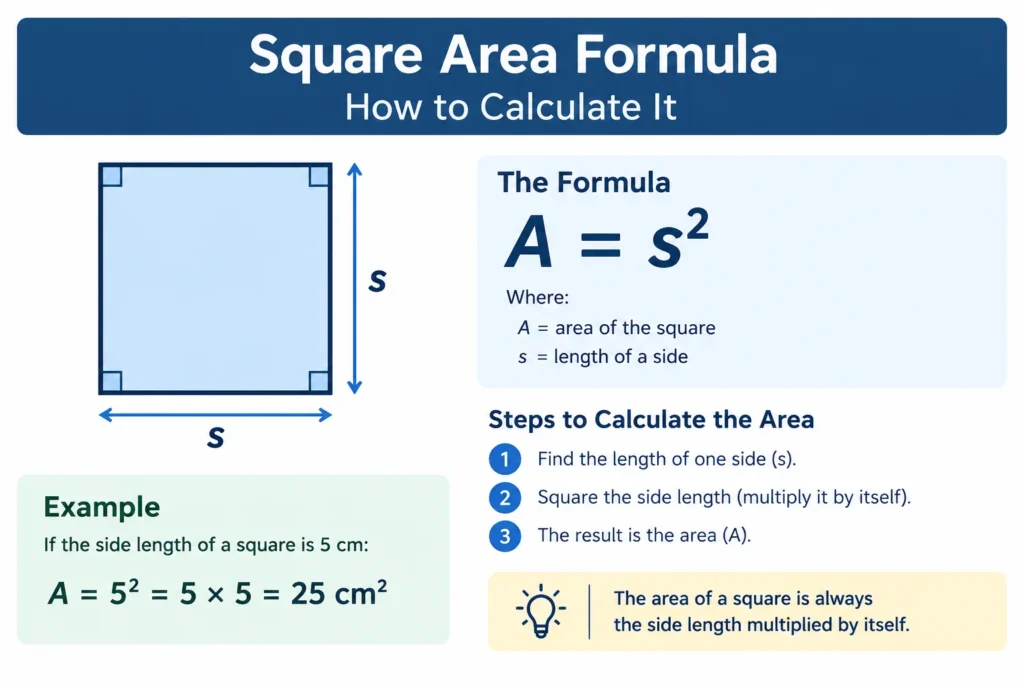
The area of a square is the side length multiplied by itself: A = s². That’s the whole formula. If a square has sides of 5 units, its area is 25 square units.
Simple, yes. But people still trip on it, usually over units or by mixing it up with the perimeter. This guide covers the formula, three ways to use it, and the mistakes worth avoiding.
What Is the Area of a Square?
Area measures how much flat surface a shape covers. For a square, all four sides are equal and every corner is a right angle, which is why one measurement is enough.
Picture a floor covered in 1-by-1 tiles. A square floor 4 tiles wide has 4 rows of 4 tiles. That’s 4 × 4 = 16 tiles. The “squared” in s² isn’t a coincidence; it literally describes this grid.
The Square Area Formula
The main version uses the side length:
A = s × s = s²
Two other versions help when the side isn’t given:
- From the diagonal (d): A = d² ÷ 2
- From the perimeter (P): A = (P ÷ 4)²
Both come from the first formula. The diagonal splits a square into two equal right triangles, which is where the ÷ 2 comes from.
How to Find the Area of a Square Step by Step
- Measure one side. Any side works, since all four match.
- Multiply it by itself.
- Write the answer in square units. Centimeters become cm², meters become m².
Example 1: A square has a side of 6 cm. Area = 6 × 6 = 36 cm².
Example 2: A patio measures 2.5 m per side. Area = 2.5 × 2.5 = 6.25 m².
[Image Prompt for ChatGPT]: Create a horizontal 3-step infographic showing how to find the area of a square: Step 1: “Measure one side,” Step 2: “Multiply side × side,” Step 3: “Add square units.” Numbered circles, simple icons (ruler, multiplication sign, cm² label), flat vector style, blue and orange on white, 1200x600px. Alt text: “Three steps for calculating square area.”
Working Backward: Finding the Side from the Area
Sometimes you know the area and need the side. Take the square root.
If A = 81 m², then s = √81 = 9 m.
Quick check: 9 × 9 = 81. Always verify this way, because it takes five seconds and catches slips.
Using the Diagonal
Say a square tile has a diagonal of 10 cm and nobody gave you the side. Use A = d² ÷ 2:
10² = 100, and 100 ÷ 2 = 50 cm².
This shortcut is handy for screens, picture frames, and tiles, where the diagonal is the number printed on the label.
A Real-World Example: Tiling a Room
Say a room is a 4 m by 4 m square, and you’re covering it with square tiles that are 0.5 m per side.
- Room area: 4 × 4 = 16 m²
- One tile: 0.5 × 0.5 = 0.25 m²
- Tiles needed: 16 ÷ 0.25 = 64 tiles
In practice you’d buy about 10% extra for cuts and breakage, so roughly 70. That extra margin is standard advice from tile suppliers, though the exact figure depends on the layout.
[Image Prompt for ChatGPT]: Create a top-down illustration of a square room floor being tiled with 0.5 m square tiles in a grid, a few tiles labeled with dimensions, “4 m,” on two sides. Flat design, warm beige and soft blue palette, white background, educational and tidy mood, 1200x600px. Alt text: “Square room floor divided into square tiles”.
Square Area vs. Perimeter
They sound alike and behave very differently.
| Area | Perimeter | |
|---|---|---|
| Measures | Surface inside | Distance around |
| Formula | s² | 4s |
| Units | cm², m² | cm, m |
| Side of 6 | 36 | 24 |
Here’s a quirk worth remembering: for a side of 4, area and perimeter are both 16. That’s the only side length where the numbers match, and it confuses plenty of students into thinking the formulas are interchangeable. They aren’t.
Common Mistakes
Doubling instead of squaring. 6² is 36, not 12. Squaring means multiplying by itself.
Forgetting square units. “36 cm” is a length. “36 cm²” is an area. Graders mark this down.
Mixing units. If one side is in meters and you convert to centimeters, convert everything. Remember that 1 m² equals 10,000 cm², not 100.
Using the perimeter formula by accident. If your answer is far too small or large, recheck which one the question wants.








1 thought on “Square Area Formula: How to Calculate It”