What Is a Conversion? Definition, Types, and How to Calculate It
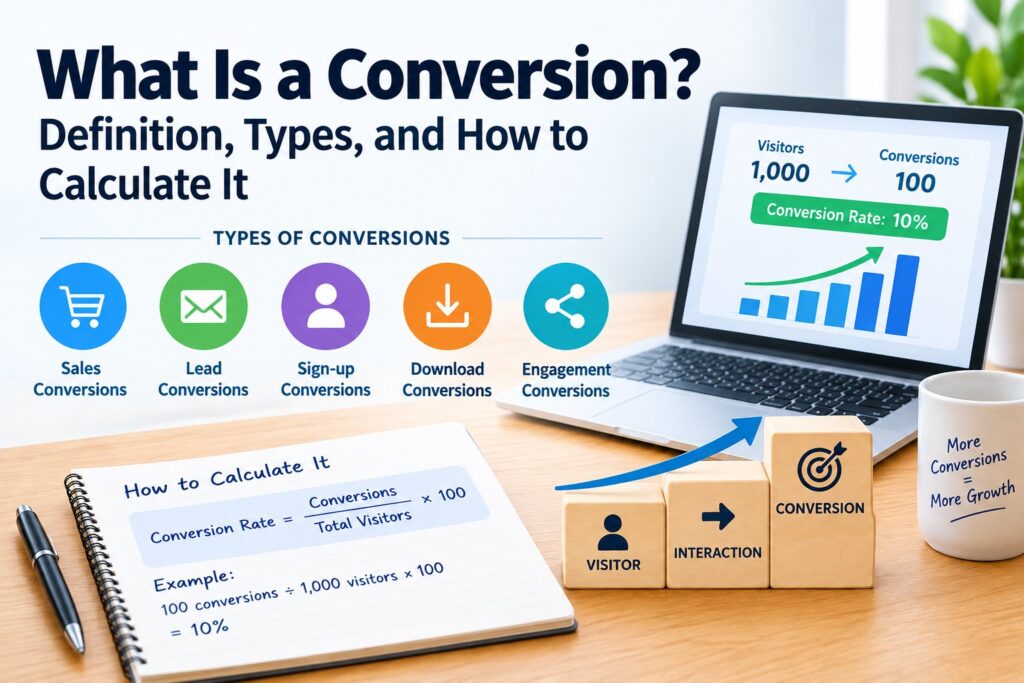
A conversion happens when someone takes the specific action a business wants them to take, whether that’s buying a product, filling out a form, or signing up for a free trial. It’s the moment a visitor stops browsing and starts doing something that matters to the business.
That’s the short version. Here’s what it actually means in practice, how to measure it, and why marketers obsess over it so much.
Conversion: The Basic Definition
In marketing, a conversion is a completed action that aligns with a specific business goal. The action itself changes depending on what the business is trying to achieve. A software company might define it as a free-trial signup. A retailer might define it as a finished checkout. A local service business might define it as a booked consultation call.
What ties all of these together isn’t the action itself; it’s intent. A conversion marks the point where a visitor moves from passively looking at something to actively engaging with it. That’s why marketers track conversions so closely: they’re one of the few metrics that show real commitment, not just attention.
You’ll also hear the term used as a verb, “converting” a visitor, and as an adjective, a “converting” landing page. Same underlying idea in each case.
Conversion Rate: The Metric That Matters
Once you know what counts as a conversion for your business, the next question is how often it happens. That’s your conversion rate, and it’s calculated with a simple formula:
Conversion Rate = (Total Conversions ÷ Total Visitors) × 100
Say a landing page gets 2,000 visitors in a month and 80 of them complete a purchase. That’s (80 ÷ 2,000) × 100, or a 4% conversion rate.
What counts as “good” depends heavily on industry and traffic source. Cold traffic from a display ad converts very differently than someone who typed your brand name into Google. As a rough benchmark, average landing page conversion rates across industries tend to sit somewhere around 2-5%, with strong performers pushing into double digits. Treat any single benchmark with some skepticism, though; the honest answer is that your own historical rate is the only baseline that really matters.
Macro Conversions vs. Micro Conversions
Not every conversion carries the same weight, and lumping them together hides useful information.
Macro conversions are the big ones, the actions tied directly to revenue or the core business goal. A completed sale. A signed contract. A paid subscription.
Micro conversions are the smaller steps that show interest without necessarily producing revenue on their own. Adding an item to a cart. Downloading a guide. Watching a demo video. Starting a form but not finishing it.
Here’s why the distinction is useful: if your macro conversions are low but micro conversions are healthy, the problem probably isn’t attracting interest; it’s closing the gap between interest and commitment. That points you toward fixing checkout friction or follow-up emails rather than rewriting your ad copy.
Common Examples by Business Type
What actually counts as a conversion looks different depending on the business:
- Ecommerce: a completed checkout, or a smaller step like adding a product to the cart
- SaaS: starting a free trial or booking a product demo
- Service businesses: a quote request, a consultation booking, a phone call from an ad
- B2B: downloading gated content, registering for a webinar, submitting a qualified lead form
- Media and publishers: a newsletter signup or a paid subscription
The same action can be a macro conversion for one company and a micro conversion for another. A newsletter signup might be the whole goal for a content creator but just one step in the funnel for an e-commerce brand. There’s no universal answer here, so the first real step is deciding, in writing, what a conversion means for your specific goal before you try to improve it.
What Influences Whether Someone Converts
A handful of factors show up again and again in conversion research and testing:
Page speed. Slow load times cost conversions directly. Even a one-second delay can measurably reduce the percentage of visitors who complete an action.
Clarity of the offer. Visitors who can’t quickly understand what they’re being asked to do and what they’ll get in return tend to leave rather than dig for answers.
Call-to-action design and wording. Vague buttons like “Submit” convert worse than specific, benefit-driven language like “Start My Free Trial.”
Trust signals. Reviews, security badges, and recognizable client logos all reduce the hesitation that stops people from acting, especially on pages asking for payment or personal information.
Mobile experience. With most traffic arriving on phones for many industries, a form that’s awkward to fill out on a small screen will quietly bleed conversions no matter how good the page looks on desktop.
None of these work in isolation. A fast, well-designed page with a confusing offer will still underperform, and vice versa. That’s why conversion rate optimization, or CRO, exists as its own discipline: it’s the ongoing process of testing these variables against each other rather than guessing which one matters most.
Why Conversions Matter More Than Traffic Alone
It’s tempting to treat traffic growth as the goal. More visitors, more opportunity, right? Not exactly. A page pulling in 10,000 visitors a month at a 1% conversion rate produces the same 100 conversions as a page getting 2,000 visitors at 5%. The second page is doing the actual job better, even with a fifth of the audience.
This is part of why many marketing teams have shifted focus toward improving what already exists rather than only chasing more traffic. As Wikipedia’s overview of conversion marketing puts it, this kind of optimization work is generally treated as a long-term strategic investment rather than a quick fix, with the emphasis on getting more out of existing traffic instead of simply driving more visitors to the site. Traffic gets people to the door. Conversion is what happens once they’re standing in it.