
Canoo Lifestyle Vehicle: Key Features Every Used Buyer Should Know
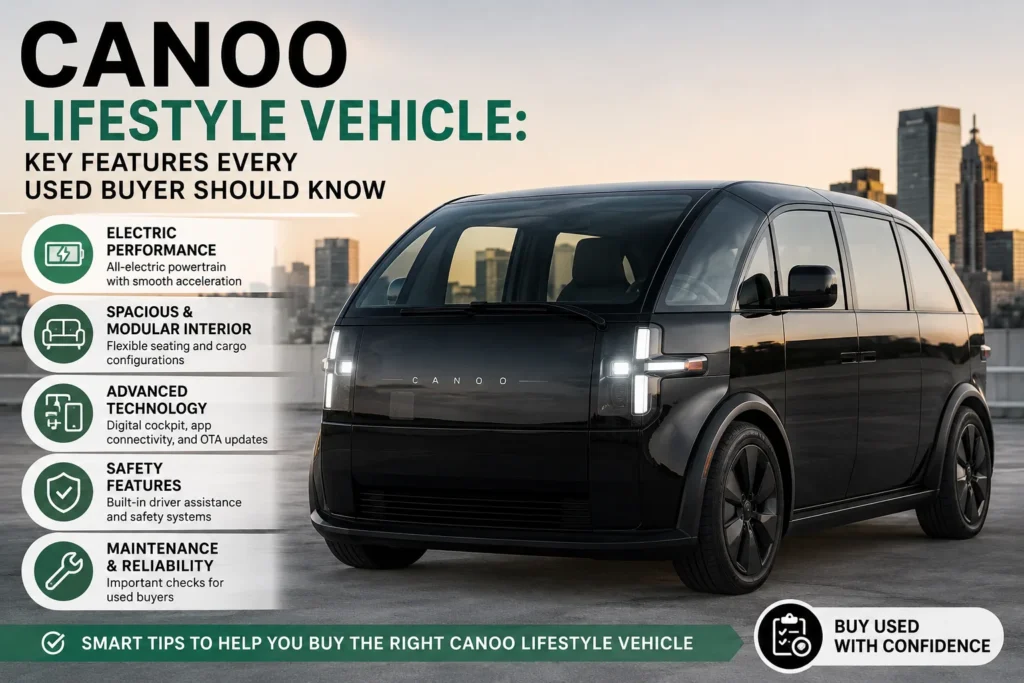
If you’re eyeing a used Canoo Lifestyle Vehicle (LV), you’re looking at one of the more unusual EVs to reach American roads: a “loft on wheels” from a startup that no longer exists. Before you go further, here’s what the vehicle actually offers and what buying one used really involves.
What the Lifestyle Vehicle Was
Canoo unveiled the LV in 2019 and built it around a “skateboard” platform, called the Multi-Purpose Platform, that packed the battery, motor, and drive components into a flat chassis. That freed up the cabin, so the LV’s footprint is about the size of a compact car, but the interior rivals a large SUV. Canoo pitched it as a rolling living room rather than a traditional sedan or crossover, and the design shows wrap-around rear bench seating, a minimalist dashboard, and a cab-forward shape that pushes the wheels to the corners.
Key Features to Check On Any Unit You’re Considering
Seating and cabin layout. The LV seats up to seven, with wrap-around rear seats meant to feel more like a lounge than a back row. Front seats have a mid-century modern look, and some trims include rear-facing jump seats. Confirm exactly which seating configuration your specific unit has, since Canoo offered several trims (Premium, Adventure, and others) over its short production run.
Powertrain and range. A single permanent-magnet synchronous motor powers the LV, with outputs ranging from roughly 200 to 350 horsepower depending on configuration. It was offered in front-wheel, rear-wheel, and all-wheel drive. Expect an EPA-style range around 250 miles from the 80 kWh battery pack and DC fast charging that can take the pack from 20% to 80% in about 32 minutes, assuming the hardware is functioning and you can find compatible charging infrastructure.
Visibility and driver assistance. One of the LV’s standout features is 22 windows, designed to cut down on blind spots, plus a forward “street view” window low on the nose. The advanced driver-assistance suite uses seven cameras, five radars, and six ultra-short-range sensors. On a used unit, test every one of these systems individually. ADAS calibration and camera/radar health are exactly the kind of thing that gets neglected when a company can no longer issue software updates.
Cargo and payload. Even the passenger-oriented LV inherited generous payload capacity from the shared platform, with related delivery variants rated near 1,464 lbs. It’s a genuine strength of the platform if you need to haul gear, not just people.
The Part That Matters Most: Canoo No Longer Exists
Canoo filed for bankruptcy in January 2025, and by mid-2026 the company’s remaining assets, including engineering prototypes, were being sold off at auction. That’s not a minor footnote. It changes the entire calculus of buying one used:
- No factory warranty or manufacturer support. There’s no Canoo to call for a recall, a software patch, or a warranty claim.
- Parts availability is uncertain. Proprietary components (steer-by-wire hardware, the sensor suite, and battery modules) may be difficult or impossible to source once existing stock runs out.
- Software and connectivity may degrade. Any cloud-connected features, over-the-air updates, or app-based controls could stop working if Canoo’s backend servers are shut down.
- Specialized service network. Very few independent shops have experience with the LV’s architecture, so plan on limited, possibly expensive, service options.
- Resale value is unpredictable. With production numbers in the low thousands and no ongoing brand support, resale value doesn’t follow normal used-EV depreciation patterns.
None of this means the LV is a bad vehicle to own if you go in with clear eyes. It means you should treat it more like buying a discontinued specialty vehicle than a mainstream used EV.