
What Are Online Games? A Complete Beginner’s Guide
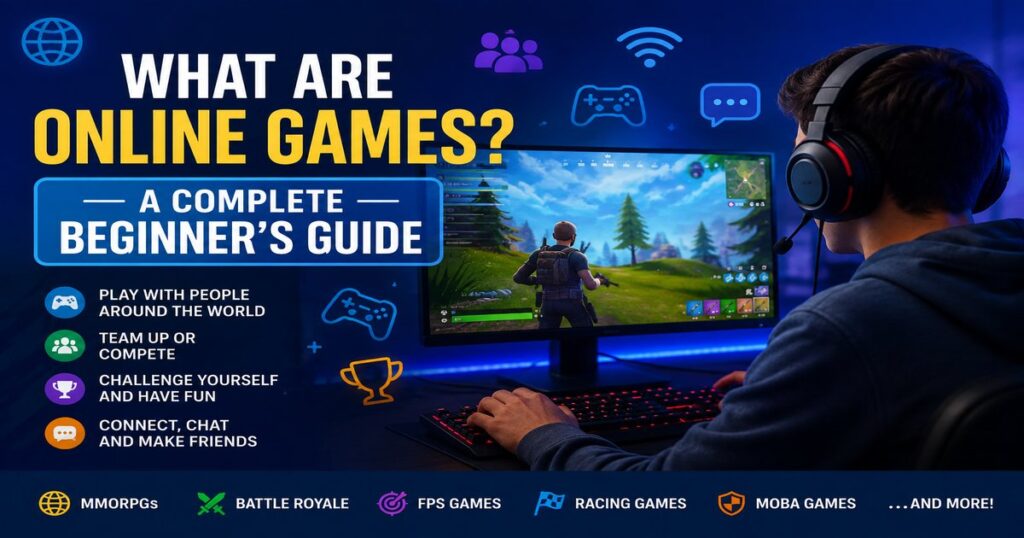
Type “online games” into Google and you’ll get millions of results in under a second. That’s the problem, really. There’s too much out there and not nearly enough guidance on where to actually start.
This guide breaks down what online games are, how they work behind the scenes, the main types you’ll run into, and how to pick something worth your time. No jargon dump, just the stuff you’d want a friend to tell you before you dive in.
What Exactly Is an Online Game?
An online game is any game that needs an internet connection to work, whether that’s for the whole experience or just parts of it. Some run entirely through a browser tab. Others need an app or a download first. A few blend both, letting you start on your phone and pick up later on a laptop.
The internet connection is what separates these from traditional single-player games you install once and never think about again. It’s also what makes them interesting: you’re playing against, with, or alongside real people, often in real time.
There’s a wide range here too. A quick word puzzle you finish on a coffee break is an online game. So is a massive multiplayer world with thousands of players logged in at once. Same category, wildly different experiences.
How Do Online Games Actually Work?
At a basic level, your device talks to a server, and that server talks back. When you move your character or make a move in a game, that action gets sent out, processed, then reflected back to you and anyone else playing.
For a simple trivia game, this happens fast enough that you won’t notice any delay. For something more complex, like a competitive shooter, even a fraction of a second matters. That’s why connection speed and server location affect how smooth a game feels. Ever had a match where everything froze for a second, then suddenly caught up? That’s lag, and it’s the server and your connection falling out of sync.
Most games also save your progress somewhere other than your device. Log in from a different phone, and your stats, level, or unlocked items usually follow you. That’s server-side storage doing its job quietly in the background.
The Main Types of Online Games
Not all online games serve the same purpose, so it helps to know the categories.
Casual and browser games. Quick to load, easy to quit. Think puzzle games, card games, or simple arcade-style titles. No download required, and no big time commitment either.
Multiplayer online games (MOGs and MMOs). These connect large groups of players in shared worlds or matches. Some focus on cooperation, building, or exploring together. Others are competitive, built around ranking and skill.
Mobile games. Designed specifically for phones and tablets, often free to download with optional purchases inside. Convenience is the whole point here.
Educational games. Built to teach a skill, a language, or a subject while keeping things engaging enough that it doesn’t feel like homework.
Social and party games. Made for playing with friends, whether that’s in the same room or scattered across different cities. These lean into chat, voice, and shared screens.
Knowing which category fits your goal, whether that’s killing ten minutes or getting genuinely invested, makes the search a lot shorter.
How to Choose the Right Online Game for You
I’ve bounced between a dozen different games over the years looking for the “right” one, and honestly, the answer is almost always about matching the game to what you actually have time for. A 40-hour-a-week MMO isn’t a great fit if you’ve only got fifteen minutes between meetings.
A few questions worth asking yourself first:
- How much time can you realistically give it, per session and per week?
- Do you want to play alone, with friends, or with strangers?
- Are you looking for something competitive or something to unwind with?
- Does it need to work on your phone, or is a laptop fine?
Free-to-play titles are a low-risk way to test the waters. Try a few, see what actually pulls you back the next day, and drop the rest without guilt.
Staying Safe While Playing Online
A quick but important point: online games often involve chatting with strangers, sharing some personal info to create an account, and sometimes spending real money on in-game items.
A few habits go a long way. Use a strong, unique password for each gaming account. Be cautious about how much personal information you share in chat or on a public profile. Set spending limits if the game offers in-app purchases, and check them regularly. If you’re helping a younger player get set up, most platforms offer parental controls worth turning on from day one.
None of this should scare you off. It’s just the same common sense you’d apply to any other online account.






1 thought on “What Are Online Games? A Complete Beginner’s Guide”