
Can You Reheat Prawns Safely?
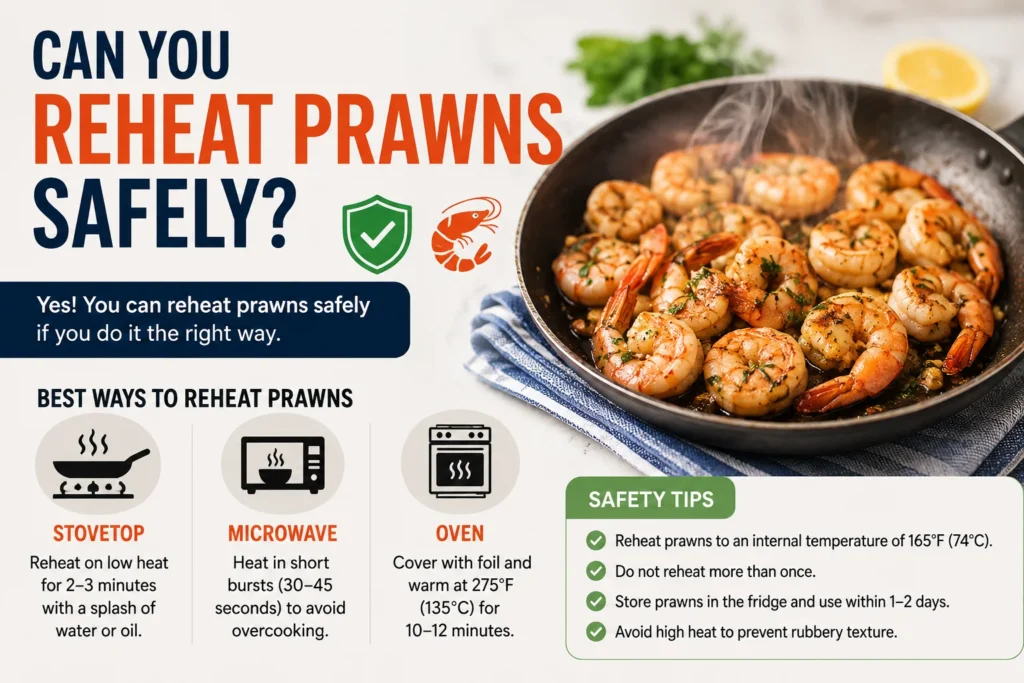
Yes, you can reheat prawns, but only if they were cooled and stored properly the first time. Once they’ve sat out too long or bounced between fridge and countertop more than once, reheating won’t save them. The prawns themselves don’t care how many times you’ve microwaved leftovers before; what matters is how they were handled between the first cook and the second.
I’ve made the mistake of leaving a bag of prawn stir-fry on the counter while I finished a phone call, then reheating it anyway because it “smelled fine.” It was fine that time. But smell isn’t a safety test, and prawns are one of the less forgiving foods to gamble on.
The Short Answer
Cooked prawns are safe to reheat once, as long as they were refrigerated within two hours of cooking and reach an internal temperature of 165°F (74°C) when reheated. Skip either of those conditions and you’re rolling the dice on foodborne illness, not enjoying leftovers.
Seafood sits in what food safety folks call the “danger zone,” the range between 40°F and 140°F where bacteria multiply fastest. Prawns move through that zone quickly because they’re small and thin. That’s actually good news: it also means they reheat fast, so there’s rarely a reason to leave them under heat any longer than needed.
How to Reheat Prawns Without Ruining Them
The real challenge isn’t safety; it’s texture. Prawns are low in fat and cook in minutes the first time around, so a second round of heat turns them rubbery fast if you’re not paying attention. Here’s what actually works.
Stovetop (Best for Flavor)
Heat a splash of oil or butter in a pan over medium-low heat. Add the prawns in a single layer, not piled up, and stir gently every 30 seconds or so. This usually takes 2 to 3 minutes total. Pull them the moment they’re hot through the center; they’ll keep cooking slightly from residual heat even off the pan.
Microwave (Fastest)
Spread prawns on a microwave-safe plate so they’re not touching. Add a splash of water or a light drizzle of oil to keep moisture in, cover loosely, and heat in 30-second bursts, checking and flipping between each one. Most portions are done in 60 to 90 seconds. Going longer “just to be sure” is the number one way people end up with chewy, shrunken prawns.
Oven (Best for Larger Batches)
Preheat to 300°F, spread prawns on a lined baking tray, cover with foil, and warm for about 8 to 10 minutes. The lower, slower heat is gentler on texture than blasting a high oven temperature, which is worth the extra few minutes if you’re reheating a big batch for guests.
What About Prawn Curry, Pasta, or Rice?
Dishes with prawns mixed into sauce or rice reheat the same way; just watch the whole dish rather than the prawns alone. A deep bowl of curry needs longer than a thin layer of stir-fry to get steaming hot in the center, so stir partway through and check that the middle isn’t lukewarm while the edges are scalding.
Mistakes That Cause Problems
Leaving prawns out too long before refrigerating. Two hours is the cutoff, and that drops to one hour if the room is above 90°F. Set a timer if you tend to forget leftovers on the counter after dinner.
Reheating more than once. Each cycle through the temperature danger zone gives bacteria another chance to grow. If you’ve got more prawns than you’ll eat in one sitting, portion them before storing so you only reheat what you need.
Judging doneness by time instead of temperature. Microwave wattage, pan thickness, and portion size all change how fast heat gets through. A thermometer reading 165°F is a far better guide than “it’s been two minutes.”
Overheating “to be safe.” Ironically, this backfires. Prawns hit safe temperature fast, and every extra minute past that point just squeezes out moisture and tightens the protein, which is where the rubbery texture comes from.
How Long Do Cooked Prawns Last in the Fridge?
Properly stored, cooked prawns are good for 3 to 4 days in the fridge. If you’re not going to use them within that window, freeze them instead; they’ll keep for up to 3 months in an airtight container or freezer bag with the air pressed out.