
PepsiCo Is Slashing Snack Brands: What’s Changing and Why
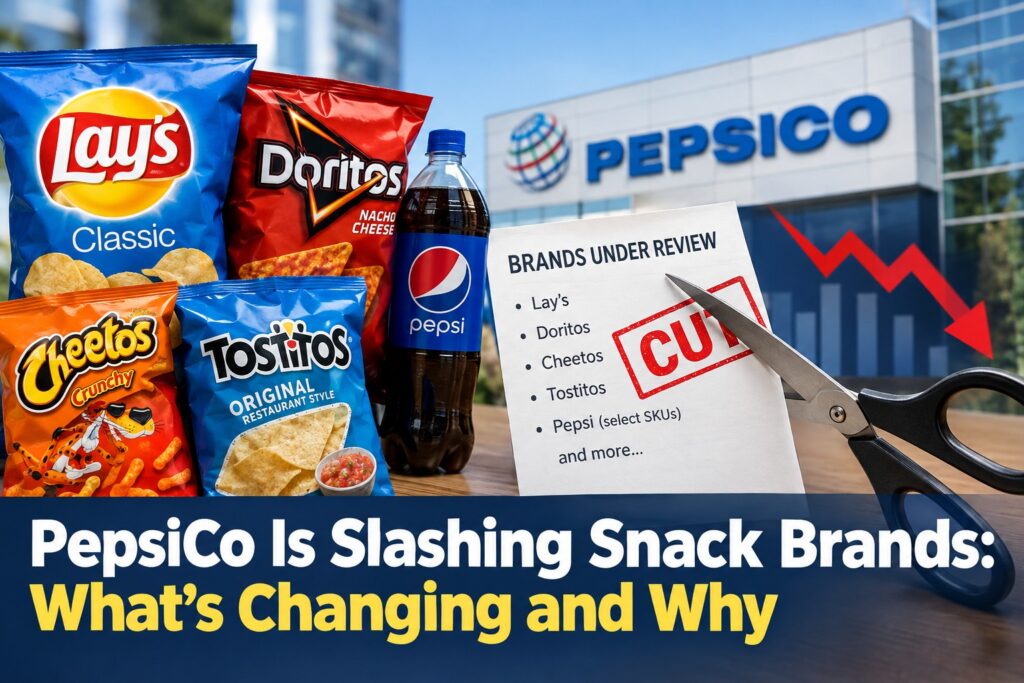
If you’ve noticed a few snack bags missing from the shelf lately, you’re not imagining it. PepsiCo has spent 2026 doing two things at once: cutting prices on its biggest chip brands and quietly walking away from a big chunk of its overall lineup. Both moves trace back to the same pressure: a company that’s losing ground with shoppers now has an activist investor looking over its shoulder.
Here’s the actual sequence of events and what it means if you’re standing in the chip aisle wondering where your usual bag went.
The price cuts came first.
In early February, PepsiCo announced it would drop prices on Lay’s, Doritos, Cheetos, and Tostitos by up to 15%, responding to months of customer complaints that snacks had gotten too expensive. The timing wasn’t random. PepsiCo Foods U.S. rolled the price cuts out the same week as the Super Bowl, one of the biggest snack-shopping days of the year.
PepsiCo said its new retail prices started rolling out that same week, and the company framed it as a direct response to feedback. The bigger context: shoppers have been turning to store-brand options or skipping snacks altogether after years of repeated price increases. In plain terms, PepsiCo raised prices for years, people pushed back, and now it’s trying to win them back.
Then came the bigger cut: nearly 20% of the lineup, gone.
The price rollback was the visible part. The less-visible part is bigger: PepsiCo is eliminating a large share of its actual products. The company said in December it was on track to cut close to a fifth of its U.S. SKUs by early 2026, and it has already closed three manufacturing plants and shut down multiple production lines.
This isn’t just trimming a few slow sellers. PepsiCo is repositioning itself as a broader food company rather than a traditional snacks-and-soda business, pivoting toward protein, fiber, and “cleaner label” products aimed at more health-conscious shoppers. Dozens of niche or underperforming chip and snack varieties are being phased out to make room and to cut costs while the company leans harder into its bigger, still-growing brands.
Why now? An activist investor with $4 billion on the line
None of this happened in a vacuum. Elliott Investment Management built a roughly $4 billion stake in PepsiCo and sent a letter to the company’s board pushing for changes, making it one of the company’s largest shareholders. Elliott’s letter argued PepsiCo should consider refranchising its bottling operations, similar to what Coca-Cola did with its own network, and review its food business for underperforming assets worth selling off.
PepsiCo hasn’t framed the SKU cuts as a direct concession to Elliott, but the timing lines up. The company’s stock had fallen well off its highs, sales had softened in North America, and an activist investor was publicly calling for a leaner, more focused operation. Cutting weak products and closing redundant plants is a fairly standard playbook move under that kind of pressure, and it’s already showing up in the numbers.
Is it working?
Early signs point to yes, at least financially. PepsiCo’s first-quarter 2026 results beat expectations, with revenue up and profit climbing sharply year over year, and the stock has responded positively. Whether that holds depends on whether shoppers who traded down to store brands come back now that prices are lower and whether the newer protein-and-fiber products actually sell.
Worth noting: analysts aren’t unanimous. Some see the reset as overdue and well-timed; others caution that PepsiCo’s 2026 targets, while reasonable, aren’t especially conservative, so there’s not a lot of room for the plan to underdeliver.
What this means if you’re a shopper
- Some familiar bags will disappear. Smaller or slower-selling varieties within Lay’s, Doritos, and other lines are being phased out as part of the SKU reduction, even as the core brands stay on shelves.
- Your usual chips should be a little cheaper. The 15% price cut applies to Lay’s, Doritos, Cheetos, and Tostitos specifically, not PepsiCo’s entire portfolio.
- Expect more “protein” and “cleaner label” versions. PepsiCo is actively expanding into functional snacking, so you’ll likely see more high-protein or reduced-ingredient spins on existing brands.
- This mirrors what Coca-Cola already did. Coke cut its own brand portfolio by roughly half back in 2020 for similar reasons: focus on what sells, cut what doesn’t.





1 thought on “PepsiCo Is Slashing Snack Brands: What’s Changing and Why”