
Amazon Mission Statement: What It Really Means
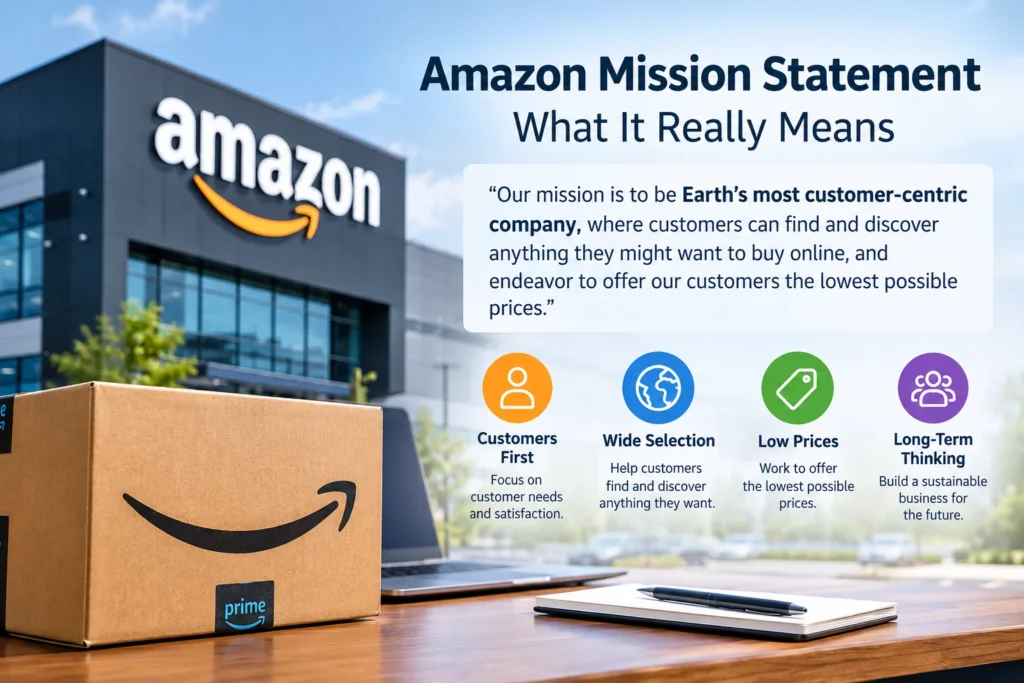
If you’ve ever wondered why Amazon obsesses over delivery speed, product selection, and price, the answer traces back to one sentence. Amazon’s stated mission is to be Earth’s most customer-centric company, and that phrase shows up almost word-for-word in the company’s shareholder letters, job postings, and internal training materials. we forum
It’s short. It’s memorable. And unlike a lot of corporate mission statements that get filed away and forgotten, this one actually shapes how Amazon runs its business day to day.
What Amazon’s Mission Statement Actually Says
Amazon’s official framing goes a bit further than the “customer-centric” tagline alone. The company says it wants to be its best employer and the safest place to work, in addition to being the top choice for customers. So the mission isn’t purely about shoppers. It covers three audiences: the people who buy from Amazon, the people who work there, and (implicitly) the shareholders who benefit when the first two groups are taken care of. we forum
That’s worth pausing on, because most companies write mission statements that talk about customers or profits. Amazon’s version tries to hold all three groups in the same sentence.
The Four Principles Behind the Mission
Amazon doesn’t just state a mission and leave it there. It backs it up with four operating principles that show up in leadership meetings, performance reviews, and even how the company writes internal memos:
- Customer obsession, not competitor focus. Amazon tracks what customers want rather than reacting to what rivals like Walmart or Target are doing.
- A genuine passion for invention. This is the mindset behind AWS, Kindle, Alexa, and dozens of other products that didn’t exist in Amazon’s original bookstore model.
- Commitment to operational excellence. Warehouses, delivery networks, and cloud infrastructure only work at Amazon’s scale if the underlying operations are tight.
- Long-term thinking. Amazon has a well-documented history of accepting thin profit margins for years so it can build market position first.
Put those four together and you get a company that’s willing to lose money on a new venture for a decade if it thinks the long game pays off. That’s not typical, and it’s a big part of why Amazon looks so different from most retailers.
Why This Matters for a Company: Amazon’s Size
A mission statement is easy to write. Living up to one at Amazon’s scale is a different problem entirely. With millions of employees and customers across dozens of countries, “customer obsession” has to translate into specific, measurable things: return policies, same-day shipping, price matching, and a recommendation engine that actually reflects what you’re likely to want next.
I’ve noticed that when companies this large lose sight of their stated mission, it tends to show up fast, in customer complaints, employee turnover, or product lines that quietly get shut down. Amazon isn’t immune to any of that. It’s faced plenty of criticism over warehouse working conditions, something that sits uncomfortably next to the “safest place to work” part of its mission. That gap between stated intent and real-world execution is worth keeping in mind. A mission statement tells you what a company is aiming for, not necessarily what it’s always achieving.
How Amazon’s Mission Compares to Its Competitors
Walmart’s stated purpose centers on helping people save money to live better. Target talks about helping families discover joy. Amazon’s language is narrower and more specific: customer-centricity, full stop. That focus is arguably why Amazon expanded into cloud computing, streaming, and logistics rather than staying a straightforward online retailer. Each move can be traced back to a version of “what would make this easier or better for the customer.”
The Bottom Line
Amazon’s mission statement is short, but it’s not vague. It names three groups (customers, employees, and by extension the business itself) and backs the claim with four principles that actually influence day-to-day decisions. Whether Amazon lives up to it perfectly is a fair question, but the mission itself explains a lot about why the company behaves the way it does.









1 thought on “Amazon Mission Statement: What It Really Means”