
What Is Run-Specific Isometrics? Alex Natera’s Method Explained
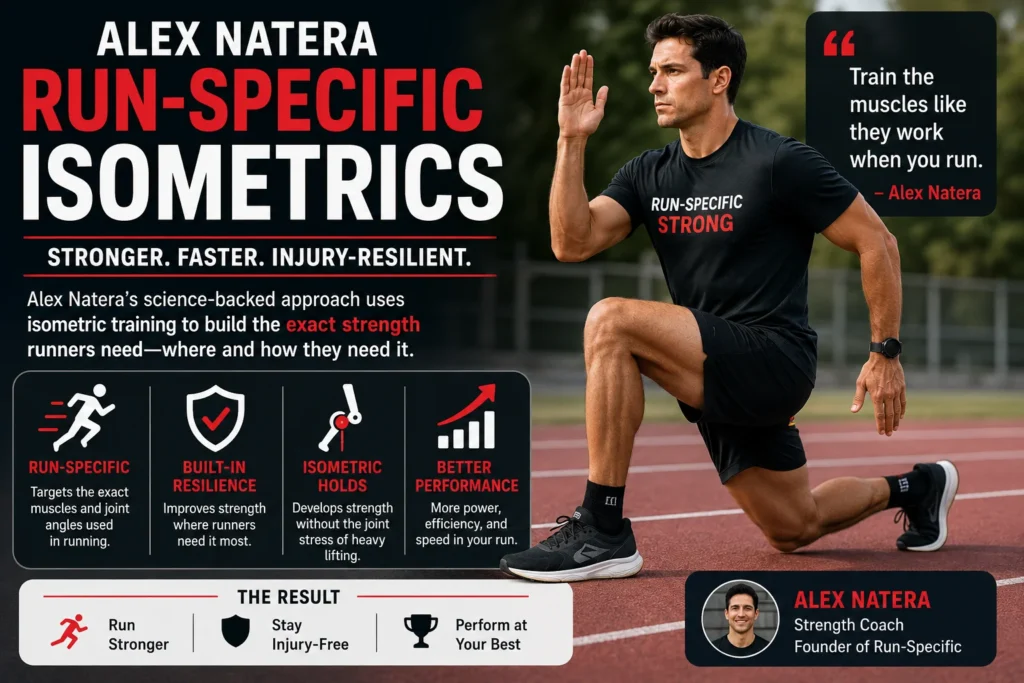
If you’ve spent any time in sprint coaching or strength and conditioning circles, you’ve probably come across the term “run-specific isometrics.” It’s tied closely to one name: Alex Natera. Here’s what the method actually involves, why it caught on with elite sport, and how coaches use it.
Who Is Alex Natera?
Alex Natera is a strength and conditioning coach with close to 25 years in professional and elite sport, including work at the New South Wales Institute of Sport and with AFL clubs such as the GWS Giants. He’s also spent time as a sports science lecturer and published researcher, and he consults with clubs and individual athletes across multiple codes, from the EPL to the NBA.
His reputation in the speed-training world largely comes from one idea: applying isometric strength work at the exact joint angles the ankle, knee, and hip pass through while sprinting, rather than training strength in generic positions that don’t match how the body actually moves at speed.
The Core Idea Behind Run-Specific Isometrics
An isometric contraction is one where the muscle produces force without changing length; think of pushing against something immovable. Traditional strength training rarely trains athletes this way. Natera’s insight was to connect isometric training directly to what happens biomechanically during running.
During ground contact in sprinting, the lower-limb muscles don’t lengthen and shorten the way they do in a squat. Instead, the tendons stretch and recoil like springs, while the muscles themselves stay close to a fixed length to keep the whole system rigid. That’s an isometric action. So instead of training strength qualities in isolation, run-specific isometrics try to recreate that exact muscle behavior, at the exact joint angle it happens at.
The Ankle, Knee, and Hip Iso-Push Tests
Natera’s system is usually built around three positions:
- Ankle Iso-Push – tests and trains force production at the ankle joint angle seen at touchdown
- Knee Iso-Push – targets the knee angle during the stance phase of the running gait
- Hip Iso-Push – trains hip extension force at the angle used during propulsion
Each of these is typically performed within about five degrees of the joint angle the athlete actually hits while running, using a Smith machine, safety bar, or barbell set against pins or a rack. That tight-angle window is the whole point: train a few degrees off, and you’re no longer training what the body needs during the run cycle.
In performance testing settings, these same positions are often measured with force plate systems to assess rapid and maximal force output, giving coaches a way to track an athlete’s readiness and identify asymmetries between limbs before they turn into injuries.
Why Coaches Use It
A few reasons this approach has spread through sprint and field-sport programs:
Specificity. Most strength training builds general qualities. Run-specific isometrics train the nervous system and tendons in the same position and same contraction type used in sprinting, which coaches see as a more direct transfer to speed.
Load without excessive fatigue. Because the joint doesn’t move through a range, athletes can apply high force without the mechanical stress that comes with heavy dynamic lifts, useful in-season when recovery time is limited.
Testing and monitoring. The same positions used for training double as an assessment tool. Coaches can screen whether an athlete is producing enough force at each joint before ramping up sprint volume, which matters most heading into pre-season when returning athletes need to prove they’re ready to run fast again.
Tendon health. Several studies Natera references point to positive effects on tendon stiffness and morphology from sustained high-intensity isometric loading, which has obvious appeal for anyone managing Achilles or patellar tendon issues in speed athletes.
Key Training Variables
Natera’s coaching material breaks the method down into variables coaches need to manipulate deliberately rather than copy blindly:
- Duration: How long each hold or push lasts
- Intensity: How close to maximal effort the push is
- Muscle length: The specific joint angle being trained
- Intent: Whether the athlete is trying to move fast (rate of force development) or simply hold maximal tension
- Volume – how many reps and sets, and how that fits around sprint sessions
- Type: Iso-hold versus iso-push, which Natera treats as distinct tools with different neural and metabolic demands
Getting these variables wrong is a common mistake. Programming a long maximal hold, for instance, trains a different quality than a short, fast push aimed at rate of force development, even though both look similar from the outside.
Where It Fits in a Training Week
Run-specific isometrics aren’t meant to replace sprinting, plyometrics, or traditional strength work. They’re generally slotted in as a complementary block, often close to a sprint session so the nervous system is primed in a similar way, or during periods of higher fatigue when heavy dynamic lifting isn’t ideal. Coaches typically categorize sessions and adjust isometric loading based on where an athlete sits in their training block and how much sprint volume they’re already absorbing.