
Avoidant Attachment Style: What It Is and How to Change It
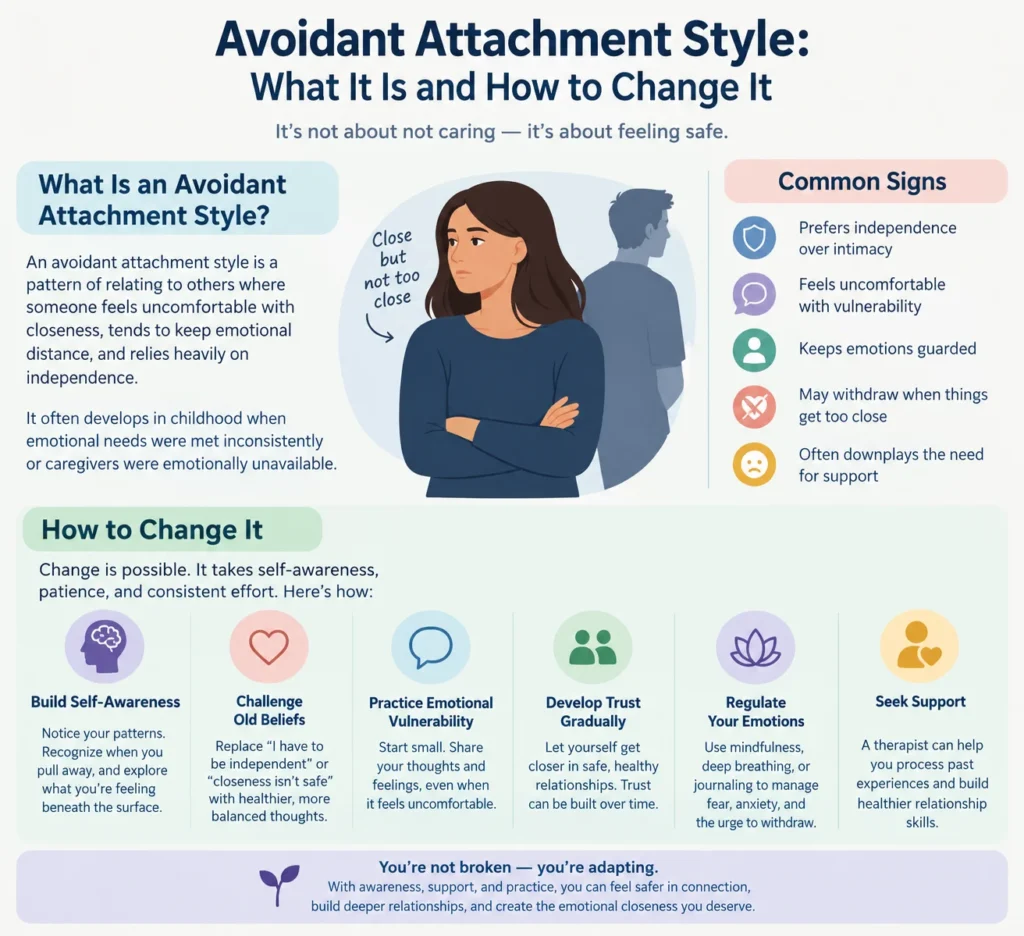
A partner asks, “Where is this going?” and suddenly your calendar fills up. Work gets intense. Your apartment needs a deep clean. If you recognize that reflex, you may have an avoidant attachment style. It isn’t a character flaw or a clinical diagnosis. It’s a learned way of handling closeness, and learned things can be unlearned.
What Is Avoidant Attachment Style?
Avoidant attachment is a pattern where a person keeps emotional distance, prizes independence, and feels uneasy when a relationship deepens. Psychiatrist John Bowlby built attachment theory, and Mary Ainsworth extended it by watching how toddlers reacted when a caregiver left and came back. Some children barely reacted on reunion. They’d figured out that leaning on others didn’t bring comfort, so they stopped reaching.
In 1987, researchers Cindy Hazan and Phillip Shaver showed the same patterns appear in adult romance. Today people usually split this style into two types:
- Dismissive-avoidant: comfortable alone, downplays emotional needs, sees closeness as a threat to freedom.
- Fearful-avoidant (disorganized): wants intimacy and fears it at once, so behavior swings between pursuing and retreating.
The two get mixed up constantly. The dismissive type says, “I don’t need anyone.” The fearful type thinks, “I need you, but you’ll hurt me.”
Common Signs in Relationships
No single behavior proves anything, but clusters matter. Here’s what tends to show up:
- Pulling back after a great weekend together
- Feeling smothered by normal requests for time or attention
- Finding flaws in good partners (“she chews too loud”)
- Keeping feelings private, even when asked directly
- Handling stress alone and seeing comfort from others as awkward
- Staying vague about commitment, labels, or the future
Here’s the catch. From the inside, none of this feels like fear. It feels like preference. “I’m just independent” is the most common explanation, and sometimes it’s true. But if independence costs you every relationship that gets serious, it’s worth a second look.
Where This Pattern Comes From
Most often, it starts in childhood. A caregiver who was emotionally unavailable, dismissive of tears, or quick to praise “being tough” teaches a child that showing need leads to rejection or silence. The child adapts by shutting feelings down early. That strategy works brilliantly at age six. At thirty-two, it blocks the connection you actually want.
Adult experiences count too. A painful breakup, a controlling partner, or years of caring for a struggling parent can push someone toward the same defense. And honestly, many parents behind these patterns did their best with what they had. Understanding the source isn’t about assigning blame. It’s about seeing why the habit exists.
How to Work With Avoidant Tendencies
Change is slow, but it’s real. Try these in order.
1. Catch the pull-away. The urge to retreat usually comes with a tell: irritation, boredom, or a sudden need to be busy. Notice it before acting on it.
2. Say it out loud. Something like “I’m feeling the urge to pull back, and it’s not about you” does more good than disappearing for three days.
3. Share in small doses. Tell your partner one honest feeling a day. Small, boring, and low-stakes is fine.
4. Ask for space with a return time. “I need tonight alone; let’s talk tomorrow at lunch.” That protects your need for room without leaving someone guessing.
5. Consider therapy. Attachment-informed approaches, emotionally focused therapy, and schema therapy all target this pattern. I’m not a therapist, so treat this article as a starting point, not treatment.
If you’re dating someone with this style, don’t chase. Pursuit usually triggers more distance. Be steady, state your needs plainly, and notice whether they’re willing to meet you partway over time.
Can an Avoidant Attachment Style Change?
Yes, with caveats. Attachment patterns tend to be fairly stable, yet they can shift through steady relationships and therapy. Researchers call the result “earned security,” meaning someone who started insecure and built a secure pattern as an adult. It takes months or years, not weeks. Setbacks happen. Online quizzes can hint at a tendency, but they can’t diagnose you, and your style may look different with different partners.
FAQ: Avoidant Attachment Style Questions
Q: What causes avoidant attachment?
A: Usually early caregiving, where emotional needs were ignored or discouraged, though adult relationship experiences can reinforce it.
Q: Can people with this style fall in love?
A: Yes. They often feel love strongly, but closeness can trigger discomfort, so the feelings come with a pull to retreat.
Q: What triggers avoidant behavior?
A: Pressure to commit, demands for emotional openness, conflict, and feeling dependent on someone else.
Q: Is it the same as being introverted?
A: No. Introversion is about energy and socializing. This pattern is about discomfort with emotional dependence, and extroverts can have it too.
Q: Which style pairs with avoidant partners?
A: Anxious attachment is the classic mismatch: one chases, the other retreats. Secure partners tend to give the steadiest ground for change.
Final Thoughts
Pulling away felt like protection once. It probably worked. The question now is whether it still serves you. Start with one step this week: name the urge to retreat, out loud, to someone you trust. Awareness comes first, and everything else builds on it.




1 thought on “Avoidant Attachment Style: What It Is and How to Change It”