
What Passive Suicidality Means and What to Do About It
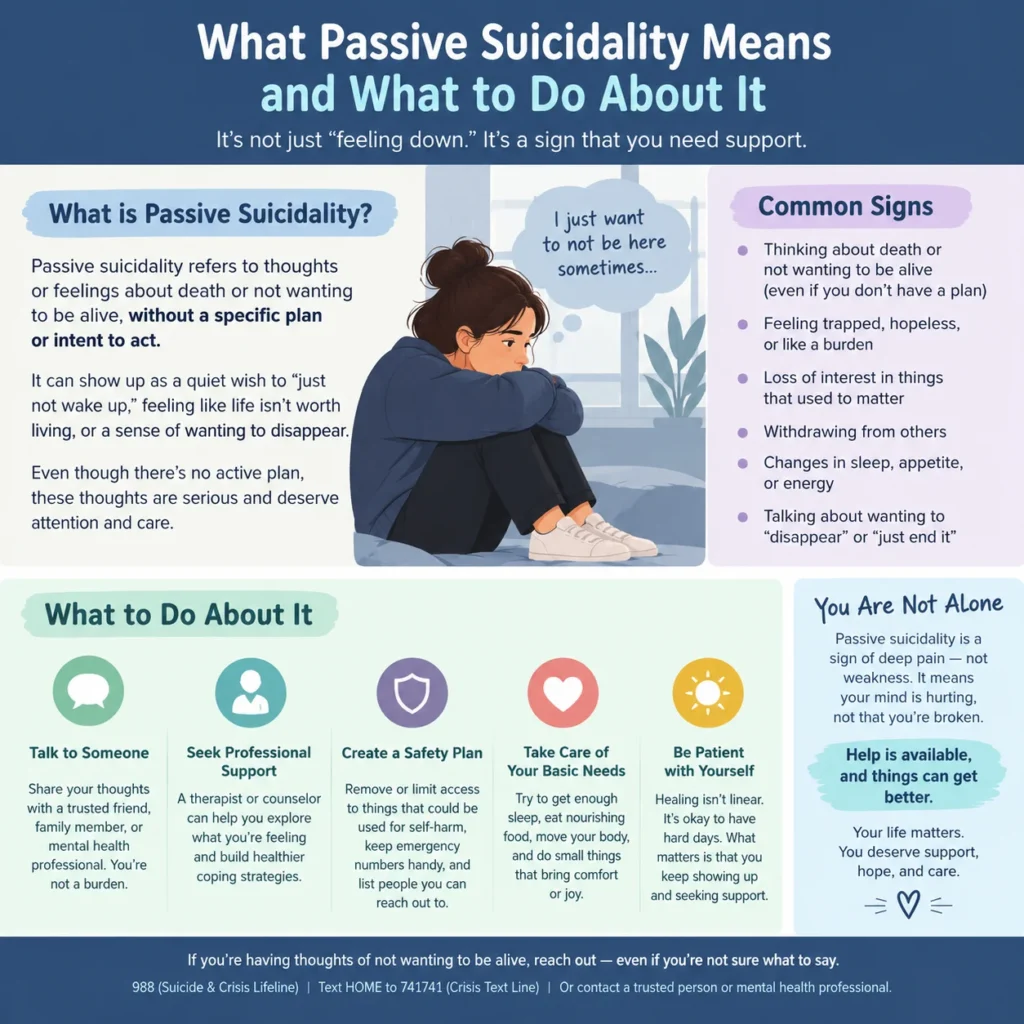
Passive suicidality means thinking about death or wishing you weren’t alive, without a plan or intent to end your life. It often sounds like “I wish I could just disappear” or “Everyone would be fine without me.”
If you’ve had thoughts like these, you’re not broken, and you’re not alone. They do deserve attention, though.
Need help right now? In the US, call or text 988 (Suicide & Crisis Lifeline) any hour. If you’re in immediate danger, call 911.
What Does Passive Suicidality Mean?
Clinicians call it passive suicidal ideation. The American Association of Suicidology describes it as thoughts about dying, or a desire to die, without a specific plan for carrying it out. It’s less “I’m going to do this” and more “I want this to stop, and I wouldn’t mind not waking up.”
Common examples include:
- Wishing you’d fall asleep and never wake up
- Hoping something would end your life without any action from you
- Feeling like a burden, or like the world runs better without you
- Fantasizing about simply not existing
Plenty of people with these thoughts say they’d never act on them. Fair enough. That still doesn’t make the thoughts harmless, because they point to real pain.
Passive vs. Active Suicidal Ideation
| Passive | Active | |
|---|---|---|
| Core thought | Wish to be dead or not exist | Thoughts of ending one’s own life |
| Plan | None | Often present |
| Intent | Absent | Present |
| Preparation | None | May include arranging affairs |
Active ideation adds planning, intent, or preparation. Examples include writing a will or giving away belongings. Researchers who compared the two forms found them related but distinct, and suicidal behavior most often occurs when active ideation combines with other risk factors.
Here’s the catch: the line isn’t fixed. Someone can drift from one to the other over weeks or within a single bad night. Left unaddressed, the underlying problems can escalate passive thoughts into active ones. So calling it “the mild kind” misses the point.
Warning Signs to Watch For
- Remarks about being a burden, or “what’s the point?”
- Pulling away from friends, family, and favorite activities
- Hopelessness that won’t lift
- Neglecting sleep, health, or hygiene
- Taking risks with little concern for safety
What Causes These Thoughts?
There’s rarely one cause. Depression, anxiety, trauma, chronic pain or illness, grief, loneliness, money stress, and substance use all show up, and they often stack. For many people, the real wish underneath is for the pain to end, not for life to end. That distinction matters, because pain can be treated.
What to Do If This Is You
- Tell one person. A friend, relative, or doctor. Say it plainly: “I’ve been having thoughts about not wanting to be alive.”
- Get assessed by a licensed professional. Therapy, medication, or both can help, and a clinician can build a safety plan with you.
- Put distance between yourself and anything you could use to hurt yourself. Ask someone you trust to help.
- Call or text 988 if the thoughts get louder, more specific, or scarier.
If you’re supporting someone else, ask directly, listen without arguing, stay with them, and help them reach 988 or a clinician. Asking doesn’t plant the idea.
FAQ: Passive Suicidality Questions
Q: Is passive suicidality a mental illness?
A: No, it’s a symptom, not a diagnosis. It often accompanies depression, PTSD, and other conditions, and it’s treatable.
Q: Is it serious if I have no plan?
A: Yes. It signals real pain and can escalate. An assessment is worthwhile either way.
Q: Can passive thoughts become active?
A: They can. Stress, loss, or worsening depression can shift them.
Q: How is it treated?
A: Usually talk therapy, sometimes medication, plus a written safety plan.
Q: What should I say to someone who mentions it?
A: Ask calmly, listen, and encourage professional help or 988.





1 thought on “What Passive Suicidality Means and What to Do About It”