
Air Calédonie’s Chapter 11: What Happened and What’s Next
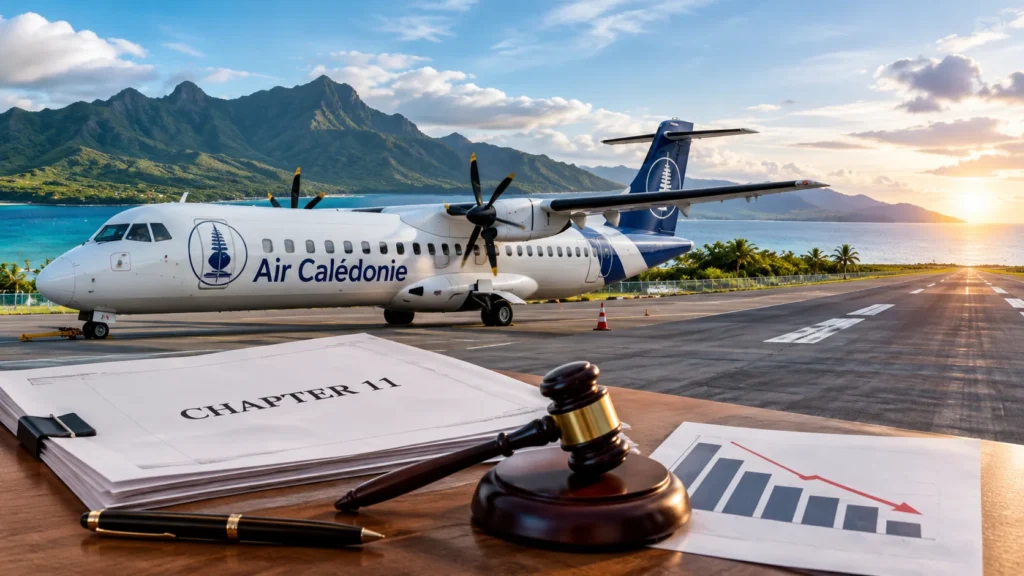
New Caledonia’s only domestic airline spent almost the entire first half of 2026 grounded, in court, or both. Air Calédonie, the small state-backed carrier that connects Nouméa to the Loyalty Islands and the Isle of Pines, filed for the French equivalent of Chapter 11 bankruptcy protection on March 27, 2026. Six months later, it’s still climbing out.
Here’s the full story: why it happened, what “Chapter 11” actually means under French law, and where things stand as of September 2026.
What Is Air Calédonie?
Air Calédonie (not to be confused with Aircalin, its international sister carrier) has flown between New Caledonia’s islands since 1954, when it started with a single De Havilland Dragon Rapide. Today it operates four ATR 72-600 turboprops, seating around 70 passengers each, and it’s the sole scheduled operator on most of its routes. For roughly 280,000 residents spread across a scattered archipelago, that makes it less of a convenience and more of a lifeline. Hospital visits, grocery runs, and job access on the outer islands often depend on whether a flight goes out that day.
That’s part of why the airline’s collapse became a territorial crisis rather than just a corporate one.
Why Air Calédonie Filed for Bankruptcy
The immediate trigger was a hub relocation. In early 2026, Air Calédonie moved its base from Nouméa Magenta Airport, close to the capital, to the more distant La Tontouta International Airport. Residents and customary authorities in the Loyalty Islands opposed the move, arguing it would cut off convenient access for people who depend on the airline most.
The response was blockades. Protesters shut down airfields at Ouvéa, Lifou, Maré, and Île des Pins, and Air Calédonie went 25 straight days without running a single domestic flight in March 2026. With no ticket revenue and fixed costs still piling up, the airline furloughed half of its 220 employees and warned it could run out of cash by April.
None of that happened in isolation, either. The blockades exposed a company that was already financially fragile: years of recurring losses, high operating costs for a small island market, and uneven post-pandemic demand had left little cushion. When the protests cut off revenue entirely, the airline had nothing left to absorb the shock.
On March 27, with no resolution in sight, Air Calédonie filed for court protection.
What “Chapter 11” Means Under French Law
Air Calédonie didn’t file for Chapter 11 in the American sense, since that’s a U.S. legal mechanism. What it filed for is called redressement judiciaire, a French court-supervised restructuring process that serves the same basic purpose: give a financially distressed company breathing room to reorganize instead of shutting down immediately.
The Commercial Court of Nouméa formally opened the process on April 14, 2026. Under the ruling:
- The airline’s existing debts were frozen as of that date.
- A court-appointed administrator could oversee operations alongside management.
- Air Calédonie was required to develop a recovery plan within a set timeframe.
- The airline was permitted to resume limited domestic flights under court supervision.
By that point, the numbers were stark. Air Calédonie had racked up roughly 256 million CFP francs (about $2.4 million) in debt, according to Ch-aviation, and was reportedly losing around 10 million CFP francs (about $95,000) a day while grounded.
Public Prosecutor Yves Dupas called the receivership a “last chance” to save a company that, in his words, exists to preserve the jobs of its 220 employees and keep the territory connected.
Could Another Airline Take Over?
Given how central Air Calédonie is to inter-island transport, one obvious question is whether a competitor could simply step in. The short answer, based on aviation industry analysis, is not really. Air Loyauté, a smaller local operator, runs light aircraft on charter routes but doesn’t have the fleet or infrastructure to replace a full network. Aircalin, the international carrier, flies jets on medium- and long-haul routes and isn’t set up for short-haul inter-island turboprop service, though some analysts have floated it playing a role in a broader restructuring down the line.
That leaves New Caledonia with what’s essentially a monopoly it can’t easily replace, which is a big part of why the government has stayed involved throughout.
Timeline: Six Months of Disruption
- March 27, 2026: Air Calédonie files for court-supervised restructuring after 25 days without flights.
- April 14, 2026: The Nouméa Commercial Court formally opens the restructuring, freezes debts, and allows limited flight resumption.
- Late May–June 2026: Some routes, including Lifou, gradually reopen as local blockades lift; Loyalty Islands customary committees signal they’ll keep protesting past New Caledonia’s June 28 provincial elections.
- Mid-2026: Flights to Ouvéa and Maré remain suspended as the 16-week dispute drags on, even as service to Lifou and Île des Pins is restored.
- September 10, 2026: Air Calédonie resumes flights to Ouvéa for the first time in roughly six months, after the Banutr customary chiefdom authorizes reopening Hulup Airport.
- September 8–10, 2026: Not everyone agrees the dispute is over. The Iaai customary coordination collective, representing three of Ouvéa’s larger chiefdoms, publicly opposes the Banutr decision, arguing it wasn’t collectively approved and that the blockade technically remains in place.
That last point matters: the reopening isn’t a clean resolution. It’s a partial, contested restart, and it illustrates how tangled the underlying political dispute still is, even as the financial restructuring moves forward on its own separate track.
What’s Next for Air Calédonie?
The court-supervised process gives Air Calédonie room to negotiate a debt settlement plan rather than face liquidation outright, but the underlying pressures haven’t disappeared. The airline still needs to prove it can operate profitably on a small island network with high fixed costs, and it still depends on political consensus with customary authorities that, as of September 2026, hasn’t fully materialized.
For now, the practical story is one of incremental progress: routes reopening one island at a time, government mediation continuing, and a company trying to rebuild both its balance sheet and the trust of the communities it serves.