
Delta Connection DL3543 Emergency Landing: What Happened
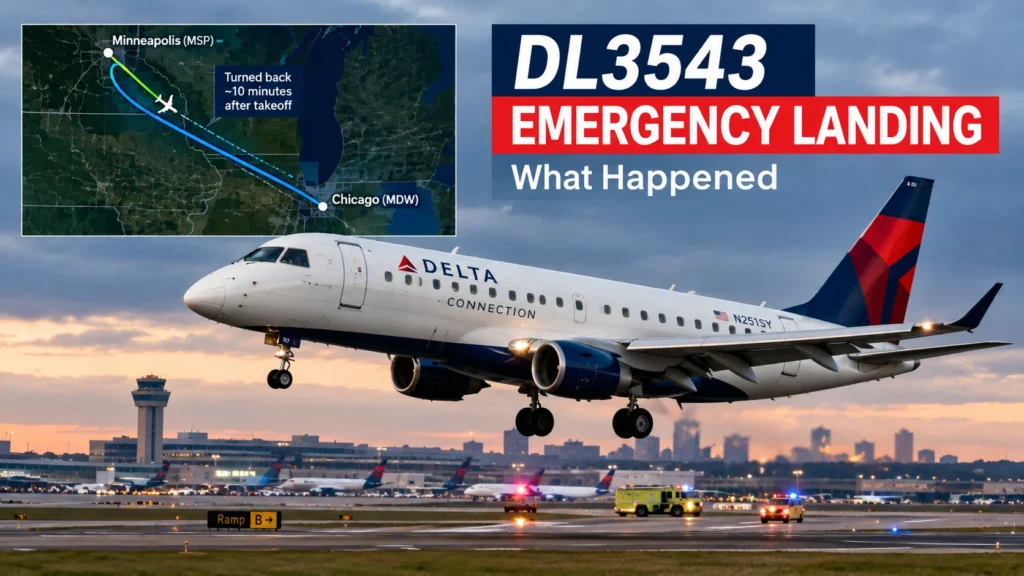
A Delta Connection flight bound for Chicago made an abrupt return to Minneapolis–St. Paul International Airport after the crew declared an emergency shortly after takeoff, according to flight-tracking reports and aviation news outlets.
What happened?
Delta Connection flight DL3543, operated by an Embraer 170-200LR (registration N259SY), departed Minneapolis at 13:09 UTC on July 7, 2025, headed for Chicago Midway International Airport. About 10 minutes into the climb, while passing through 21,000 feet, the flight crew stopped the ascent and requested priority handling back to Minneapolis.
Air traffic control records show the crew squawked code 7700, the universal transponder signal pilots use to alert controllers to an emergency. That code doesn’t specify what’s wrong; it simply tells every radar screen and controller in range to clear the way. The aircraft landed safely on runway 12R roughly 37 minutes after departure and taxied to gate C12.
No injuries were reported among passengers or crew.
What caused it
Delta has not issued a detailed public statement identifying the specific mechanical issue, and the FAA has not published a finding. Some secondhand accounts point to a possible flaps-related problem, but that detail hasn’t been confirmed by the airline or federal investigators, so it should be treated as unverified rather than as the official cause. Passengers were assisted at the gate and rebooked onto later flights to Chicago.
Why this kind of return isn’t unusual
Emergency declarations like this one happen more often than most travelers realize, and they don’t always signal serious danger. A 7700 squawk is primarily a priority request: it tells controllers to give the aircraft the shortest, fastest route back to a runway and to have emergency crews standing by, just in case. Modern airliners are built with redundant systems, so a single warning light or sensor fault doesn’t mean something has actually failed, only that it needs to be checked before the flight continues. Airline crews are trained to treat these situations conservatively, choosing to turn back early rather than press on and find out later that the problem was worse than it looked.
That’s part of why DL3543 was back on the ground in well under an hour: the crew caught the issue early in the climb, while still close to its departure airport, and used the emergency declaration to get to the front of the line.
The bigger picture
Flight DL3543 is one of several Delta and Delta Connection flights that have made headlines for in-flight emergencies over the past year, including a July 2025 Atlanta–Fort Lauderdale flight that diverted after a passenger’s device battery caught fire. Incidents like these tend to draw outsized attention on social media, partly because passengers document them in real time, even when the outcome (a safe, uneventful landing) is the norm rather than the exception.
For travelers on DL3543 or similar delayed flights, Delta’s standard practice is to rebook affected passengers on the next available flight and, depending on the circumstances, offer meal or hotel accommodations for lengthy delays.









1 thought on “Delta Connection DL3543 Emergency Landing: What Happened”