
15 Unusual Facts About Peru You Probably Don’t Know
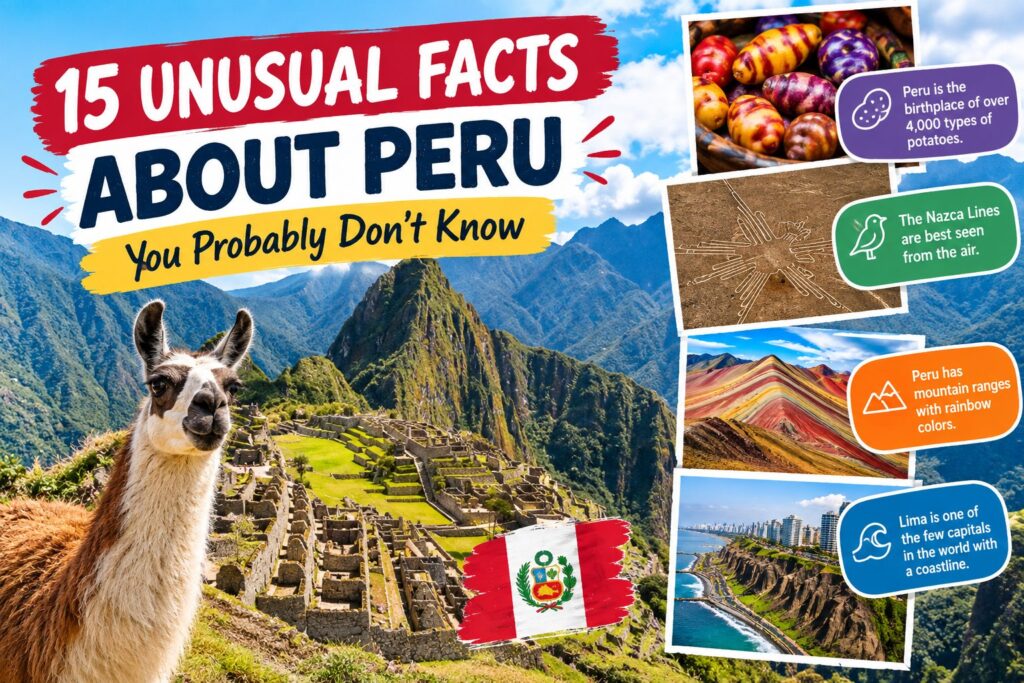
Most people picture Machu Picchu when they think of Peru, and fair enough, it earned its spot as one of the New Seven Wonders of the World. But the country hides far stranger and more interesting stories than one ruined citadel. Here are 15 facts about Peru that rarely make the postcard.
1. The Amazon River Starts Here, Not in Brazil
Everyone assumes the Amazon belongs to Brazil. In reality, its headwaters trace back to Peru’s high Andes. Researchers spent decades arguing over the exact source, but a 2014 study pinned it to the Mantaro River, which joins the Apurímac and Marañón before the river even earns the name “Amazon.”
2. People Live on Man-Made Floating Islands
On Lake Titicaca, the Uros people build entire islands out of totora reeds, then live, cook, and raise families on top of them. The reeds rot from below, so residents keep piling on fresh layers from above. Some islands have existed, in one form or another, for centuries.
3. It’s the Birthplace of the Potato
Peru domesticated the potato around 10,000 years ago near Lake Titicaca, and the country still grows more than 4,000 varieties, ranging from tiny purple tubers to bright yellow ones the size of a fist. May 30th is National Potato Day, and Peruvians take it seriously.
4. Peru Holds Two of the World’s Deepest Canyons
Colca Canyon and Cotahuasi Canyon, both in the Arequipa region, are roughly twice as deep as the Grand Canyon. Andean condors ride the thermals above them, and a handful of remote villages still farm the terraced slopes the way their ancestors did.
5. There’s a City Older Than the Pyramids of Giza
Caral, a sprawling complex north of Lima, dates back to around 2600 BC, making it contemporary with early Egyptian pyramids and older than the Inca, Maya, or Aztec civilizations. Archaeologists consider it one of the oldest urban centers in the Americas.
6. Alpacas Outnumber People in Some Regions
Over 70% of the world’s alpacas live in the Peruvian Andes, and their wool supports roughly 150,000 families. The fiber comes in 22 natural colors, no dye required, which is part of why alpaca textiles command such high prices abroad.
7. Machu Picchu Wasn’t “Lost” to Everyone
Spanish conquistadors never found Machu Picchu, so it was never looted or dismantled. Locals, however, likely always knew it was there. A farmer named Agustín Lizárraga is credited with visiting the site in 1902, nearly a decade before Hiram Bingham “discovered” it for the outside world in 1911.
8. The World’s Tallest Sand Dune Sits in the Desert
Cerro Blanco, about three hours south of Lima in the Sechura Desert, rises roughly 1,176 meters, making it one of the tallest sand dunes on the planet. Sandboarders travel from around the globe just to ride it.
9. Pink Dolphins Swim in the Amazon
The Amazon basin covers about 60% of Peru’s territory, and its rivers host pink river dolphins, a genuinely rare sight for anyone expecting the typical gray variety.
10. Quechua Is Still an Official Language
Spanish dominates, but Quechua, the language of the Inca Empire, remains an official language alongside Aymara and dozens of other Indigenous tongues. Roughly 8 million people still speak Quechua today, and street signs in parts of the Andes reflect it.
11. Peru Ranks Second in the World for Shamans
Only India is home to more practicing shamans than Peru. Ayahuasca ceremonies and traditional Andean healing rituals remain deeply woven into daily life in many communities, particularly in the Amazon.
12. Ceviche Has Its Own Holiday
Peru’s national dish, raw fish cured in citrus and chili, is popular enough to have a dedicated national day: June 28th. Every region riffs on the recipe differently.
13. The Longest Left-Hand Wave on Earth Breaks Here
Surfers travel to Chicama, on Peru’s northern coast, specifically because the wave there can carry a rider for more than a mile, longer than any other left-hand break in the world.
14. Lake Titicaca Is the Highest Navigable Lake Anywhere
Sitting above 3,800 meters, Titicaca is high enough to leave first-time visitors short of breath just walking around Puno, let alone boarding a boat.
15. Peru Is One of the Most Biodiverse Countries on Earth
Despite covering less than 1% of the planet’s land area, Peru is one of just 17 “megadiverse” countries, home to thousands of bird, plant, and mammal species found almost nowhere else.








1 thought on “15 Unusual Facts About Peru You Probably Don’t Know”