
EV Charging Explained: Levels, Costs, and the NACS Switch in 2026
If you’re new to electric vehicles, the charging side of ownership can feel more confusing than the driving side. Plugs have changed. Networks have merged. And the whole country is in the middle of switching connector standards. Here’s what actually matters right now, without the jargon.
The Three Levels of Charging
Every public or home charger falls into one of three speed categories.
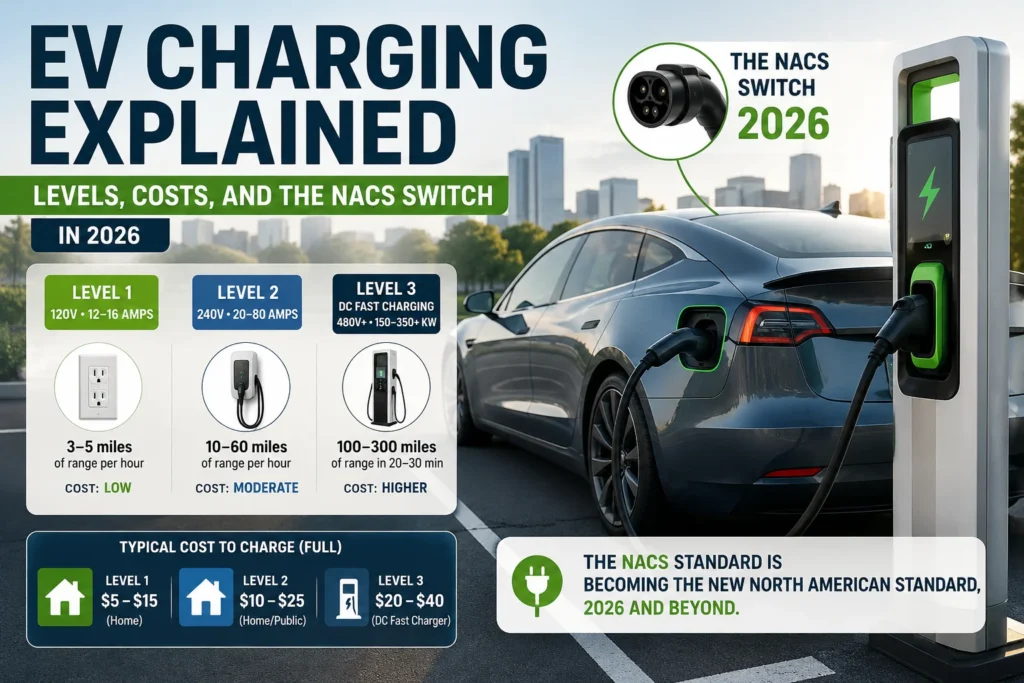
Level 1 uses a standard 120-volt household outlet. No special equipment beyond the cord that comes with your car. It’s slow, adding roughly 3 to 5 miles of range per hour, which makes it a backup option rather than a daily plan for most drivers. It works fine if you drive under 30 miles a day and can plug in overnight.
Level 2 runs on a 240-volt circuit, the same type that powers an electric dryer. Home units typically deliver 20 to 40 miles of range per hour, and this is what most EV owners install in their garage. Public Level 2 stations, common at grocery stores, hotels, and workplaces, add power at a similar rate. A home Level 2 charger runs $300 to $800 for the hardware, plus $500 to $2,000 for installation depending on your electrical panel.
DC fast charging, sometimes still called Level 3, is a different animal entirely. These stations bypass your car’s onboard charger and feed high-voltage direct current straight to the battery, adding 150 to 400 miles of range per hour depending on the station and your vehicle. This is what you use on road trips, not at home. Home electrical service can’t support it: the equipment needs three-phase commercial power and typically costs $75,000 to $150,000 to install at a public site.
What Charging Actually Costs
Home charging is the budget option by a wide margin. At the national average residential rate of around $0.16 to $0.19 per kWh, filling a 60 kWh battery from empty costs roughly $10 to $11. Most drivers who charge at home spend $30 to $50 a month for around 1,000 miles.
Public charging costs more, and pricing varies a lot by network:
- ChargePoint Level 2 sessions run about $0.20 to $0.35/kWh, with DC fast charging at $0.30 to $0.50/kWh.
- Tesla Supercharger pricing runs $0.25 to $0.50/kWh, cheaper for Tesla owners on a membership plan.
- Electrify America is typically the priciest major network, at $0.43 to $0.60/kWh, though its Pass+ membership knocks off roughly $0.10/kWh.
A rough rule of thumb: charging from 10% to 80% on a 75 kWh battery at a public fast charger costs somewhere around $25 to $28 at average rates. Still cheaper per mile than gasoline in most parts of the country, but not free the way overnight home charging basically is.
The NACS Transition: What Changed and Why It’s Messy
This is the part that trips up new owners the most. For over a decade, North America had two competing DC fast-charging connectors: Tesla’s proprietary plug, used only on Tesla vehicles and at Superchargers, and CCS1, the open standard used by nearly everyone else, including Ford, GM, Hyundai, and the Electrify America and EVgo networks.
That’s no longer true. Tesla opened up its connector design, and SAE standardized it in 2023 as NACS, the North American Charging Standard, officially designated J3400. Since then, most major automakers, including Ford, GM, Rivian, Hyundai, Kia, BMW, and Toyota, have committed to building NACS ports into new vehicles. Tesla’s own Supercharger network has opened to non-Tesla vehicles in the process.
Here’s where it gets messy: 2026 is what a lot of people in the industry call the “hybrid grid” period. New cars increasingly ship with native NACS ports, but plenty of existing vehicles on the road still have CCS1 ports, and a meaningful share of public infrastructure was built around CCS1 first. Practically, that means:
- If your car has a native NACS port, you can plug straight into a Tesla Supercharger with no adapter, and use a NACS-to-CCS1 adapter (often included, or roughly $150 to $250 if bought separately) to reach older CCS stations.
- If your car has a CCS1 port, you’ll need a CCS1-to-NACS adapter to access most Superchargers. Coverage isn’t universal. Some Supercharger stations, especially older ones, don’t yet support the “Magic Dock” style CCS access.
- Volkswagen Group (VW, Audi, Porsche) is the notable holdout, still shipping CCS1-only vehicles as of 2026, in part because VW is a major investor in the CCS-based Electrify America network.
New public stations are increasingly being built with both plug types on the same cabinet, which is the industry’s way of avoiding the compatibility mess long-term. Federally funded NEVI charging sites, for instance, are now generally required to support both NACS and CCS1 connectors.
Home Charging: What You Actually Need
If you’re setting up a home charger, a Level 2 unit is worth it if you drive an EV regularly. The math is straightforward: Level 1 charging (the plug that comes with the car) recovers only a few miles per hour of downtime, which doesn’t keep pace with daily driving for most households.
Before installing, check your electrical panel’s available capacity. Many installations need panel upgrades if the home is older or already near capacity, which is the biggest swing factor in the $500 to $2,000 installation cost range. A licensed electrician can tell you in about ten minutes whether your panel has room.
One thing worth knowing: a federal tax credit under Section 30C covers 30% of home charger installation costs, up to $1,000, for qualifying installations. It’s worth checking current eligibility before you buy, since rules and qualifying ZIP codes have shifted over time.
Road Trip Charging: A Few Practical Habits
Fast charging is the only practical option for long trips, but a few habits make it less painful:
- Charge to 80%, not 100%. Charging speed drops sharply above 80% state of charge on most batteries, so topping off past that point wastes time for little range gained.
- Use a routing app that accounts for charger availability, not just charger location. Broken or occupied stalls are still common enough to plan around.
- Consider a network membership if you road-trip often. Electrify America’s Pass+ and similar programs from other networks can meaningfully cut your per-kWh cost if you’re a regular customer rather than a one-off user.
- Don’t panic about battery degradation from fast charging. Occasional DC fast charging on road trips has a small effect on long-term battery health. It only becomes a real factor if fast charging makes up the bulk of your charging routine.
The Bottom Line
Charging an EV in 2026 is easier than it was even two years ago, mostly because the NACS standardization is pulling the industry toward one connector instead of two. But it’s not fully settled yet. If you’re shopping for a new EV, check which port it uses natively and whether an adapter is included, because that one detail determines how much of the existing charging network is available to you without extra hardware. If you already own an EV, keep an adapter in the glovebox if your car’s port doesn’t match the majority standard, and get comfortable with a routing app before your first road trip.