Shadow Labyrinth Review: A Bold, Bloated Take on Pac-Man
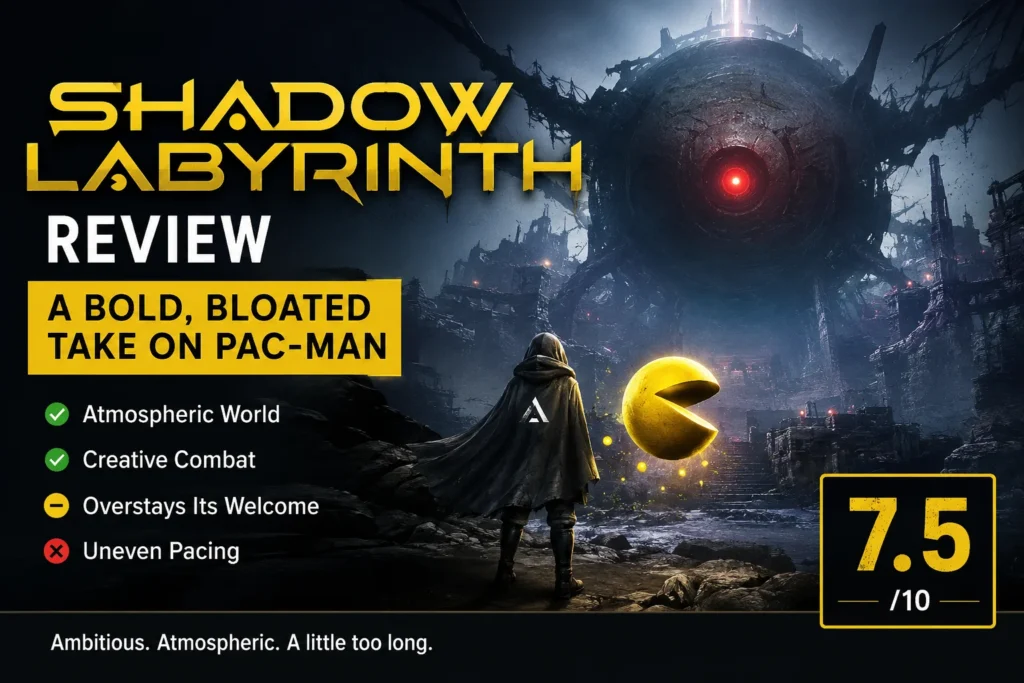
Bandai Namco’s pitch for Shadow Labyrinth sounds like a joke at first: take Pac-Man, one of gaming’s most cheerful icons, and drop him into a dark, blood-and-sword metroidvania. It shouldn’t work. Somehow, it mostly does, even if the final product struggles under the weight of its own ambition.
What Is a Shadow Labyrinth?
You don’t actually play as Pac-Man. Instead, you control Swordsman No. 8, a silent, hooded fighter awakened on a ruined planet by a floating yellow orb named PUCK. That orb is your real connection to the franchise, and it’s a smarter idea than it sounds. Certain sections let you activate glowing rails and switch into Puck himself, automatically zooming through classic-style mazes, gobbling pellets, and dodging ghosts in short, arcade-flavored bursts. These callbacks are genuinely fun, and they’re where the game’s love for Namco’s history shines brightest.
The rest of the experience is a fairly traditional 2D action-platformer in the Metroid/Hollow Knight mold: sprawling, interconnected biomes, gated progression, sword combat, dodges, parries, and a steady drip of new traversal abilities. If you’ve played a metroidvania in the last decade, the shape of Shadow Labyrinth will feel immediately familiar.
The Good
Exploration is where the game earns its keep. Areas are dense with secrets, shortcuts, and reasons to backtrack, and the biomes have a distinct, sometimes painterly visual identity. Combat is responsive once you adjust to its rhythm, demanding precise timing on attacks and dodges rather than button-mashing. And the Pac-Man rail sections work as clever pacing breaks, injecting arcade energy into an otherwise moody, slower-burn game.
There’s also a real sense of ambition here. This isn’t a cynical cash-in on nostalgia; it’s an attempt to reinterpret 45 years of Namco history through a genre that rewards patience and curiosity. When it leans into that identity, it’s one of the more interesting big-budget metroidvanias in recent memory.
The Not-So-Good
The problems mostly come from scale. At roughly 30 hours, Shadow Labyrinth is a long game for its genre, and it doesn’t always have enough new ideas to fill that runtime. Long stretches play like generic, if competent, metroidvania fare, and the momentum from the game’s stranger, more inventive moments doesn’t always carry through. Some critics have also flagged a visual mismatch, with heavily detailed character models set against blurrier, less defined backgrounds, which can make busy combat encounters harder to read.
It’s also a game that asks for patience before it clicks. The opening hours lean generic, and the difficulty curve can spike in frustrating ways, particularly during specific platforming gauntlets tied to key upgrades. If you’re not already sold on the metroidvania format, there’s little here early on to convert you.
Who Should Play It
Metroidvania veterans looking for a meaty, challenging entry will likely find plenty to like, especially once the game opens up. Longtime Namco and Pac-Man fans will get the most out of the historical nods layered throughout. Newcomers to the genre, or anyone hoping for a straightforward Pac-Man game, should temper expectations.
Final Verdict
Shadow Labyrinth is a strange, sometimes brilliant, sometimes overstuffed experiment. It doesn’t fully justify its length, and its ideas occasionally get lost in familiar genre trappings, but its best moments, especially the Pac-Man rail sequences, prove the concept was worth trying. It’s a good metroidvania wrapped around a genuinely odd, ambitious idea, and that’s more than enough to make it worth a look for genre fans.