
St. Bonaventure: The Franciscan Friar Who Shaped Christian Thought
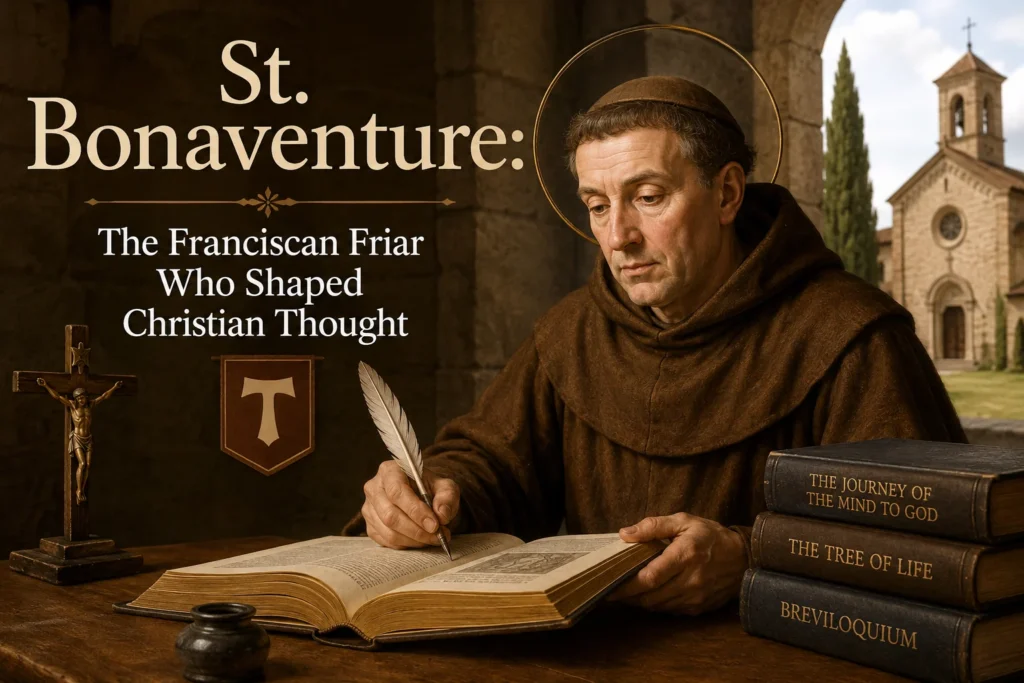
Few medieval theologians left as deep a mark on the Church as St. Bonaventure. A Franciscan friar, philosopher, and eventual cardinal, he spent his life trying to answer a single question: how does the human mind find its way back to God? That question still shapes Catholic theology today.
Who Was St. Bonaventure?
Born Giovanni di Fidanza around 1221 in Bagnoregio, Italy, he took the name Bonaventure after joining the Franciscan Order in his twenties. He studied at the University of Paris under Alexander of Hales, one of the leading scholastic minds of the era, and by his early thirties he was teaching there himself.
In 1257, at just 36, he was elected Minister General of the Franciscan Order. It wasn’t an easy job. The order was splitting into factions over how strictly to follow St. Francis’s original vow of poverty. Bonaventure spent nearly two decades holding the movement together, which is part of why he later earned the title “Second Founder” of the Franciscans.
His Major Works
Bonaventure wrote across several fields at once, and his range is honestly impressive for someone juggling administrative duties.
Itinerarium Mentis in Deum (“The Mind’s Journey into God”) is his best-known work. Written around 1259, it lays out a six-stage path for the soul to move from observing the created world to direct contemplation of God. It’s dense, but it’s also personal; Bonaventure composed it after a retreat at Mount La Verna, where Francis of Assisi had received the stigmata decades earlier.
He also wrote Legenda Maior, an official biography of St. Francis commissioned by the order in 1263. This became the standard account of Francis’s life for centuries, and it shaped how generations of Franciscans understood their founder.
His theological commentary on Peter Lombard’s Sentences, written during his Paris years, remains a core text for scholars studying 13th-century scholasticism.
Theology and Approach
Bonaventure’s thought blends Augustinian philosophy with Franciscan spirituality. Where his contemporary Thomas Aquinas leaned heavily on Aristotelian logic, Bonaventure kept mysticism closer to the center. For him, reason mattered, but it was never the endpoint. Knowledge existed to draw a person toward love of God, not just to win an argument.
That doesn’t mean he avoided debate. He clashed directly with radical Aristotelians at the University of Paris and defended the mendicant orders against critics who questioned whether begging friars had any place in academic life.
Cardinal, Council, and Death
In 1273, Pope Gregory X named Bonaventure Cardinal Bishop of Albano. He helped organize the Second Council of Lyon, which aimed to reunite the Eastern and Western churches. He didn’t live to see the council’s aftermath play out. He died in Lyon on July 15, 1274, reportedly while the council was still in session.
He was canonized in 1482 and declared a Doctor of the Church in 1588, one of only 37 people to hold that title.
Why He Still Matters
Bonaventure’s influence runs through Franciscan spirituality, medieval philosophy courses, and Catholic mysticism alike. His feast day, July 15, is still observed in the Roman Catholic Church, and Itinerarium Mentis in Deum remains standard reading in seminaries and theology programs.