MOTG ETF Explained: VanEck Global Wide Moat 2026
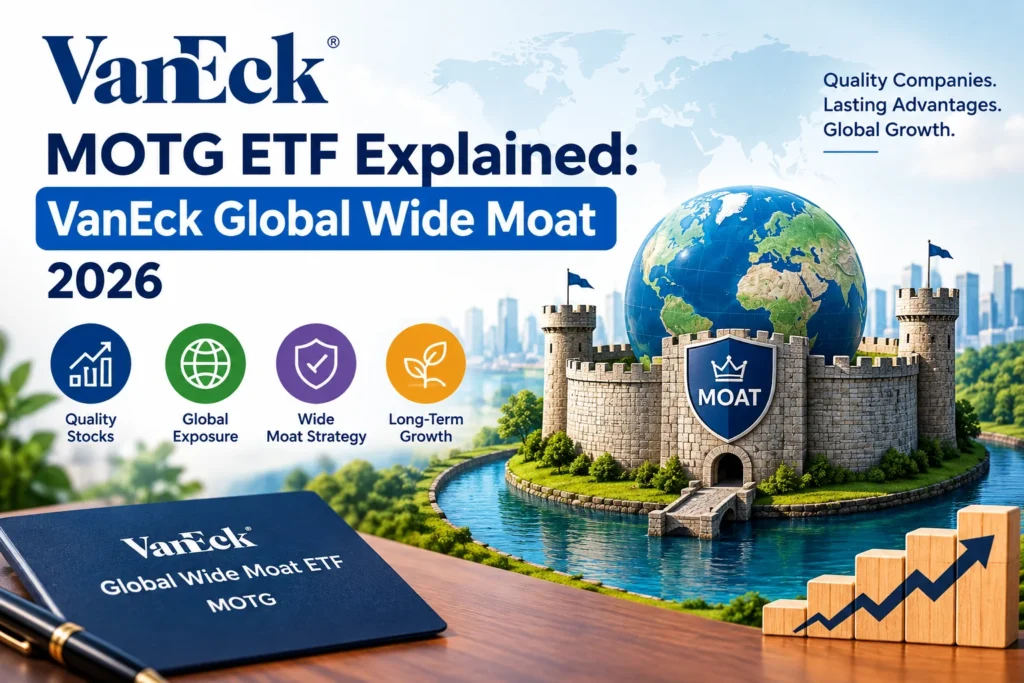
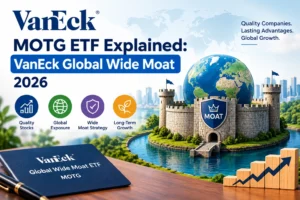
Seen MOTG on a brokerage screen and wondered what it is? It’s the ticker for the VanEck Morningstar Global Wide Moat ETF, a fund built around global companies that Morningstar considers both durable and reasonably priced. This guide covers how the approach works, what the fund owns, what it costs, and where it can trip you up. It’s educational, not personal investment advice.
What the MOTG ETF Actually Tracks
The fund aims to replicate the price and yield of the Morningstar Global Wide Moat Focus Index, which targets attractively priced global companies with sustainable competitive advantages.
A moat, in Warren Buffett’s phrase, is whatever shields a business from rivals: a trusted brand, high switching costs, or sheer scale. Morningstar’s equity research team, over 100 analysts strong, drives the process, and the index leans toward companies trading at attractive prices relative to Morningstar’s fair value estimates.
One naming wrinkle. The fund traded under the GOAT ticker until December 10, 2021, so older articles use that symbol. Some data sites also list a 2021 launch, but VanEck gives October 30, 2018, and the issuer is the source I’d trust.
How the Index Picks and Weights Stocks
Picture a two-filter funnel. First, does the company have a moat? Second, is the stock cheap relative to fair value? Only names passing both make the cut.
Weighting is where MOTG departs from most global funds. The index is staggered and equal-weighted, so each holding gets a similar slice instead of a share tied to company size. With roughly 79 to 81 positions, the ten largest made up about 22% of assets in one snapshot. A cap-weighted index, by contrast, can let a handful of giants dominate.
Equal weighting means smaller companies matter more than they would elsewhere. That’s neither good nor bad. It just means returns won’t track a headline global index closely.
What’s Inside the Portfolio
Sector mix surprises many first-time readers. As of April 3, 2026, industrials led at 28.5%, followed by consumer defensive at 17.7%, healthcare at 15.2%, and technology at 14.6%. That’s a different shape from a typical global index, which tends to lean harder on tech.
Named holdings in that snapshot included BAE Systems, Thales, GSK, Taiwan Semiconductor, and Bristol-Myers Squibb. Another listing showed Baidu, Tencent, and Rheinmetall among the leaders. Different dates, different names. Holdings rotate as prices and fair value estimates move, so check the current list on VanEck’s site before drawing conclusions.
Costs, Size, and Trading Reality
The net expense ratio is 0.52%, against a gross ratio of 1.14%. A gap like that usually points to a fee waiver, and waivers can expire, so look for the end date in the prospectus.
Size matters more here than fees. Net assets were about $18.65 million in mid-August 2026, which is small for an ETF. One March snapshot showed only 336 shares trading in a day. Thin trading tends to widen bid-ask spreads, so use limit orders rather than market orders. Small funds can also close if assets don’t grow. My read: that’s the biggest practical risk, bigger than the fee.
Performance and the Dividend Quirk
VanEck’s August 2026 page listed NAV returns of 10.37% over one year, 12.50% over three years, and 7.18% over five. Past results don’t predict future ones, and those figures come before your own taxes and trading costs.
The dividend needs a warning label. One data site showed an 18% yield based on $6.88 per share over the trailing year. But the fund pays once a year, with the last ex-dividend date on December 22, 2025. One large annual payout inflates a trailing figure. An older VanEck fact sheet listed a 30-day SEC yield of just 1.73%. Don’t treat 18% as income you can count on.
Who Might Consider It, and Who Might Not
A value-minded investor wanting global exposure beyond the tech-heavy mainstream may find the approach appealing. Someone who wants low cost, deep liquidity, and a set-and-forget core holding may prefer a broader index fund.
Risks worth weighing: fair value estimates are opinions and can be wrong; a valuation tilt can lag when growth stocks lead; foreign holdings add currency swings; and the small asset base adds the spread and closure issues above.
I can’t tell you whether it fits your situation. A licensed adviser can, and the prospectus is the document to read first.
FAQ: MOTG ETF Questions
What does MOTG stand for?
It’s a ticker, not a formal acronym. It identifies the VanEck Morningstar Global Wide Moat ETF.
Is MOTG a good investment?
That depends on your goals, time horizon, and risk tolerance. Its small size and 0.52% net fee are the main trade-offs to weigh against the value-focused strategy.
How much does MOTG cost?
The net expense ratio is 0.52%, with a 1.14% gross ratio before waivers.
Does MOTG pay dividends?
Yes, once a year. The amount varies, so past payouts aren’t a reliable guide.
Is MOTG the same fund as GOAT?
Yes. It traded as GOAT before December 10, 2021
Bottom Line
MOTG offers a rules-based way to own roughly 80 global companies. Morningstar sees it as protected and fairly priced, with a sector mix unlike the usual global fund. The small asset base, partial fee waiver, and misleading yield figures deserve a close look. Read the current fact sheet, compare it with broader alternatives, and decide from there.