How to Run a Pre-Market Analysis on US Income ETFs
Income ETFs look calm on paper. Monthly payouts, a tidy yield, nothing to babysit. Then you open your brokerage app at 8:10 a.m., and your fund is down 1.4% before the bell. Panic? Shrug? Honestly, it depends.
A pre-market analysis is a short routine you run before the 9:30 a.m. ET open. You check the calendar, the overnight news, the early quote, and a few facts about how the fund pays its distributions. Then you decide whether anything needs doing. Most mornings, nothing does.
This guide is educational, not financial advice.
What Pre-Market Analysis Means for Income ETFs
Pre-market trading covers orders placed before the regular session opens. FINRA describes it as typically running from about 7 a.m. to 9:30 a.m., and one large broker lists a 4 a.m. ET start. Your platform sets the real hours, so check yours.
“Income ETF” is a wide label. It can mean a plain dividend fund, a bond fund, or a covered-call fund, which owns stocks and sells call options against them to collect extra premium. Each behaves differently at 8 a.m. A dividend fund mostly follows the market. A covered-call fund follows it too, but its upside is capped, which matters on big green mornings.
So why bother with an early check at all? Because thin trading can make a calm fund look wild.
Why Early Quotes Can Mislead You
The SEC’s investor education office lists the risks of trading outside regular hours: less liquidity, bigger price swings, prices that may not match the regular session, unlinked trading systems, and wider bid-ask spreads. FINRA adds that the national best bid and offer is only published during regular hours, so the price you get early can be worse than the one at the open.
One custodian’s risk disclosure also warns that fund value estimates may not be widely published before the open, which leaves everyday investors behind professionals.
Say a $25 fund shows a 30-cent spread at 7:45. That quote isn’t a signal. It’s noise.
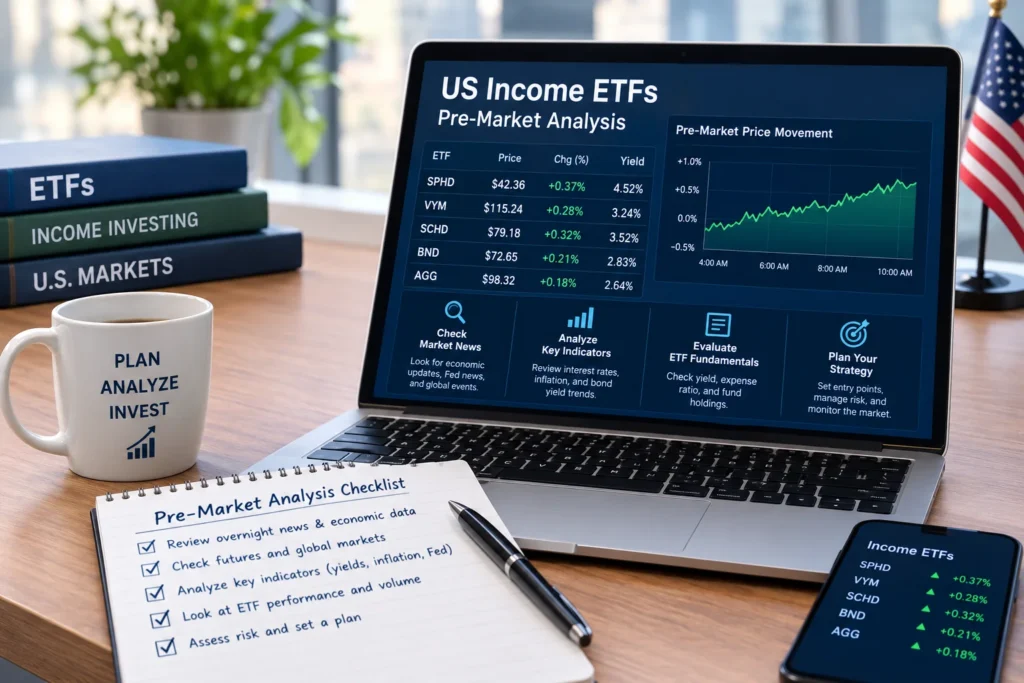
The 5-Step Morning Routine
Step 1: Check the distribution calendar.
Find the ex-dividend date on the issuer’s website. On that date, the share price typically drops by about the payout amount. A lower quote that morning may be bookkeeping, not bad news. Monthly payers trigger this every few weeks, so it’s the most common false alarm.
Step 2: Scan the overnight drivers.
Look at index futures, Treasury yields, and earnings from the fund’s largest holdings. Pull the top ten holdings from the fact sheet. Rate moves hit bond and preferred-stock funds harder, while stock-heavy funds track equity futures.
Step 3: Judge the quote, not just the price.
Compare the early price with yesterday’s close, then check the spread and volume. Wide spread plus tiny volume means the number says little. If you do trade early, use a limit order. Some brokers restrict which order types you can use in extended hours anyway, and some don’t offer early trading at all.
Step 4: Re-read what the fund does.
Spend two minutes on the fact sheet. Covered-call strategies tend to work best when the underlying stock is flat or moves moderately. Then check the distribution breakdown. Very high payouts may be funded by return of capital, borrowing, or both, and a fat yield tells you little about total return.
Step 5: Write the decision rule.
Decide before the open what would make you act. Something like, “If the fund gaps more than X% with no news, I look closer. Otherwise I wait.” Rules written in advance beat reactions. My take: for anything that isn’t urgent, wait for the first 30 minutes of regular trading.
Common Mistakes
Treating yield as return. Distribution yield does not equal investment return. Some of what lands in your account may be your own money coming back.
Reading ex-date drops as losses. See Step 1.
Using market orders in thin trading. You can get a worse fill than the quote suggested.
Reacting to one quote. A single early print can reverse by 9:35.
Ignoring costs. Covered-call ETFs typically carry higher expense ratios than broad index funds because the strategy is harder to run.
A Tip Worth Trying
Keep a simple log for 20 mornings: early move, opening price, and closing price. You’ll see how often early gaps fade. I can’t promise your results will match anyone else’s, and a small sample proves little. Still, it beats guessing.
FAQ: Income ETF Pre-Market Questions
Can you trade income ETFs pre-market?
Often yes, if your broker offers it. FINRA notes that firms may set their own parameters for extended-hours trading or skip it entirely.
What time does pre-market start?
It varies by broker, from about 4 a.m. to 7 a.m. ET, and ends at the 9:30 a.m. open.
Is the pre-market price reliable?
Not always. Low volume and wide spreads can make early quotes poor guides to the opening price.
Do covered-call ETFs beat dividend ETFs?
It depends on the market. One Canadian financial press analysis notes that they can do well in flat or falling markets but tend to lag when markets rise.
What is return of capital?
It’s the part of a payout that gives investors their own money back rather than fund earnings. It usually affects your cost basis, so ask a tax professional how it applies to you.
The Bottom Line
A good pre-market check takes five minutes: calendar, news, quote quality, fund mechanics, and decision rule. It won’t predict the day. It keeps you from reacting to noise, and that’s the point.