New Bacteria Species Discovered Aboard Tiangong Space Station
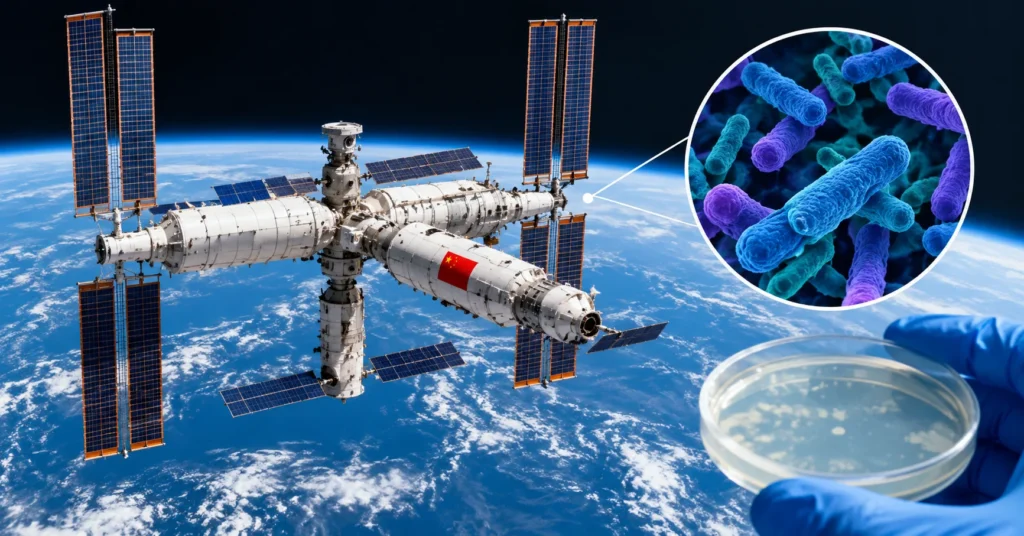
In May 2023, a Chinese astronaut swabbed a control panel inside the Tiangong space station. Nobody thought much of it at the time. It was routine hygiene monitoring, the kind of unglamorous housekeeping that keeps a crewed spacecraft from turning into a floating petri dish.
Two years later, that swab turned into a scientific first: a bacterium never recorded anywhere on Earth, born and shaped by conditions that don’t exist outside a spacecraft.
Researchers named it Niallia tiangongensis, and its discovery is now raising real questions about astronaut health, spacecraft hygiene, and what life quietly does to itself when it’s sealed inside a metal box orbiting 250 miles above the ground.
What Is Niallia Tiangongensis?
Niallia tiangongensis is a newly identified bacterial species, formally described in a March 2025 paper in the International Journal of Systematic and Evolutionary Microbiology. It’s rod-shaped, forms spores, and needs oxygen to survive, three traits that place it firmly within the Niallia genus.
Its closest known relative is Niallia circulans, a bacterium that lives in soil, sewage, and spoiled food here on Earth. That relative isn’t harmless: in people with weakened immune systems, it can cause infections, and in rare cases, sepsis.
The space-borne version isn’t identical, though. Genome sequencing, growth pattern analysis, and metabolic testing all pointed to something distinct enough to earn its own species classification. Whether it evolved on the station itself or simply arrived as an undiscovered Earth strain that got lucky in a sterile environment is still an open question. Researchers lean toward the former, given how specifically adapted it appears to be.
How Scientists Found It
The discovery traces back to the China Space Station Habitation Area Microbiome Program, known as CHAMP, an ongoing effort to track what’s actually living inside Tiangong. Crew members on the Shenzhou-15 mission collected surface samples in May 2023 as part of that monitoring, then froze them for the trip home when the mission wrapped up in June 2023.
Once back on Earth, researchers at the Shenzhou Space Biotechnology Group and the Beijing Institute of Spacecraft System Engineering ran the samples through genomic sequencing and phylogenetic analysis, essentially building a family tree to see where this microbe fit. It didn’t fit anywhere existing. So they gave it a name tied to the place it was found.
This kind of monitoring isn’t a one-off. China’s astronauts regularly sample air, surfaces, and even water dispenser outlets aboard Tiangong to keep tabs on the station’s microbial makeup over time.
Why This Bacterium Is Different
A few specific traits set N. tiangongensis apart from its Earth-bound relative, and they’re not cosmetic differences.
Stronger biofilm formation. The microbe builds a three-dimensional protective structure, a biofilm, more effectively than its terrestrial cousin. Think of it as armor: biofilms shield bacteria from environmental stress and can even help fend off competing microbes.
Better resistance to oxidative stress. Spacecraft interiors expose organisms to elevated radiation compared to Earth’s surface, which drives up oxidative stress, essentially cellular wear and tear from reactive molecules. This bacterium handles that stress noticeably better than N. circulans does.
A unique way of breaking down gelatin. The species can use gelatin as a nitrogen and carbon source in a way its relatives can’t. That matters because it feeds directly into biofilm construction, giving the microbe a nutritional shortcut for building its own protection.
Researchers tied these differences to structural changes in specific proteins, not random mutation, but a coherent set of adaptations that point toward genuine evolution in response to the spaceflight environment.
Is It Dangerous to Astronauts?
Here’s the honest answer: nobody knows yet, and that’s the point of studying it.
N. circulans, its closest relative, isn’t a routine threat to healthy people. It becomes a concern mainly for immunocompromised patients. Spaceflight itself already suppresses immune function to some degree; astronauts experience documented changes in immune response during long missions, which raises a fair question about whether a harder, biofilm-forming cousin poses more risk in that specific context.
So far, there’s no reported illness linked to this species aboard Tiangong. The bigger concern isn’t a sudden outbreak; it’s the slow accumulation of resilient microbes over years of continuous habitation, especially on missions lasting six months or longer.
How Does This Compare to the ISS?
Tiangong isn’t the first station to grow something new. The International Space Station has its own history here, and a more troubling one in some respects.
Researchers monitoring the ISS previously identified strains of Enterobacter bugandensis that showed resistance to multiple antibiotics, along with signs of ongoing genetic change that suggested the bacteria were adapting toward a distinct species over time. Separately, a joint study by researchers in the U.S. and Saudi Arabia working at NASA’s Jet Propulsion Laboratory found 26 previously uncatalogued bacterial species inside NASA clean rooms, some of the most rigorously sterilized environments ever built.
What’s notable is that Tiangong’s microbiome appears to differ from the ISS’s in both makeup and behavior, not just in which specific bacteria show up, but in how the station’s sealed environment shapes microbial life differently than an older, larger structure with a longer history of crew turnover. That’s useful data. Every space station is running its own unplanned microbiology experiment, and comparing results across stations helps researchers spot patterns that a single station’s data never could.
Why This Research Actually Matters
It’s easy to read a story like this and file it under “space is weird.” But there’s a practical reason space agencies fund microbiome tracking programs like CHAMP.
Sealed environments accelerate microbial adaptation. No wind, no rain, no soil turnover, just recycled air, repeated crew contact, and radiation levels Earth’s atmosphere normally filters out. That combination can push microorganisms toward changes over months that might take decades on the ground or might never happen at all outside that specific pressure.
As missions get longer, and as China pursues plans to expand Tiangong while future crewed missions eye the Moon and eventually Mars, understanding these pressures early matters more, not less. A six-month ISS rotation is one thing. A multi-year Mars transit, with no option to restock supplies or evacuate in an emergency, is another entirely. Knowing which microbes thrive under those conditions and how they change gives engineers and mission planners a real head start on designing filtration, disinfection, and monitoring systems that actually hold up.