The Multi-Stage Fitness Test (Beep Test): A Practical Guide
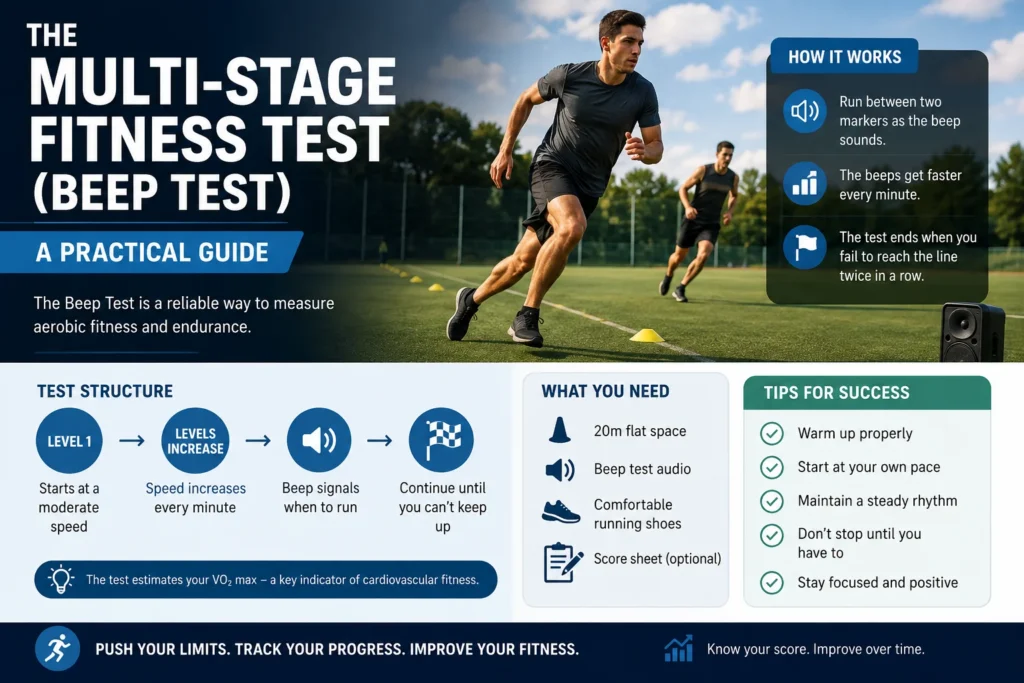
If you’ve ever stood on a gym floor waiting for three beeps to sound, you already know the feeling. Your stomach drops a little. Everyone lines up at the same cone, and for the next twenty-odd minutes, a recorded voice decides how hard you’re about to work.
The multi-stage fitness test, better known as the beep test, is one of the most widely used fitness assessments in the world. Schools use it. So do the police, the fire service, and most professional sports teams. But most people who’ve taken it don’t actually understand what it’s measuring, why the protocol has to be followed exactly, or how much their score can swing based on things that have nothing to do with fitness. This guide covers all of that: how the test works, how to run one properly, how scoring and VO2 max estimation actually work, and where the test falls short.
What Is the Multi-Stage Fitness Test?
The multi-stage fitness test (MSFT) is a running assessment used to estimate aerobic capacity, or VO2 max. <cite index=”1-1″>It requires participants to run 20 meters back and forth across a marked track in time with a series of beeps, and every minute the gap between beeps shrinks, forcing runners to speed up. </cite> Miss two turns and you’re done. Your final level and shuttle count become your score.
You’ll hear it called by several other names, and they all mean the same thing:
- Beep test or bleep test
- 20m shuttle run test
- PACER test (Progressive Aerobic Cardiovascular Endurance Run), the version used in US schools
<cite index=”3-1″>The test was originally built for adults in 1982 by Luc Léger and Jean Lambert, then adapted for children in 1988 by shortening each stage from two minutes to one. </cite> It caught on because it needs almost no equipment: a flat 20-meter space, cones, and an audio track.
How the Test Works, Step by Step
Setup matters more than most people realize. A track that’s even a meter short can throw scores off by a wide margin, which is why sloppy setups are one of the biggest sources of bad data in group testing.
- Mark two lines 20 meters apart. Use a proper tape measure, not paces. This is the single most common setup error.
- Line everyone up at the start line. Cones or tape work fine as markers.
- Play the audio. <cite index=”8-1″>Three beeps in a row signal the start of the test and each new level. </cite> A single beep marks the end of each shuttle.
- Run to the far line before the beep sounds, touch or cross it, then turn and run back.
- Keep pace as the beeps speed up. <cite index=”3-1″>The test runs across 23 levels, each lasting roughly a minute, starting at 8.5 km/h and increasing by 0.5 km/h every level. </cite>
- Get two warnings and you’re out. If you’re more than about a meter from the line when the beep sounds, that’s a warning. A second one ends your test.
- Record level and shuttle. Written as level. shuttle, so a score of 9.5 means level 9, five shuttles in.
That’s the whole protocol. What trips people up isn’t the running; it’s the discipline of testing everyone under identical conditions.
Scoring and What Your Level Actually Means
Your raw score is the level and shuttle you reached before you couldn’t keep up. On its own, that number tells you very little unless you convert it into something comparable, which is where VO2 max estimation comes in.
Coaches typically plug the final level into a prediction equation (there are several floating around, built by different researchers) to estimate VO₂ max in mL/kg/min. <cite index=”8-1″>A full run through all 21 levels covers a total distance of 4,940 meters and takes just over 22 minutes. </cite> Very few people get anywhere close to that. Most recreational athletes land somewhere between level 6 and level 11.
It’s worth being clear about what this number is and isn’t. It’s a field estimate, not a lab measurement. Treadmill VO2 max testing in an exercise physiology lab is still the gold standard. The beep test is a stand-in and a decent one but a stand-in nonetheless.
Who Actually Uses This Test
<cite index=”4-1″>The beep test shows up across military and emergency-service fitness standards, including the US Army, US Navy, and various police and fire departments, and it’s a fixture in high school and college sports programs where cardiovascular endurance matters, from soccer and rugby to basketball and hockey. </cite>
The appeal is obvious. You can test thirty people at once, cheaply, with equipment that fits in a bag. Compare that to lab-based VO2 max testing, which needs a treadmill, a metabolic cart, and a technician, and it’s easy to see why the beep test won.
How Reliable Is It, Really?
This is the part most guides skip, and it’s the part that matters if you’re relying on your score for anything important, like a job application or a training benchmark.
The test itself is consistent when conditions are controlled. Test-retest studies show a strong correlation between repeated attempts on the same person, meaning if you run it twice under the same setup, you’ll likely land close to the same level both times.
Where it gets shakier is accuracy against true lab-measured VO₂ max. <cite index=”10-1″>A study on collegiate women’s field hockey athletes compared beep test results against treadmill-measured VO2 max and tested six different prediction equations, finding that only two of them (the Ramsbottom and Flouris formulas) produced accurate estimates, while the others were off. </cite> Separate research on Sri Lankan national rowers found <cite index=”12-1″>the beep test consistently overestimated VO2 max compared to lab testing</cite>, echoing similar findings in other athlete populations.
There’s also a well-documented list of things that can quietly wreck your results without touching your actual fitness:
- Motivation and pacing strategy. Someone who paces smart will out-score someone who sprints early and burns out, even with identical cardio fitness.
- Turning technique. The 180-degree pivots add a small but real mechanical cost.
- Setup precision. <cite index=”7-1″>A track that’s off by just one meter can shift results by 10-20%. </cite>
- Sport specificity. <cite index=”7-1″>Because the run is continuous, it doesn’t map well onto intermittent sports like football or netball, where athletes sprint, stop, and change direction constantly. </cite>
- Weather, surface, and time of day, if you’re testing outdoors.
None of this means the test is useless. It means the number on the sheet is an estimate with a margin of error, not a precise physiological measurement, and it should be treated that way.
Common Mistakes That Skew Results
A few patterns show up again and again in group testing sessions:
- Measuring the track by eye instead of with a tape measure. Small errors compound over 20+ levels.
- Letting participants start too fast. The first few levels feel easy, so people sprint them, then fade hard once the pace catches up.
- Inconsistent warning enforcement. If one tester is lenient about the “two warnings” rule and another isn’t, scores across groups stop being comparable.
- Testing on an unfamiliar surface. Grass, indoor courts, and asphalt all change turn speed slightly.
- Ignoring recovery time before retesting. Fatigue from a prior session will tank a score that has nothing to do with declining fitness.
How to Improve Your Score
If you’re training toward a specific level, the honest answer is that beep test performance improves the same way general aerobic fitness improves: consistent interval work over weeks, not a clever trick the night before.
A few things that actually move the needle:
- Interval training that mimics the test’s structure. Short, progressively faster efforts with brief recovery build the exact energy system the beep test taxes.
- Practicing the turn. A clean, low, quick pivot saves fractions of a second on every shuttle, and those fractions add up over 20+ levels.
- Pacing discipline. Going out too hard in the first five levels is the single most common reason people underperform relative to their actual fitness.
- Running the actual test occasionally, not just simulated intervals, so your body and your head get used to the specific rhythm of the beeps.
The Bottom Line
The multi-stage fitness test earns its popularity honestly: it’s cheap, it’s fast for testing groups, and it gives a workable estimate of aerobic capacity without a lab. But it’s still an estimate. Setup precision, pacing strategy, and which prediction equation gets used all move the final number more than most people realize. Run it under consistent conditions, track your own level over time rather than chasing a universal benchmark, and treat the VO2 max figure as a useful guide rather than a lab-grade measurement.