
UK EV Charging Planning Reforms: What’s Changed and What’s Still Coming
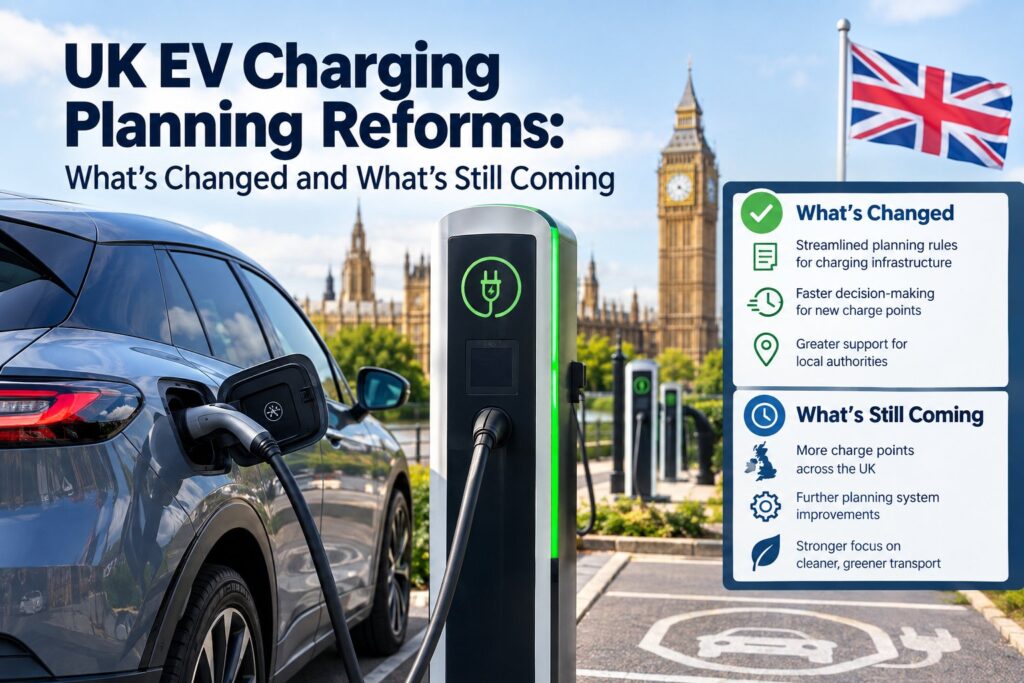
If you’ve tried to find a straight answer on whether you need planning permission for a home EV charger in the UK, you’ve probably hit a wall of contradictory blog posts. Some of that confusion is fair. The rules genuinely have moved twice in the last eighteen months, and a further round of changes has just been confirmed but hasn’t taken legal effect yet. Here’s where things actually stand.
Do you need planning permission for a home EV charger?
For most homeowners with off-street parking, no. Since 29 May 2025, installing a home EV chargepoint in England no longer requires a planning application or prior notification to the local council, provided the installation falls within permitted development rights under the Town and Country Planning (General Permitted Development) (England) Order 2015.
This removed a step that used to catch out anyone installing a charger close to the road: previously, you had to notify the council if the unit faced onto a highway. That distance restriction is gone. In practice, this means an electrician can usually fit and commission a driveway charger in a single visit, with no council paperwork in between.
That said, “permitted development” is not the same as “no rules at all.” Two separate classes of development right still set physical limits on what you can install.
The permitted development rules that still apply
Under Schedule 2, Part 2 of the GPDO, two categories cover most home chargers:
Class D (wall-mounted electrical outlets): the outlet and its casing must not exceed 0.2 cubic meters and must not sit within a scheduled monument or the curtilage of a listed building.
Class E (freestanding upstands): the unit must not exceed 2.7 metres in height, measured from the parking surface.
Neither right applies if your property is a listed building or within a scheduled monument site. Conservation areas, national parks, World Heritage Sites, and similar designated land are treated differently: permitted development still applies there, though a council could ask you to consider the visual impact if the installation would be unusually prominent. If you’re at all unsure, a quick call to your local planning authority before work starts is still worth doing, since removing a chargepoint installed without the right approval can cost far more than the five-minute phone call.
None of this covers on-street parking. If your car sits on the road rather than a driveway, permitted development rights don’t reach that far, which is exactly the gap the newest reforms are trying to close.
What’s new: the September 2026 government response
In November 2025, the Department for Transport opened a consultation asking whether permitted development rights should be extended further in two specific areas. That consultation closed in January 2026, and the government published its response on 11 September 2026. Two changes were confirmed.
Bigger equipment housing for workplace and public charging hubs
Larger chargepoints need supporting equipment, transformers, control units, and sometimes battery storage, housed in cabinets near the charger. The existing rule allowed one such cabinet, capped at 29 cubic meters, at least 5 meters from a highway and 10 meters from any home. The government has now confirmed it will raise the cumulative volume allowed for this equipment from 29 to 45 cubic meters and permit multiple housing units rather than just one. This is aimed squarely at operators building bigger, high-powered charging hubs in car parks and workplaces, not at individual homeowners.
A new right for cross-pavement charging
This is the change that matters most if you don’t have a driveway. Roughly a third of UK households have no off-street parking, and for them, home charging has meant running a cable across the pavement, something that currently needs up to three separate permissions: highway consent to lay a cable under the Highways Act 1980, a standalone planning application for the cross-pavement solution itself, and separate street works permissions.
The government has now confirmed it will create a new permitted development right specifically for cross-pavement charging solutions and the associated home chargepoint. This removes the planning application step. The highway authority consent and street works permissions stay in place since councils still need to manage pavement safety and accessibility, particularly for pedestrians with visual or mobility impairments. But cutting out the separate planning application is meant to make the process faster and cheaper for the millions of drivers currently locked out of affordable home charging.
Important: this is confirmed, not yet in force.
Here’s the detail most coverage glosses over. A government response confirming a policy direction is not the same as a change in the law. These new rights still require secondary legislation amending the GPDO, and that legislation is expected to be laid before Parliament in autumn 2026, subject to parliamentary time. Until it’s made and commenced, the current rules, including the requirement for a separate planning application for cross-pavement solutions, remain in force. Anyone planning a cross-pavement installation now should check the current requirements with their local highway authority rather than assume the new right already applies.
If you’re a renter or live in a flat
None of the permitted development changes above alter your position if you’re renting or living in a leasehold flat. You’ll still need written consent from your landlord or freeholder, sometimes called a license to alter, before any charger can be installed, since this is a matter of property law rather than planning law. Shared electrical supplies and communal parking can also complicate installation in blocks of flats. It’s worth asking early, since some landlords and management companies now have standard processes for this given how common the request has become.
Scotland, Wales, and Northern Ireland
All of the reforms described here apply to England only. The GPDO is English planning legislation, and planning policy for EV charging is devolved. Scotland, Wales, and Northern Ireland set their own permitted development rules, and while some mirror England’s approach, none are bound to adopt these specific changes. If you’re outside England, check with your own devolved planning authority rather than assuming these rules apply to you.







1 thought on “UK EV Charging Planning Reforms: What’s Changed and What’s Still Coming”