
Application Service Providers (ASP): Definition, History, and How They Worked
If you’ve stumbled across the term “application service provider” in an old IT textbook or a legacy vendor contract, you might be wondering whether it’s just another name for cloud software. It’s related, but not quite the same thing.
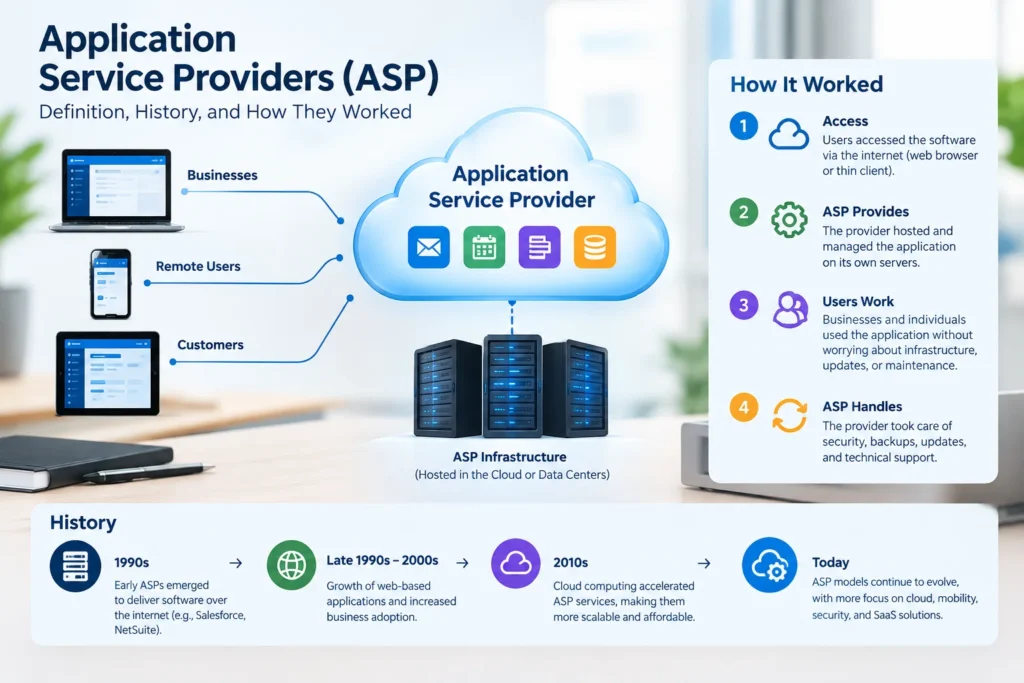
An application service provider, or ASP, is a company that hosts software on its own servers and delivers it to customers over the internet, usually for a subscription or usage fee. Instead of buying software and running it on your own machines, you rented access to it. The idea sounds familiar today because it’s essentially the model that Software as a Service (SaaS) grew out of.
Here’s the short version: ASP was the term for hosted software from roughly the late 1990s through the mid-2000s. Most of the companies that used it either failed, got acquired, or rebranded as SaaS providers once broadband, browsers, and multi-tenant architecture matured. Understanding what an ASP actually was helps explain why SaaS looks the way it does now.
What Is an Application Service Provider?
An application service provider is a business that owns, hosts, and maintains application software on its own infrastructure, then delivers that software to clients over a network, typically the internet. The customer doesn’t install anything locally beyond a browser or a thin client. The ASP handles the servers, the updates, the backups, and usually the support.
A few defining traits separate an ASP from a plain web host or a software vendor:
- The ASP owns and operates the servers running the application, not the customer.
- Access happens over the internet or a private network, often through a browser or lightweight client software.
- Billing is usually per-use, monthly, annual, or based on labor hours rather than a one-time license purchase.
- Each customer typically gets a dedicated, single-tenant environment rather than sharing infrastructure with other clients.
That last point is one of the biggest technical differences between the old ASP model and modern SaaS. According to the Encyclopedia of Information Systems, an ASP deploys, hosts, and manages standardized applications from a remote facility, letting clients purchase access without owning or customizing the underlying software themselves.
A Brief History: Where the ASP Model Came From
The concept took off in the late 1990s, when broadband adoption and centralized computing started looking attractive again after decades of businesses moving software onto individual PCs. Small and mid-sized companies without the budget for their own IT departments were the main audience, along with larger organizations testing the waters on outsourcing infrastructure.
In 1999, Hewlett-Packard, SAP, and Qwest Communications formed the Application Service Provider Industry Consortium to promote the model, and Microsoft began letting partners rent out products like Exchange and SQL Server on a pay-as-you-go basis. Early ASPs marketed themselves around the phrase “apps on tap,” a pitch that a small business could get enterprise-grade software without buying servers or hiring a systems administrator.
The market didn’t hold up well. Many first-generation ASPs offered single-tenant hosting that didn’t scale efficiently, so costs stayed high even as customer counts grew. A wave of ASPs shut down or got absorbed by larger players in the early 2000s. The survivors mostly pivoted, rebranding as managed service providers or building the multi-tenant, browser-based platforms that we now just call SaaS.
How the ASP Model Actually Worked
In a typical ASP arrangement, the customer would purchase or license the software itself, then pay the ASP separately to host, run, and maintain it. The provider handled the server infrastructure, security patches, uptime, and technical support, often under a service-level agreement with specific performance guarantees.
Delivery happened in one of two ways: through a standard web browser or through special client software that connected to the ASP’s servers via an API or proprietary protocol. Because most ASPs ran single-tenant environments, each customer effectively got its own isolated copy of the application, which added a layer of security but also meant the provider couldn’t spread infrastructure costs across its full customer base the way a multi-tenant system can.
Types of Application Service Providers
Not all ASPs served the same market. The industry generally split into a handful of categories:
- Local or regional ASPs: Focused on businesses within a specific geographic area, often offering hands-on support.
- Specialist ASPs: Delivered one type of application, such as medical billing or e-commerce management software.
- Vertical market ASPs: Built for a particular industry, like legal practices or healthcare providers.
- Enterprise ASPs: Hosted large-scale business applications, including early ERP systems, for bigger organizations.
- Volume ASPs: Offered a low-cost, prepackaged bundle of applications aimed at small businesses.
ASP vs. SaaS: What Actually Changed
People still use “ASP” and “SaaS” interchangeably sometimes, but the architecture underneath is different, and that difference explains why SaaS won out.
Traditional ASPs relied on single-tenant infrastructure: one dedicated environment per customer, often requiring client-side software to be installed locally. SaaS providers, by contrast, generally build multi-tenant applications, where one codebase and one set of servers serve many customers at once, each accessed through a browser with no local installation required.
That architectural shift is what let SaaS providers finally get the economies of scale that ASPs never really achieved. It’s also why SaaS pricing tends to be far more predictable and affordable than what early ASP customers paid. In short: the promise of ASPs was right, but the underlying technology and business model needed another decade to catch up.
Advantages and Disadvantages of the ASP Model
Advantages:
- Lower upfront costs. Customers avoided the capital expense of buying servers or hiring a large internal IT team.
- Faster deployment. Since the application was already running on the provider’s infrastructure, rollout was quicker than an on-premises install.
- Managed upgrades. The ASP handled patching and version updates as part of the service contract.
- Tailored service agreements. SLAs could be customized to a specific client’s needs.
Disadvantages:
- Limited economies of scale. Single-tenant environments meant costs didn’t drop much as the ASP added more customers.
- Perceived security risk. Many small and mid-sized ASP customers ran on shared virtual servers rather than dedicated hardware, which raised (sometimes overstated) security concerns.
- Integration gaps. Early ASP offerings often didn’t connect well with a customer’s existing legacy systems.
Real-World Examples of Early ASPs
A handful of companies illustrate how the ASP model played out, for better or worse:
- Corio, founded in 1998, hosted a suite of enterprise applications before IBM acquired it in 2005.
- DoubleClick provided hosted ad-serving tools starting in 1995 and was later bought by Google in 2008.
- Pandesic, a joint venture between SAP and Intel formed in 1997, offered hosted e-commerce management software but shut down by mid-2000.
- Salesforce, in its earliest years, operated closer to the ASP model before evolving into the SaaS company most people know today.
Is the ASP Model Still Used Today?
Not in any meaningful volume. The term itself has mostly fallen out of active use, replaced almost entirely by SaaS, platform as a service (PaaS), and managed service provider (MSP) terminology. Occasionally, a business will still look for something closer to the old ASP arrangement when it needs a highly customized, single-tenant hosted application rather than a shared, off-the-shelf SaaS product, but that’s now the exception rather than the rule.







1 thought on “Application Service Providers (ASP): Definition, History, and How They Worked”