Can Lasers Really Push a Tiny Probe to Alpha Centauri?
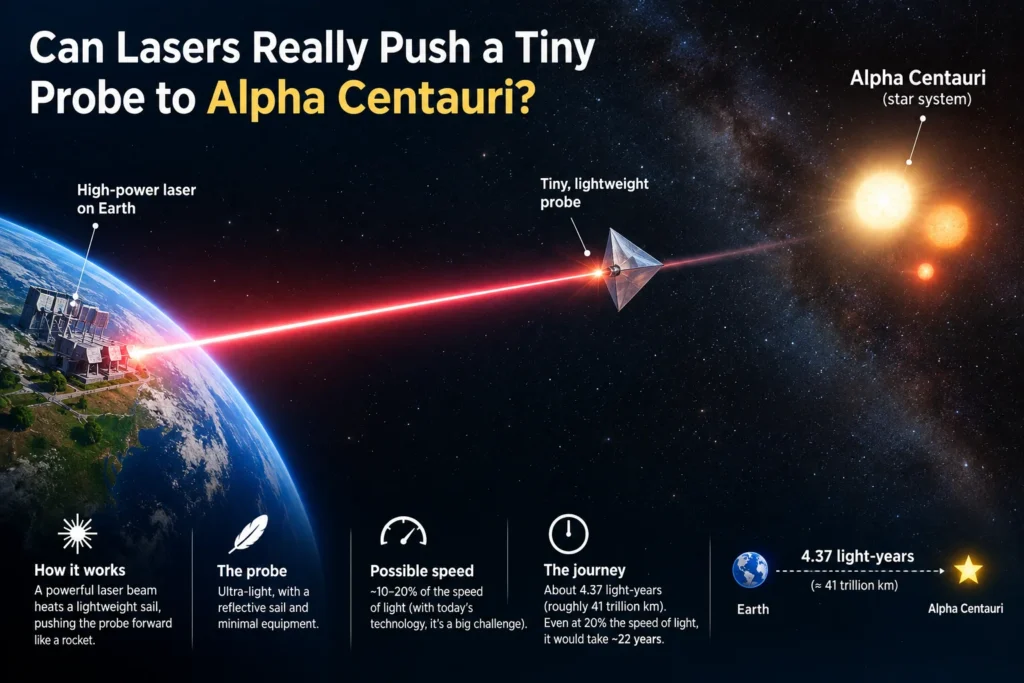
Alpha Centauri sits about 4.37 light-years away, roughly 41 trillion kilometers. A probe on a conventional rocket would need tens of thousands of years to cover that gap; Penn engineers put it near 80,000. So researchers flipped the question. What if the spacecraft carried no fuel at all?
That’s the thinking behind the Alpha Centauri laser propulsion study work tied to Breakthrough Starshot. Different teams have tackled different pieces. Here’s what each found and what still doesn’t work.
How does laser propulsion work?
Starshot launched in 2016 with $100 million behind it. The plan: microchip-size probes, each attached to a thin reflective sail, and a giant ground-based laser array aimed at them. Light has no mass, but it does carry momentum, so photons bouncing off a mirror push it forward.
Pushed hard enough, a sail could reach about 20 percent of light speed and arrive in roughly 20 years. That takes an array near 100 gigawatts, which the Caltech team behind the sail research described as the biggest laser ever built by a wide margin.
Why skip fuel? Fuel weighs something, and carrying more fuel needs even more fuel to haul it. The problem snowballs. A sail leaves the engine back on Earth.
What the key studies found
The laser array (ANU, 2021)
Australian National University researchers published a design in the Journal of the Optical Society of America. B. It links roughly 100 million lasers so they behave as one. Coordination is the hard part, because each laser drifts. The team scrambles every measurement with a random digital signal, then separates them afterward. A guide laser on an orbiting satellite maps atmospheric distortion so the ground beams can be corrected. Next, the team plans lab tests of small arrays, so this remains a paper design.
Keeping the sail on the beam (Harvard, 2017)
Zachary Manchester and Avi Loeb showed that a cone-shaped sail on a single Gaussian beam isn’t stable. One small nudge and it slides off. Their fix was a spherical shell sail riding a beam built from four Gaussians, which pushes a drifting sail back toward center. In simulations it stayed centered for several minutes, long enough to accelerate. Simulation, though. Not flight.
The sail material (Caltech, 2018)
Harry Atwater’s team, writing in Nature Materials, sized each sail at about 10 square meters and under one gram, which works out to roughly 100 atoms thick. No known material has the full property set. Gold and silver reflect near-infrared light well but absorb too much heat. Crystalline silicon and molybdenum disulfide come closer, and hexagonal hole patterns could trim weight. Dust would likely be survivable: around a billion particles would punch holes totaling under 0.1 percent of the sail.
Surviving the push (Penn, 2022)
Igor Bargatin and Deep Jariwala at Penn, publishing in Nano Letters, focused on sail shape and composition. The beam would hit with an intensity millions of times greater than sunlight, so the wrong design melts or tears.
A heavier alternative (Andromeda Study)
Andreas Hein and colleagues sketched a 23-gram probe pushed by a 15-gigawatt beam to 0.1c, a 50-year trip. Slower, but far lower beam power.
What’s still unsolved
Honestly? Every result above is a design, a simulation, or a roadmap. I’m not an optics engineer, so treat this as a reader’s judgment, but the sail looks like the hardest piece to me. A huge laser array is a brutal engineering job. A sail under one gram that survives that beam is a materials problem nobody has solved.
There’s also the flyby issue. The probe wouldn’t stop at Alpha Centauri; it would record images and measurements as it passed, then send them home. And a University of California study points to a nearer payoff: modest arrays of 100 kilowatts to 10 megawatts could make laser propulsion practical for small craft around our solar system.