
How to Play Word Whomp and Actually Win
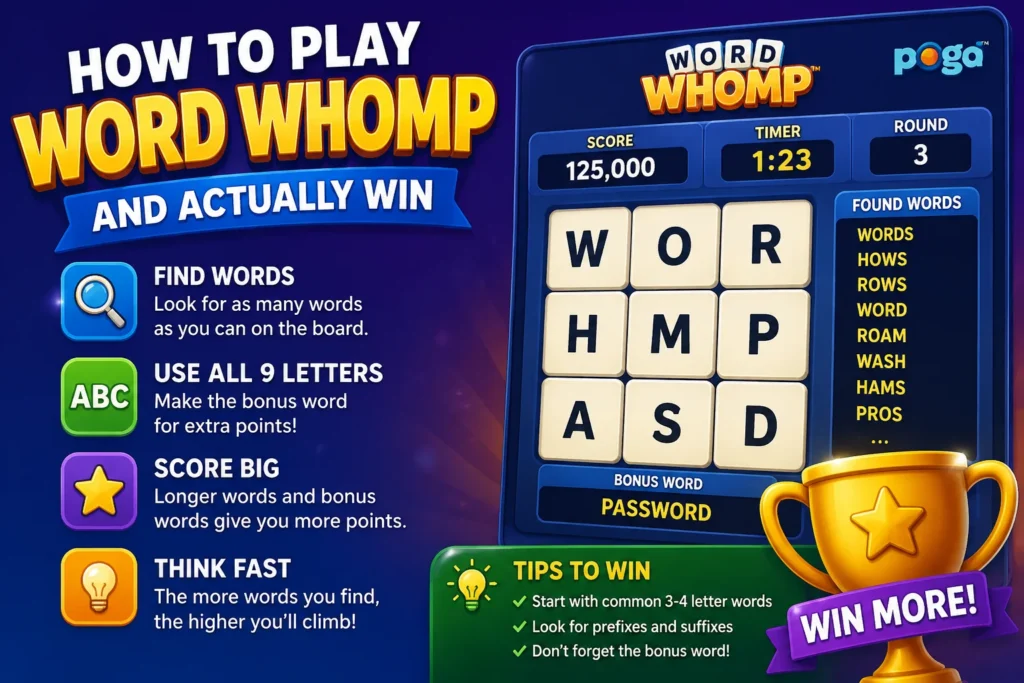
You’ve got six letters, a two-minute-twenty-second clock, and a small mole waiting for you to prove yourself. That’s Word Whomp in a nutshell, and it’s a lot harder than it looks the first time you play.
Word Whomp is a browser word game from Pogo, the online gaming site owned by Electronic Arts. The idea is simple: build as many valid words as you can from a set of six letters before time runs out. Simple rules, real challenge. Here’s what you need to know to play well, along with the strategies that actually move your score.
What Is Word Whomp?
Word Whomp is an anagram-style puzzle game. Each round gives you six letters arranged on tiles. Your job is to rearrange them into real words of three letters or more, click or type them out, and submit before the timer hits zero.
It plays a lot like Boggle or the New York Times’ Spelling Bee, minus the grid and the required center letter. There’s no penalty for guessing wrong, so the only real cost is time.
Pogo has run Word Whomp for years as part of its library of more than 50 casual games. You can play it logged into a free Pogo account, which saves your scores and unlocks community features, or as a guest if you’d rather skip the sign-up.
The Basic Rules
Every round of Word Whomp follows the same setup:
- You get exactly six letters per round.
- Words must be at least three letters long.
- You have two minutes and twenty seconds to find as many words as possible.
- Letters can be rearranged and reused within a single guess, but you’re limited to the tiles you’re given.
- Wrong guesses cost you nothing but a few seconds.
That last point matters more than most players realize. Since there’s no penalty for an incorrect word, hesitation is your real enemy, not accuracy.
How to Play Word Whomp: Step by Step
1. Scan for short words first. The moment the round starts, look for three- and four-letter combinations. They’re the easiest to spot, and they get points on the board fast, which also builds momentum for spotting longer words.
2. Shuffle when you’re stuck. Most versions include a “mix” or shuffle button. Use it often. Seeing the same six letters in a new arrangement can jolt your brain into noticing a word you walked right past.
3. Test your hunches. If a word feels plausible, type it. There’s no downside to a wrong guess, so guessing is basically free information.
4. Check for plurals and simple endings. If your letter set includes an “s,” go back through your solved words and see which ones can take an “s” on the end. It’s an easy way to pick up extra points you might otherwise miss.
5. Watch the word count, not just the clock. Most versions show how many words are left to find. That number tells you whether to keep hunting for something obscure or move on, since not every level has a six-letter bonus word waiting to be found.
6. Save the six-letter word for last, but don’t ignore it. Every round has one word that uses all six letters, and it’s usually worth a large bonus. Keep it in the back of your mind while you clear smaller words. Sometimes solving three-letter words reveals patterns that make the full word obvious.
Common Mistakes That Cost Points
A few habits quietly drain scores, even for people who know a lot of words:
- Staring at the letters without shuffling. Your eyes get anchored on one arrangement and stop seeing new combinations.
- Chasing the long word too early. It burns time you could spend banking three or four smaller words.
- Second-guessing valid words. If you think it’s real, type it. Checking a dictionary in your head wastes seconds you don’t get back.
- Playing on a phone when a laptop is available. A keyboard is faster than tapping letter tiles, and most versions were built with a desktop layout in mind.
Why Word Whomp Is Worth Your Time
Beyond the fun of it, games like this double as light mental exercise. Research from the University of Exeter and King’s College London followed a large group of adults through their PROTECT cognitive health platform and found that people who did word puzzles regularly scored notably higher on tests of grammatical reasoning and short-term memory, performing closer to people 8 to 10 years younger. That doesn’t mean five minutes of Word Whomp will transform your memory, but it’s a reasonable argument for choosing a word game over a scroll through your phone when you’ve got a few spare minutes.
Word Whomp also rewards the kind of pattern recognition that carries over to other anagram games, Scrabble, and even crossword solving. The more you play, the faster you’ll spot hidden words in a jumble of letters.








1 thought on “How to Play Word Whomp and Actually Win”