
What Is Creditspring? How the Membership Loan Model Works
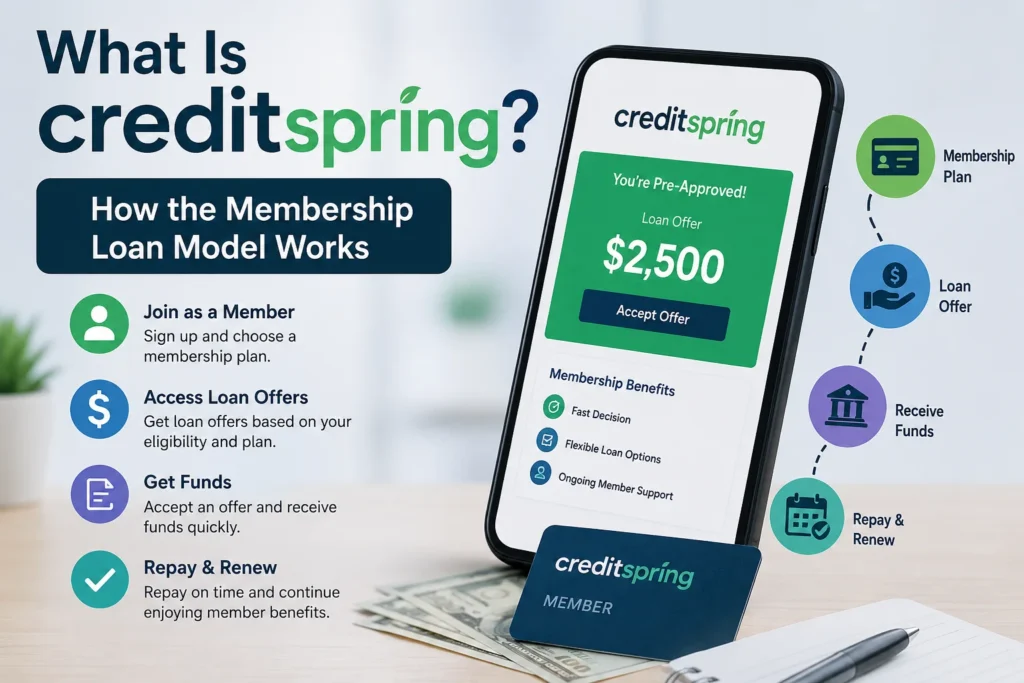
If you’ve searched “Credit Spring” and landed here still unsure whether it’s a loan, a subscription, or something in between, that confusion is fair. It’s genuinely a different setup than a normal loan or credit card, and understanding the mechanics matters before you sign up for anything with your bank details attached.
Here’s the short version: Creditspring is a UK, FCA-regulated lender that swaps interest charges for a fixed monthly membership fee. Pay the fee, and you get access to up to two interest-free advances a year. No interest doesn’t mean no cost, though, and that distinction is where most people get tripped up.
What Is Creditspring, Exactly?
Creditspring is the trading name of Inclusive Finance Limited, a London-based company authorized and regulated by the Financial Conduct Authority. Instead of charging interest on the money you borrow, it charges a flat membership fee, similar to a gym membership or a streaming subscription, and that fee is what covers the cost of borrowing.
As a member, you get access to two no-interest advances per year, each repaid over six monthly installments. Every on-time repayment is reported to UK credit reference agencies, so consistent payments can help build your credit history over time (though, as with any lender, other factors also affect your score).
The company tracks your account through something it calls the Spring Score, an internal monitoring system that follows your repayment behavior and informs you whether you’re offered a higher membership tier when you renew.
How Does Creditspring Work, Step by Step?
The process runs in a few clear stages:
- Apply for membership. You fill out an application, and Creditspring runs a soft credit check, which won’t affect your credit file, to work out which membership tier fits your situation.
- Get approved and choose a tier. Membership levels (typically named things like Step, Core, Plus, and Extra) come with different fixed monthly fees and different maximum advance amounts, generally ranging from around £200 up to £1,200 per advance.
- Wait out the cooling-off period. New members serve a 14-day cooling-off period before drawing their first advance. This is a deliberate friction point designed to slow down impulsive borrowing.
- Draw your first advance. Once the wait is over, you can access your first interest-free advance.
- Repay in six installments. Each advance is repaid over six monthly payments, with the first installment due roughly six weeks after you draw the funds.
- Draw your second advance. After the first is fully repaid, you can access a second advance within the same membership year.
- Renew or step down. At renewal, your Spring Score and repayment history determine whether you’re offered the same tier, a higher one, or asked to step down.
There’s also a free membership tier that doesn’t include loan access but still gives you monthly eligibility checks and Spring Score monitoring, which is which is useful if you just want to track your position before committing to a paid tier.
What Does Creditspring Actually Cost?
This is the part worth reading slowly. “Interest-free” describes the advances, not the overall product. You’re still paying, just through the membership fee rather than an interest rate line item.
Based on the lender’s published examples, a typical £400 advance (two £200 draws across a year) carries a representative APR in the region of 48% to 66%, once the membership fee is factored into the total cost of credit. On a £2,400 credit line (two £1,200 advances), the total repayable can run to roughly £2,712 across 12 months. Exact figures depend on your tier and current pricing, so treat any number here as illustrative rather than a quote, and check the live figures on Creditspring’s site before applying.
A quirk to know about: the membership fee is typically charged whether or not you end up drawing a loan, and it keeps being charged if you’re later declined for an advance. That’s a common thread across independent customer reviews, and it’s worth weighing before you commit.
Who’s Eligible for Creditspring?
Eligibility criteria are fairly standard for UK short-term credit:
- You’re a UK resident aged 18 or over
- You have a regular income sufficient to cover the membership fee and repayments
- You hold a UK bank account that can process direct debits
- You pass the soft credit and affordability check at application
None of this guarantees approval. Affordability checks exist precisely to catch situations where repayments wouldn’t be sustainable, and Creditspring, like any FCA-regulated lender, is required to lend responsibly.
Creditspring: Pros and Cons
What tends to work in its favor:
- No traditional interest charges, so costs are predictable and fixed upfront
- On-time repayments are reported to credit agencies, which can support a thin or recovering credit file
- The 14-day cooling-off period discourages impulsive borrowing
- Strong customer satisfaction scores on independent review platforms, with a high Trustpilot rating across tens of thousands of reviews
- FCA regulation means standard consumer protections apply
Where it’s worth pausing:
- The representative APR, once the fee is included, is still high relative to a 0% credit card or a credit union loan
- The membership fee is charged even if you don’t draw an advance or if a later advance is refused
- It’s a more expensive way to borrow than mainstream credit for anyone who qualifies for cheaper options
- It’s still, functionally, a form of high-cost short-term credit, just structured differently from a payday loan
Creditspring vs. the Alternatives
Before applying, it’s worth lining Creditspring up against the other options available to you:
- Credit unions often offer lower-cost loans to members, though approval can take longer and membership eligibility varies by region.
- 0% purchase or balance transfer credit cards can be cheaper if you have the credit history to qualify and can clear the balance within the promotional window.
- Payday loans are generally more expensive and carry a worse reputation for debt cycles; Creditspring is usually positioned as a step up from this category.
- Credit builder cards (low limit, designed for score-building) suit people who want to build history without borrowing a lump sum at all.
If you’re already in financial difficulty, free debt advice from a service like MoneyHelper or StepChange is worth exploring before taking on any new credit commitment, paid membership fee, or otherwise.