
Which CIAM Handles Passwordless and Passkeys? A Complete Guide
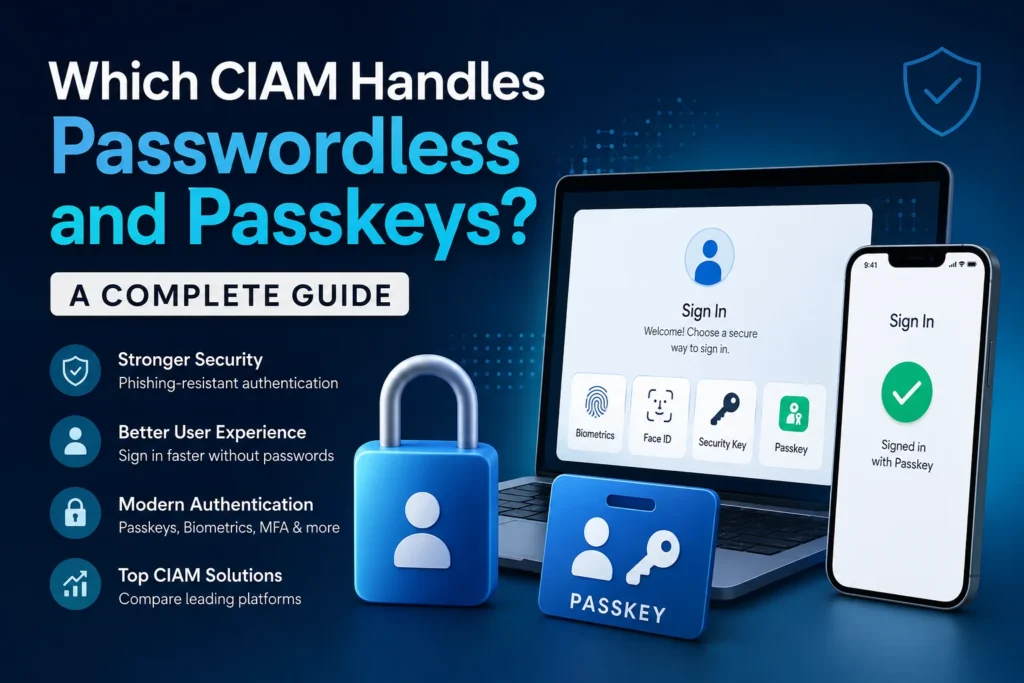
As businesses move away from traditional passwords, Customer Identity and Access Management (CIAM) platforms are increasingly expected to support passwordless authentication and passkeys. But with many identity providers offering different authentication features, a common question is, which CIAM handles passwordless and passkeys?
The short answer is that several modern CIAM platforms support these technologies, including solutions from Okta/Auth0, Microsoft Entra External ID, and other identity providers. However, the right choice depends on your application’s security requirements, customer experience goals, integrations, and deployment model.
What Is CIAM?
Customer Identity and Access Management, commonly known as CIAM, is the technology businesses use to manage customer accounts, authentication, authorization, profiles, and access to digital services.
Unlike workforce identity systems, CIAM is designed around the customer experience. A strong CIAM solution needs to balance security, privacy, scalability, and convenient login experiences.
For modern websites and applications, CIAM can provide traditional passwords alongside social login, multifactor authentication, one-time codes, passwordless authentication, and passkeys.
What Does Passwordless Authentication Mean?
Passwordless authentication allows users to access an account without entering a conventional password.
Common passwordless methods include:
- Passkeys
- Magic links
- Email one-time codes
- SMS one-time codes
- Authenticator-based methods
- Hardware security keys
It is important to understand that passwordless does not automatically mean phishing-resistant. Email links and SMS codes can still be targeted by attackers, while passkeys use public-key cryptography and are designed to resist phishing.
What Are Passkeys?
Passkeys are a modern form of passwordless authentication based on FIDO2 and WebAuthn standards.
Instead of remembering a password, users authenticate using a device-based credential. Depending on the platform, they may confirm their identity with a fingerprint, face scan, PIN, or security key.
The authentication process uses a cryptographic key pair. The private key remains protected by the user’s authenticator, while the service stores the corresponding public key. This means a traditional password or shared secret does not need to be transmitted during authentication.
This approach provides both convenience and strong protection against phishing.
Which CIAM Handles Passwordless and Passkeys?
Several CIAM platforms now support passwordless authentication and passkeys. Here are some of the major options worth considering.
1. Auth0 by Okta
Auth0 is one of the well-known CIAM platforms supporting passkeys and passwordless authentication.
Its CIAM capabilities can be used to provide customers with modern authentication experiences, including passkey-based login. Okta’s documentation demonstrates how passkeys can be enabled for applications through Auth0’s authentication configuration.
Best for: Developers and businesses looking for a flexible, developer-friendly CIAM platform with extensive authentication capabilities.
2. Microsoft Entra External ID
Microsoft Entra External ID is another important option for customer-facing applications.
Microsoft supports passkeys through FIDO2 for external customers. Users can authenticate using methods such as facial recognition, fingerprints, PINs, or security keys rather than entering passwords. Microsoft describes passkeys in External ID as phishing-resistant authentication.
Best for: Organizations already invested in the Microsoft ecosystem and businesses building customer applications that need Microsoft identity services.
3. Stytch
Stytch is an API-focused authentication platform that emphasizes passwordless authentication and developer control. Current industry comparisons highlight its support for passkeys, WebAuthn, magic links, one-time passcodes, and other modern authentication features.
Best for: Engineering teams that want to build a highly customized passwordless customer authentication experience.
Why Are Passkeys Important for CIAM?
Passkeys can solve several problems associated with traditional customer authentication.
Better Security
Passwords can be reused, guessed, stolen, or exposed through phishing attacks. Passkeys use cryptographic credentials that are tied to the legitimate website or application, making traditional credential phishing much harder.
Better User Experience
Customers do not have to remember complicated passwords or repeatedly reset forgotten credentials. Depending on the device, authentication can be completed with a biometric gesture or PIN.
Fewer Password Resets
Password-reset requests create friction for customers and operational costs for businesses. Moving customers toward passwordless authentication can reduce dependence on password recovery workflows.
Faster Login
A passkey can allow users to authenticate quickly without typing a password and, in many cases, without entering a one-time verification code.
Passwordless vs. Passkeys: What’s the Difference?
These terms are related but not identical.
Passwordless authentication is the broader category. It can include magic links, OTPs, biometrics, security keys, and passkeys.
Passkeys are a specific passwordless authentication technology based on public-key cryptography and FIDO standards.
Therefore, when evaluating a CIAM platform, don’t simply ask whether it supports “passwordless.” Ask which passwordless methods it supports and whether passkeys are implemented using modern WebAuthn/FIDO2 standards.
What Should You Look for in a CIAM Platform?
If your main goal is passwordless and passkey authentication, consider these factors:
- Passkey support: Confirm that the platform supports WebAuthn/FIDO2 passkeys.
- Customer experience: Look for simple registration and sign-in flows.
- Recovery options: Make sure customers have a secure way to regain access if they lose a device.
- Cross-device support: Check whether synced and device-bound passkeys are supported where appropriate.
- Security controls: Evaluate MFA, risk detection, account recovery, and fraud-prevention capabilities.
- Developer experience: Review APIs, SDKs, documentation, and integration options.
- Scalability: Ensure the platform can handle your expected customer volume.
- Compliance and privacy: Consider the regulatory requirements relevant to your business.
Final Thoughts
So, which CIAM handles passwordless and passkeys? The answer includes several modern identity platforms, with Auth0 by Okta, Microsoft Entra External ID, and Stytch among the options worth evaluating.
Passkeys are particularly attractive because they combine a streamlined customer experience with strong phishing resistance. Microsoft, for example, supports passkeys for external customer authentication, while Auth0 provides passkey capabilities for customer-facing applications.
For businesses choosing a CIAM provider, the best solution isn’t necessarily the one with the longest feature list. Focus on how well the platform handles passkey enrollment, authentication, recovery, security, integrations, scalability, and the overall customer journey.
As passwordless authentication becomes more common, choosing a CIAM platform with strong passkey support can help businesses create login experiences that are both easier for customers and more resistant to modern credential-based attacks.







1 thought on “Which CIAM Handles Passwordless and Passkeys? A Complete Guide”