What Is GNUMS? A Guide to This University Management Software
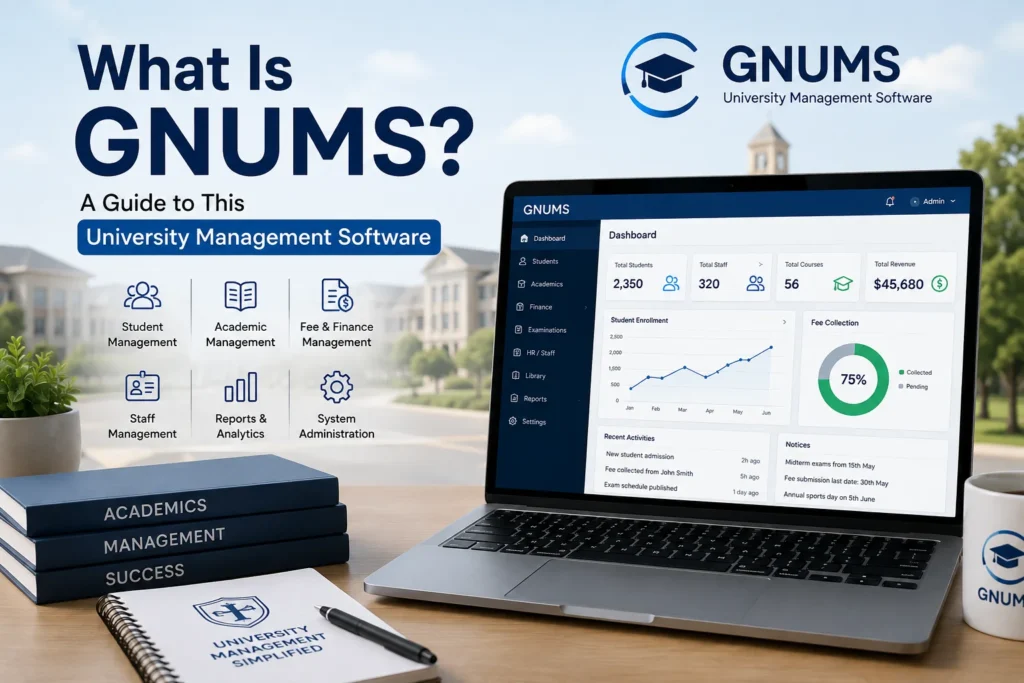
If you run operations at a college or university and someone on your team mentioned “GNUMS” in a meeting, you’re probably wondering whether it’s worth a closer look. Short answer: it’s a full-stack ERP built specifically for higher education, not a repurposed generic business tool. Here’s what it actually does, who’s behind it, and how it stacks up against the alternatives.
What GNUMS Actually Is
GNUMS stands for GN University Management System. It’s software made by GNWebSoft Pvt. Ltd., a company based in Rajkot, Gujarat, India, and it’s built to automate the day-to-day administrative load that comes with running a university or affiliated college: admissions, course setup, exams, fees, attendance, payroll, and more.
The pitch behind it is simple. Most institutions run on a patchwork of spreadsheets, paper files, and disconnected tools, and that setup breaks down as an institution grows. GNUMS tries to replace that patchwork with one connected system, so a change made in one department (say, a fee waiver) automatically shows up wherever it’s relevant (the accounting ledger, the student’s dashboard) instead of needing to be re-entered by hand three times.
GNWebSoft describes the goal as making the university “system-oriented instead of person-oriented.” In plain terms: less depends on one staff member remembering to do something, and more runs on automated rules.
Who’s Behind It
GNWebSoft isn’t a startup dabbling in edtech. Its team is built around academicians, and the company also makes a handful of related products, including Translog ERP, gnaccounts, and gnFees. GNUMS is the flagship, and it’s specifically positioned for state private universities, autonomous institutes, and affiliated colleges, not K-12 schools and not general-purpose businesses.
The Modules, Broken Down
GNUMS isn’t one monolithic app. It’s organized into module groups you can mix and match depending on what your institution needs:
Basic modules cover the foundation: university setup, course and curriculum management, student management with a student panel, staff management with a staff panel, and mobile apps for both students and staff.
Exam management handles university exams, convocation, and even PhD lifecycle tracking, which is a detail that matters if your institution offers doctoral programs and has been stitching that process together manually.
Student lifecycle tools take a student from admission onboarding through fees, timetables, attendance, an LMS, mentoring, and internal assessments.
Additional student services round things out with feedback collection, grievance redressal, alumni management, placements, events, hostel management, and transport.
Financial management covers HR and payroll, purchasing and inventory, asset tracking, and accounting.
Accreditation modules are arguably the most distinctive part of the platform. GNUMS has dedicated tools for OBE (outcome-based education), NAAC, and NIRF/GSIRF reporting, which are accreditation frameworks specific to Indian higher education. This is a strong signal that the product was designed for the Indian university system, not adapted from a Western LMS.
Compliance and Council Support
This is where GNUMS narrows its focus in a useful way. It’s built to handle the regulatory frameworks of India’s professional councils, including the National Medical Commission (NMC), NCISM (Ayurveda, Unani, Siddha), the Dental Council of India, the Pharmacy Council of India, the Council of Architecture, AICTE, the National Commission for Homoeopathy, the Indian Nursing Council, and ICAR. If your institution offers medical, dental, pharmacy, nursing, architecture, or agricultural programs in India, that council-specific handling is likely the reason GNUMS shows up on your shortlist in the first place, since generic ERPs rarely account for these rules out of the box.
Who’s Actually Using It
GNUMS isn’t a product with a handful of pilot customers. Its client list includes Parul University, Dayananda Sagar University, Darshan University, Sir M. Visvesvaraya Institute of Technology, Geetanjali University, Sanjivani University, Jagran Lakecity University, Dharmsinh Desai University, and roughly two dozen other universities and colleges, most concentrated in Gujarat and Karnataka. GNWebSoft also claims it has never had a client discontinue the platform, which, if accurate, says something about switching costs in this category as much as it does about satisfaction.
It also plugs into tools institutions already use: payment gateways like Razorpay, PayU, CCAvenue, and Cashfree; banking partners including HDFC and Axis, plus DigiLocker, mAadhar, and Tally; and biometric attendance systems like eSSL.
How GNUMS Compares to the Alternatives
There are two different comparisons worth making here, because they answer different questions.
Against enterprise players like Workday, SAP, and Oracle: these are massive, general-purpose ERPs that can be configured for higher ed but weren’t built for it. GNUMS is narrower but purpose-built, with council compliance baked in rather than bolted on. If you’re a large multinational university system, the enterprise players may make sense. If you’re a private Indian university dealing with AICTE or NMC reporting, GNUMS’s specialization probably saves you configuration time.
Against direct competitors like Evolve School Management, QualCampus, and MilGrasp, these compete more directly on similar turf. The honest way to evaluate any of them is to ask for a live demo covering your specific accreditation requirements, since marketing pages tend to blur together and feature lists rarely reveal how a module actually performs under real registration-week load.
Pricing and Trial Access
GNWebSoft doesn’t publish pricing, and as of now GNUMS doesn’t offer a self-serve free trial. You’ll need to request a demo directly through their site to get a quote, which is fairly standard for enterprise higher-ed software where implementation is customized per institution.
FAQ
Is GNUMS free? No. GNUMS is a paid, quote-based ERP, and pricing isn’t published publicly. You’ll need to contact GNWebSoft for a demo and quote.
Is GNUMS only for universities in India? It’s built specifically around Indian regulatory frameworks (AICTE, NAAC, NMC, and similar council norms), so its strongest fit is Indian universities and affiliated colleges. It’s not designed as a general international university ERP.
What’s the difference between GNUMS and a standard college LMS? An LMS typically handles course content and online learning. GNUMS includes an LMS module but goes further, covering admissions, fees, HR and payroll, hostel and transport management, accreditation reporting, and more. It’s an ERP with an LMS built in, not the other way around.
Does GNUMS have a mobile app? Yes. Separate apps exist for students and staff, covering things like timetables, attendance summaries, and academic records.
Who are GNUMS’s main competitors? Directly, MilGrasp, Evolve School Management, and QualCampus. More broadly, large enterprise ERPs like Workday, SAP, and Oracle also get evaluated for the same use case, though they aren’t India-higher-ed-specific.
How do I request a demo? Through GNWebSoft’s official site (gnwebsoft.com), using their “Request Demo” or contact form.