
VanEck Uranium and Nuclear ETF (NLR): What You Own and What It Costs
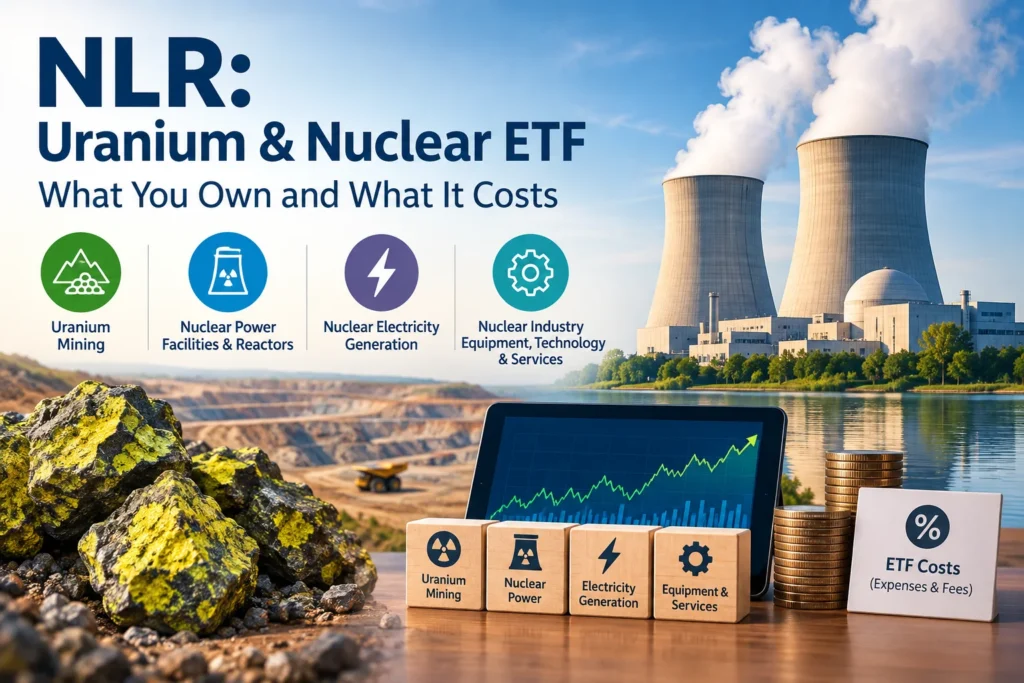
The VanEck Uranium and Nuclear ETF (ticker NLR) is a passive fund that spans the nuclear supply chain: uranium miners, reactor operators, equipment makers, and plant builders. VanEck charges 0.52% a year, and the fund was down 16.71% for the year as of October 2, 2026.
That second figure surprises people. Nuclear has been one of the loudest themes in markets, so why is a fund built around it in the red? This guide covers what’s inside, what it costs, how it has performed, and who might (or might not) want it. Every number below is dated, because fund data goes stale fast.
| NLR at a glance | |
|---|---|
| Ticker | NLR (NYSE Arca) |
| Index | MVIS Global Uranium & Nuclear Energy Index |
| Launched | August 13, 2007 |
| Expense ratio | 0.52% |
| Net assets | $3.52 billion |
| Holdings | 28 (VanEck’s count) |
| Distributions | Annual |
Source: VanEck fund page, October 2026.
What is the VanEck Uranium and Nuclear ETF?
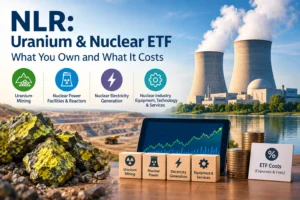
NLR launched on August 13, 2007, and follows the MVIS Global Uranium & Nuclear Energy Index, which covers uranium mining, building and maintaining nuclear plants, generating power from nuclear fuel, and supplying equipment or services to the industry. VanEck says a company generally needs at least half its revenue from these activities to qualify.
So it’s not a pure uranium bet. Picture three layers: the fuel (miners), the plants (utilities and operators), and the hardware (reactor builders and component makers). The fund tracks the index rather than picking winners. The SEC notes that ETFs have tended to cost less to run than similar mutual funds, per its investor bulletin on ETFs.
Why nuclear is back in the conversation
Two forces keep pulling investors toward nuclear. The first is electricity demand. McKinsey estimates that demand for AI-ready data center capacity could climb about 33% a year between 2023 and 2030, a figure Motley Fool cites. Big tech has noticed, and Microsoft and Google have both struck nuclear-related power deals.
The second is policy. VanEck points to supportive government policy and newer small modular reactor designs as tailwinds. Neither force guarantees profits for the companies in this fund. They just explain the attention.
What’s inside NLR?
As of October 1, 2026, the biggest positions were Constellation Energy (8.38%), Cameco (8.12%), Public Service Enterprise Group (7.78%), Fortum (7.12%), and BWX Technologies (6.23%). Add up the top ten and, by my math, you get roughly 62% of the fund. VanEck’s page lists 28 holdings in total, a few of them small cash lines.
At the end of September, energy stocks made up 46.53% of assets, utilities 33.42%, and industrials 20.02%. The U.S. held 49.62%, Canada 18.63%, Finland 7.17%, Australia 7.06%, and China 6.96%.
Look closer and you’ll spot a newer layer. Oklo, at 5.05%, is a pre-revenue reactor developer, and X-Energy (4.32%) and NuScale (3.86%) are also early-stage reactor names. Meanwhile, Fortum trades in Helsinki, and some other holdings trade on foreign exchanges, so most U.S. investors can only reach them through a fund.
What NLR costs and what it pays
The expense ratio is 0.52%, and the adviser has agreed to waive fees so total operating costs stay at or below 0.60% until at least May 1, 2027, which means the number could rise after that. Plenty of third-party sites still show 0.56% or 0.61%, so check the issuer’s page before you trust a figure.
NLR pays once a year. The 2024 payout was $0.61 per share, and 2025’s was $3.17. The trailing 12-month yield is 3.07%, while the 30-day SEC yield is 0.54%. Don’t treat the bigger number as a promise. One tax note: VanEck says the fund doesn’t generate Schedule K-1 forms.
How NLR has performed
Here’s the awkward part. Through September 30, 2026, NLR’s NAV return was -16.40% year-to-date, -21.69% over one year, and -12.80% in the past month alone. Longer windows look much better, at 16.37% a year over three years, 17.04% over five, and 10.92% over ten. The index tracked those results closely. Net assets sit at $3.52 billion, down from $4.64 billion on April 2.
Why the slide? Honestly, I can’t pin it on one cause, and anyone who claims certainty is guessing. What the data does show is that everything fell together. 24/7 Wall St. reported that NLR and the Global X Uranium ETF (URA) each lost about 12% over a month, so owning the whole supply chain gave little shelter.
[Image 3: see Prompt 4 below]
NLR vs. URA: Which one fits?
Based on 24/7 Wall St.’s reading of recent filings, URA put 22.18% of its assets in Cameco, versus 8.41% for NLR. URA charges 0.69%. Over five years, NLR’s price gain was about 120% against URA’s 106%; over ten, URA pulled far ahead, 329% to 183%, with both figures excluding distributions.
My read: URA is the sharper tool if you want exposure to the uranium price itself. NLR is broader, and its utility and equipment holdings tie part of the fund to electricity demand. Pure-miner funds such as URNM lean even harder toward the commodity. None of them is gentle, as last month proved. Don’t confuse NLR with VanEck’s NUCL and NUKL either; those are separate UCITS funds tracking a different index.
Risks to weigh before buying
Treat this as a high-volatility holding. Wealthfront labels it very high risk.
- Concentration: about 62% sits in ten names, and the fund is classed as non-diversified.
- Project and policy risk: VanEck’s own notes point to reactor cost overruns, delays, regulatory shifts, and swings in uranium prices.
- Foreign exposure: roughly half the fund sits outside the U.S., so currency moves and overseas rules matter.
- Early-stage companies: several reactor developers haven’t yet shown they can earn steady profits.
Who NLR suits, and who should pass?
It may suit someone who wants the whole nuclear buildout in one ticker, can stomach drops like this year’s, and would rather not pick individual stocks. Position size matters. A small slice of a diversified portfolio limits the damage when a theme turns.
It probably doesn’t suit money you’ll need within a few years, anyone who wants steady income, or a person who wants nothing but uranium price exposure. I’m not a financial advisor, and this isn’t personal advice. A licensed professional can weigh your situation.
How to buy NLR
NLR trades on NYSE Arca, and you buy it the way you’d buy a stock, through a brokerage account or with an advisor. A limit order lets you set your price, which helps when markets are jumpy. Check the fund’s premium or discount to NAV on VanEck’s site, and read the summary prospectus first.
FAQ: VanEck Uranium and Nuclear ETF questions
What does NLR invest in?
Uranium miners, nuclear power generators, reactor builders and equipment suppliers worldwide, tracked through the MVIS Global Uranium & Nuclear Energy Index.
What is the NLR expense ratio?
It’s 0.52% per VanEck’s October 2026 page, with a fee waiver capping costs at 0.60% through at least May 1, 2027.
Does NLR pay dividends?
Yes, once a year. It paid $3.17 per share in 2025 and $0.61 in 2024.
Is NLR a good investment?
That depends on your goals and risk tolerance. It has delivered strong multi-year returns but fell about 21.7% over the past year, so it suits investors who accept big swings.
How does NLR differ from URA?
NLR holds a broader mix, including utilities and reactor builders. URA leans harder on uranium, with Cameco above 22% of assets and a higher 0.69% fee.
The bottom line
NLR gives you the nuclear supply chain in one fund at a fair price, but this year has shown how hard it can fall. Check VanEck’s fund page for current numbers before you act, and read the summary prospectus. If the theme still makes sense to you, size the position so one bad year doesn’t hurt. If it doesn’t, no fund fixes that.



1 thought on “VanEck Uranium and Nuclear ETF (NLR): What You Own and What It Costs”