Primrose Candy Co. Files Chapter 11: Inside the Squeeze Hitting America’s Candy Makers
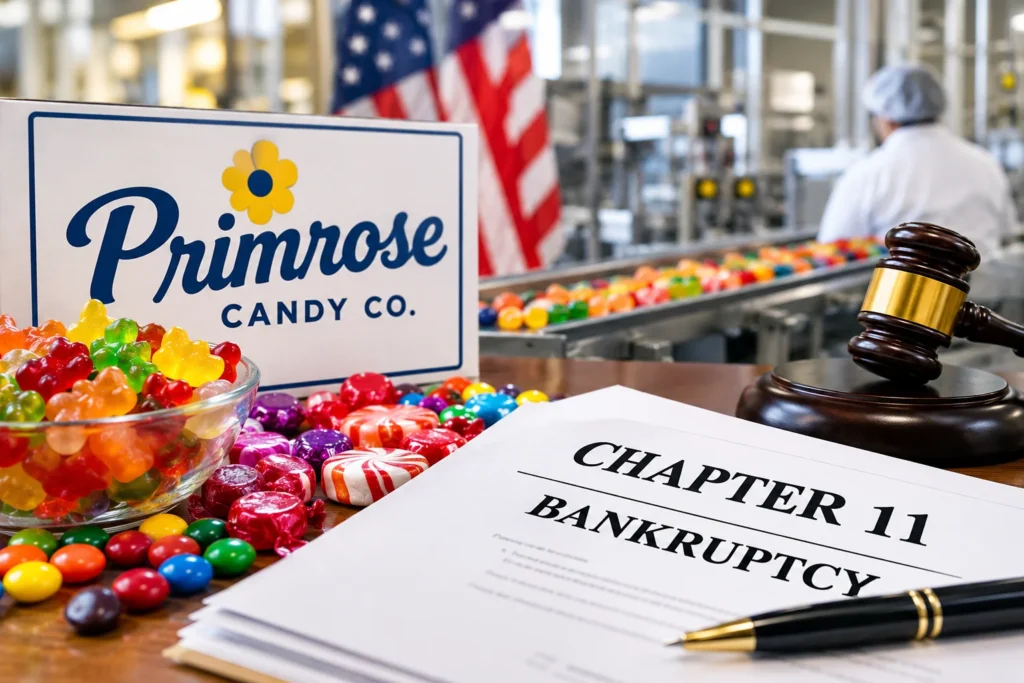
Primrose Candy Co., the Chicago confectioner that’s been twisting butterscotch and lemon drops since 1928, filed for Chapter 11 bankruptcy protection on January 27, 2026. It’s not an isolated story. Over the past several months, candy makers of very different sizes have landed in the same courtroom territory, squeezed by the same handful of costs: sugar, cocoa, imported ingredients, and debt that’s gotten harder to service.
Here’s what happened at Primrose and why its filing fits a pattern playing out across the confectionery business right now.
What Primrose Candy Co. Filed and Why
Primrose submitted its voluntary Chapter 11 petition in the U.S. Bankruptcy Court for the Northern District of Illinois, listing assets of $1 million to $10 million against liabilities of $10 million to $50 million. Company attorney David Welch told the Chicago Tribune the business is carrying old debt it can no longer fully repay, a problem that’s grown harder to solve as candy production costs have climbed faster than pricing can absorb.
A few numbers explain the pressure. Primrose’s revenue slid from roughly $11.8 million in 2024 to about $7.8 million in 2025, according to figures the Chicago Tribune reported and other outlets later cited. The company is trying to reorganize more than $12 million in obligations while still meeting payroll for its 90 or so factory workers on the city’s Northwest Side. On top of the core debt, Primrose had also funded a $125,000 settlement tied to an Illinois Biometric Information Privacy Act class action over fingerprint scanning at the plant, one more line item weighing on cash flow.
None of this means the 130,000-square-foot Chicago factory is going dark. A Chapter 11 filing is a request for breathing room, not a shutdown notice. Primrose is asking the court for post-petition financing and permission to keep using cash collateral, the standard moves a company makes when it wants to keep the lights on while it renegotiates what it owes.
Primrose Isn’t Alone: A Rough Stretch for Candy Makers
Primrose’s filing lands a few months after Sugar Land, Texas-based CandyWarehouse.com sought Chapter 11 protection on October 24, 2025, just before Halloween. That company’s president told Newsweek the pandemic hit hard and the business never fully recovered. Its numbers were smaller than Primrose’s, around $224,000 in assets against $2.8 million in liabilities, but the underlying story rhymes: rising costs and softer sales collided with debt the company could no longer carry comfortably.
Even the giants have felt it. Hershey executives put their expected 2025 tariff costs at $160 million to $170 million, a figure large enough to move the needle for a company that size, let alone a family-owned outfit with a fraction of the resources. Separately, a National Retail Federation survey found nearly eight in ten Americans expected higher Halloween candy prices this past season because of tariffs, and an analysis of retail sales data put candy running about 10.8% more expensive than the year before, roughly four times the overall inflation rate.
There’s a partial reprieve in the numbers, too. In November 2025, an executive order lifted tariffs on several agricultural imports, cocoa included, which should ease one piece of the cost stack for chocolate-heavy manufacturers going into 2026. Sugar remains a separate headache for companies like Primrose, since U.S. sugar prices have stayed well above global rates for years under the country’s import quota system.
Why Small, Family-Owned Candy Companies Are Getting Hit Hardest
A few forces keep showing up in these filings, and they hit smaller manufacturers disproportionately:
- Domestic sugar costs. U.S. price supports keep sugar more expensive here than almost anywhere else, a cost a company like Primrose can’t dodge the way a multinational might through global sourcing.
- Import competition. Lower-cost hard candy and confections from overseas undercut legacy U.S. brands on price, even when buyers say they value the nostalgia factor.
- Contract losses. Primrose reportedly lost two lemon-drop production contracts worth about $1 million a year combined, cited to lower-cost foreign competitors, a gap that’s tough to replace quickly in a niche category.
- Old debt at higher rates. Legacy borrowing taken on years ago becomes far costlier to service once interest rates climb, and refinancing options shrink for smaller, less liquid businesses.
- Thin margins already. Candy is priced for impulse buys and bulk retail; there’s only so much a manufacturer can pass along before a retailer just switches suppliers.
Put together, it’s less a single crisis than a slow tightening. A company can absorb one of these pressures. Stack four or five on top of decades-old debt, and Chapter 11 becomes the tool for buying time to restructure rather than simply running out the clock.
What Happens Next for Primrose
The bankruptcy filing doesn’t answer whether Primrose emerges as an independent company, gets acquired, or eventually liquidates; Chapter 11 cases can end any of those ways. Early filings signal the company wants to keep operating and reorganize its debt load rather than sell off assets piecemeal, which is the more common path for a manufacturer that still has working factory space, an established retail footprint, and products that move.
For now, Primrose candy is still shipping to the retailers that sell it in bulk and under private labels. Whether the century-old brand looks the same on the other side of reorganization is the open question the court process will settle over the coming months.