
Symptoms of Liver Failure in Cats: A Complete Guide
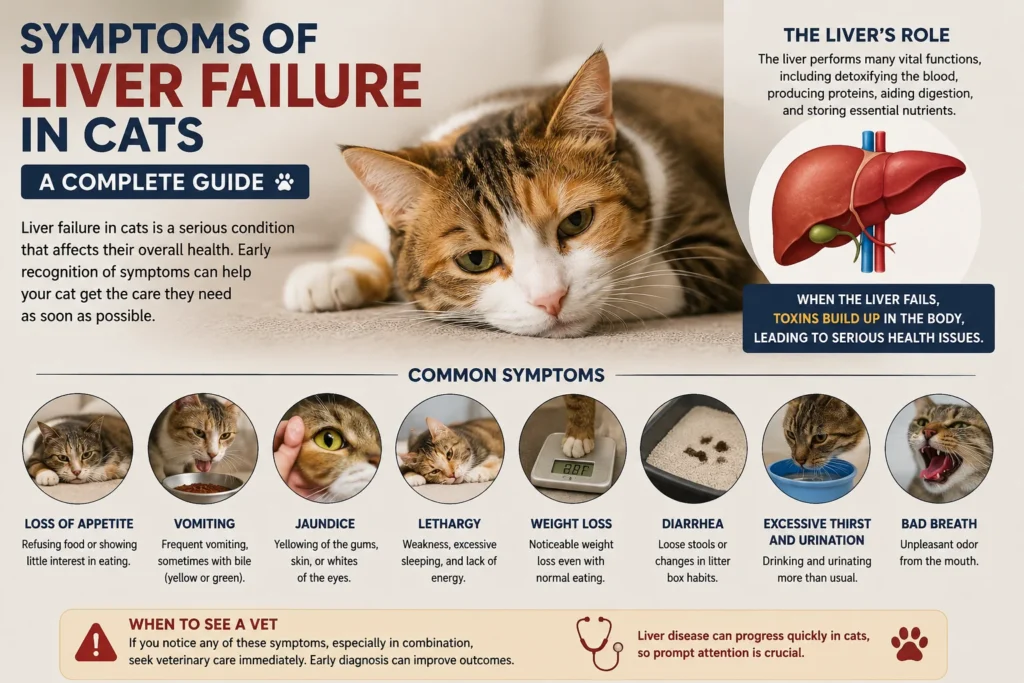
A cat’s liver does a lot of quiet, unglamorous work. It filters toxins, helps digest fat, stores vitamins, and keeps blood sugar steady. When it starts failing, the early warning signs are easy to miss: a little less appetite and a bit more sleeping than usual. By the time most owners notice something is truly wrong, the disease has often been building for days or weeks.
That’s what makes liver failure in cats so dangerous. It doesn’t announce itself. This guide walks through the symptoms in the order they usually appear, what causes them, and exactly when a “wait and see” approach stops being safe.
What Liver Failure Actually Means for a Cat
Cats can lose a surprising amount of liver tissue and still function normally because the organ has real regenerative capacity. Liver failure sets in only once damage passes a critical threshold, generally cited as roughly 70% of liver function lost. Below that point, the organ simply can’t keep up with the body’s needs anymore.
Vets separate this into two broad patterns. Acute liver failure happens fast, sometimes within days of the original injury, and tends to be harder to reverse because the body has so little time to adapt. Chronic liver disease builds gradually, often over months, and can eventually progress to cirrhosis, where scar tissue replaces healthy tissue permanently. According to the Merck Veterinary Manual, sudden liver failure is often linked to hepatic encephalopathy and clotting problems, both of which explain several of the more alarming symptoms below.
Early Symptoms of Liver Failure in Cats
This is the stage where things are genuinely subtle, and honestly, most cat owners chalk these signs up to “she’s just being a cat” or a minor stomach bug. That hesitation is understandable. It’s also the main reason liver disease so often gets caught late.
Watch for:
- Reduced appetite that lingers for more than a day or two, especially in a cat that’s usually food-motivated
- Low energy or a general lack of interest in normal routines like playtime or greeting you at the door
- Occasional vomiting or soft stool, without an obvious trigger like a diet change
- Increased thirst and urination, which owners sometimes mistake for a kidney issue instead
- Mild, unexplained weight loss, particularly notable in a cat that was previously overweight and has started slimming down quickly
That last point deserves attention. A formerly obese cat that loses weight fast, even if the weight loss initially seems like good news, is at real risk of hepatic lipidosis (fatty liver disease), one of the most common causes of liver failure in cats. Fast weight loss forces the body to mobilize fat, and cat livers process that fat poorly compared to other species.
Body image prompt: Simple infographic titled “Early vs. Advanced Liver Failure Symptoms in Cats,” two-column comparison layout, left column soft yellow with icons for appetite loss, lethargy, and weight loss, right column deeper orange with icons for jaundice, bruising, and disorientation, flat vector design, clean sans-serif labels, white background, 1200x700px.
Advanced Symptoms: When It Becomes an Emergency
Once liver function drops further, symptoms shift from “something’s off” to unmistakable. These signs mean the disease has progressed significantly, and the cat needs emergency veterinary care, not a next-available appointment.
- Jaundice (icterus): a yellow tint in the gums, inner ears, whites of the eyes, or skin on the belly. This happens because a failing liver can’t clear bilirubin, a pigment from broken-down red blood cells.
- Drooling and nausea that goes beyond occasional vomiting
- Bleeding or bruising that appears without injury, including nosebleeds, blood in stool (melena, which looks black and tarry), or small red-purple spots on the skin and gums called petechiae
- Swelling of the belly (ascites) from fluid buildup, or puffiness in the limbs
- Neurological changes, sometimes described as hepatic encephalopathy: disorientation, circling, pressing the head against walls or furniture, unsteady walking, excessive drooling, seizures, or, in severe cases, coma
If any of these show up, this is not a “monitor at home” situation. As veterinary reference sources note, a cat in liver failure typically appears jaundiced, nauseated, refuses to eat, and looks visibly, obviously sick. Get to a vet or emergency animal hospital the same day.
What Causes Liver Failure in Cats
There isn’t one single cause. The liver processes so many substances that damage can come from several directions at once, and sometimes a vet never pins down an exact trigger.
Common causes include:
- Hepatic lipidosis (fatty liver disease): the most frequent cause of acute liver failure in cats, usually triggered when a cat, often an overweight one, stops eating for several days
- Toxin exposure: acetaminophen (Tylenol), certain plants like lilies, rodenticides, mold toxins in spoiled food, and some household chemicals
- Infections: bacterial, viral (including FeLV and FIV), fungal, or parasitic organisms that reach the liver
- Cholangiohepatitis or triaditis: inflammation that hits the liver, gallbladder, and pancreas together
- Cancer, including lymphoma
- Congenital issues like portosystemic shunts, where blood bypasses the liver instead of being filtered through it
- Certain medications, even ones that are considered safe in other species
Cats have a genuine physiological disadvantage here. They lack some of the enzyme pathways other animals use to break down and clear toxins, which is part of why medications and chemicals that barely affect a dog can seriously harm a cat’s liver.
Body image prompt: Clean flat-design diagram titled “Common Causes of Feline Liver Failure,” central liver icon with six branching labeled nodes (fatty liver, toxins, infection, cancer, congenital shunts, medications), muted blue and terracotta color palette, white background, professional and educational style, 1200x700px.
When to Call the Vet (and When to Go to the ER)
Any appetite loss lasting more than 24 hours in a cat is worth a same-day call to your vet, not because every case is liver-related, but because cats hide illness well and rarely stop eating without a real reason. Add jaundice, repeated vomiting, or behavioral changes to that picture, and it’s an emergency visit, full stop.
A few honest caveats: not every case of a picky day or two means liver failure, and plenty of cats vomit occasionally without anything serious going on. But a formerly food-motivated cat that skips meals for a full day, combined with even one other symptom from the lists above, is enough reason to get checked out. Vets would rather run a blood panel that comes back normal than see a cat after 70% of its liver function is already gone.
How Vets Diagnose and Approach Treatment
Diagnosis usually starts with bloodwork and a physical exam, since liver enzyme levels, bilirubin, and clotting values all offer clues. From there, vets often move to abdominal ultrasound, and in many cases, a needle aspirate or biopsy is needed to confirm exactly what’s going on and rule out cancer.
Treatment depends heavily on the cause and how far the disease has progressed. Supportive care, IV fluids, anti-nausea medication, liver-protective supplements like SAMe or milk thistle, and nutritional support (sometimes through a feeding tube) form the backbone of most treatment plans. When an underlying cause is identified, like a toxin or infection, treating that directly gives the cat the best shot at recovery, since feline liver tissue can regenerate if the damage hasn’t gone too far.






1 thought on “Symptoms of Liver Failure in Cats: A Complete Guide”