
What Is TechTarget Priority Engine, and How Does It Work?
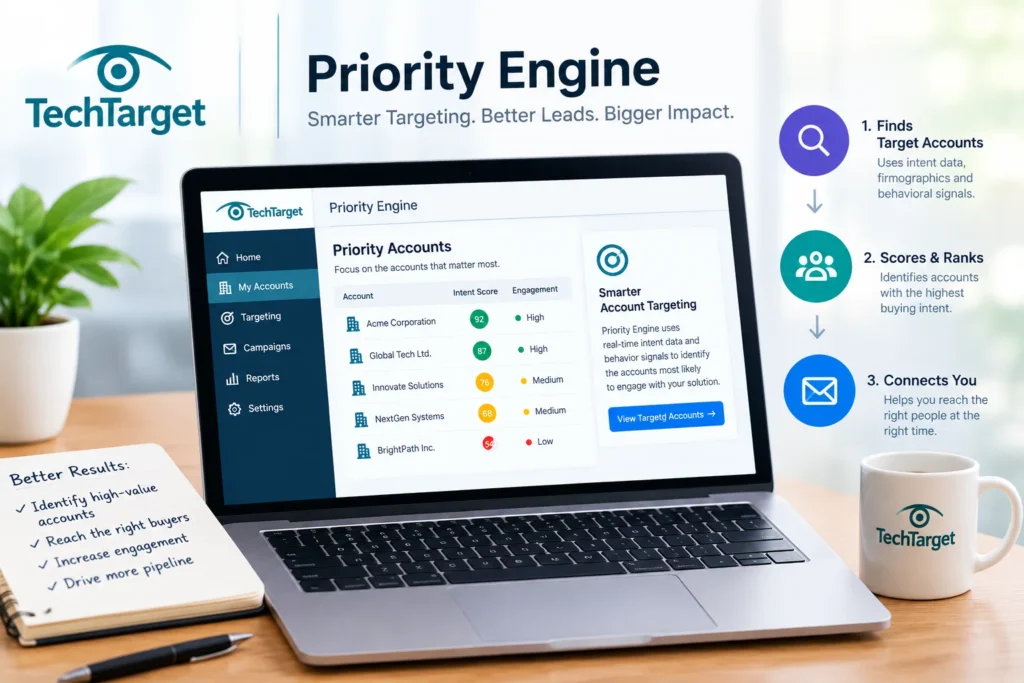
If you sell enterprise technology, you’ve probably heard sales or marketing colleagues mention “Priority Engine” in the same breath as intent data and account-based marketing. It’s not a new concept dressed up in a new name. It’s a specific platform, built by TechTarget, that tries to answer one question for B2B tech vendors: which companies are actually researching a solution like yours right now?
This guide breaks down what the platform is, how the underlying data actually gets collected, what you can do with it day to day, and where it tends to fall short.
What Is TechTarget’s Priority Engine?
Priority Engine is a SaaS platform from TechTarget (now part of Informa TechTarget) that gives sales and marketing teams real-time visibility into which named accounts and individual contacts are researching technology purchases. Instead of guessing who’s in-market from generic firmographic data, it ranks accounts by how actively they’re engaging with content tied to specific topics or product categories.
At its core, the platform does three things: it identifies active buyers, it tells you what they’re researching, and it hands that information to sales and marketing tools you already use, like Salesforce or Marketo, so reps can act on it.
TechTarget built its reputation by running a large network of specialized IT and enterprise-tech publications. Priority Engine is essentially the commercial layer built on top of that editorial audience: the research behavior happening across those sites becomes the raw material for the intent signals customers pay for.
How the Intent Data Actually Gets Collected
This is where a lot of the confusion sits, so it’s worth being specific.
TechTarget’s network spans more than 150 technology-focused content sites covering categories from cybersecurity to cloud infrastructure to healthcare IT. When someone reads an article, downloads a white paper, or watches a webinar on one of these properties, and they’ve opted in to being tracked for this purpose, that activity becomes a data point.
Priority Engine aggregates those data points at the account and contact level. It then surfaces:
- Which companies have people actively consuming content in a given topic area
- Which individuals within those companies are doing the research
- What specific vendors, products, or subtopics they’re paying attention to
- How recent and how intense that activity has been
Because the underlying audience opted in, TechTarget markets this as permission-based, first-party intent data rather than data scraped or inferred from third-party cookies. That distinction matters more now that browser-level tracking keeps getting restricted.
Key Features and How Teams Use Them
Target Profile Filtering
Instead of scrolling through a raw list of accounts, users build a “Target Profile,” a saved filter combining firmographics (industry, employee count, region) with intent criteria (topics, recency, engagement depth). The platform then keeps that list refreshed automatically as new activity comes in.
Contact-Level Detail
Account-level intent is useful for prioritization, but Priority Engine also names the individuals doing the research where consent allows it, along with their role and what content they’ve engaged with. That’s the detail sales development reps use to personalize outreach instead of sending a generic email to a company’s general inbox.
CRM and Marketing Automation Integration
Priority Engine connects to Salesforce, HubSpot, Marketo, Eloqua, and a handful of other common platforms. Accounts and contacts flagged as high-intent can flow directly into existing pipelines, which is what makes the tool useful for SDR teams rather than something marketing checks in isolation.
Priority Engine Demand
TechTarget expanded the product with a module called Priority Engine Demand, which pairs the intent data with a larger pool of opted-in contacts, content syndication, and lead-generation services. The goal is to move beyond just identifying accounts and contacts toward actively engaging entire buying groups, not just the one person who happened to fill out a form.
Technographic Overlay
Through a data partnership, Priority Engine layers in installed technology data, so a rep can see not just that an account is researching, say, endpoint security, but also what tools that account already has in place. That context shapes whether the pitch is a replacement conversation or a net-new one.
Who Actually Uses This Platform
Priority Engine is built specifically for B2B enterprise technology vendors, not for general consumer marketing or unrelated industries. The typical buyer is a company selling software, hardware, or IT services where the sales cycle is long, the deal size justifies a dedicated intent-data budget, and the audience genuinely overlaps with TechTarget’s editorial network.
In practice, that means demand generation managers, ABM leads, and SDR teams are the day-to-day users, while marketing operations usually owns the CRM integration and reporting.
What It Costs
TechTarget doesn’t publish list pricing, and quotes vary by how many accounts you’re monitoring, how many topics or keywords you’re tracking, and which integrations you need. Based on public benchmarking and buyer reports, entry-level deployments commonly start somewhere in the tens of thousands of dollars annually, with mid-market contracts often landing in a wider range and enterprise deals climbing well past that depending on scope. Bundling a priority engine with content syndication or display advertising sometimes brings the blended rate down.
If budget is a real constraint, it’s worth asking your rep directly for a scoped quote rather than relying on secondhand numbers, since pricing structures change and vary by account universe size.
Strengths and Limitations
Worth knowing before you evaluate it:
Where it tends to deliver:
- Genuinely first-party, opt-in data rather than modeled or scraped signals
- Deep contact-level detail, not just company-level guesses
- Strong fit if your buyers already read TechTarget-network publications
Where it tends to fall short:
- It’s an intent data source, not a full campaign or content-creation platform. You still need separate tools for building landing pages, forms, or email creative.
- Coverage is limited to accounts and individuals active on TechTarget’s specific network, so if your buyers research elsewhere, the signal will be thinner.
- Pricing isn’t transparent upfront, which makes early-stage comparison shopping harder.
Frequently Asked Questions
Is TechTarget Priority Engine the same as an ABM platform? Not exactly. It’s often used inside an account-based marketing strategy, and it does support ABM workflows, but it’s specifically an intent-data and account-identification tool rather than an end-to-end ABM platform with built-in campaign orchestration.
Where does the intent data come from? It’s drawn from opted-in user activity across TechTarget’s network of technology-focused editorial websites, including article reads, content downloads, and webinar attendance.
Does it integrate with Salesforce? Yes. Salesforce is one of the platform’s core native integrations, along with HubSpot, Marketo, and Eloqua, among others.
Who is Priority Engine designed for? Primarily B2B enterprise technology vendors whose target buyers overlap with TechTarget’s IT and technology publishing audience.
Is pricing publicly available? No. TechTarget quotes pricing based on the number of accounts monitored, topics tracked, and integrations required, so you’ll need to contact sales for a specific number.
Bottom Line
Priority Engine solves a narrow but genuinely hard problem: figuring out which accounts are actively in-market before they raise their hand. Its value depends heavily on whether your buyers actually spend time on TechTarget’s network. If they do, the contact-level detail and CRM integration make it a practical tool for prioritizing outbound rather than guessing. If they don’t, the intent signal will be too thin to justify the cost, and it’s worth comparing it against broader intent-data providers before committing budget.







1 thought on “What Is TechTarget Priority Engine, and How Does It Work?”