
How PromptCare’s CIO Used UiPath to Fix a Broken Revenue Cycle
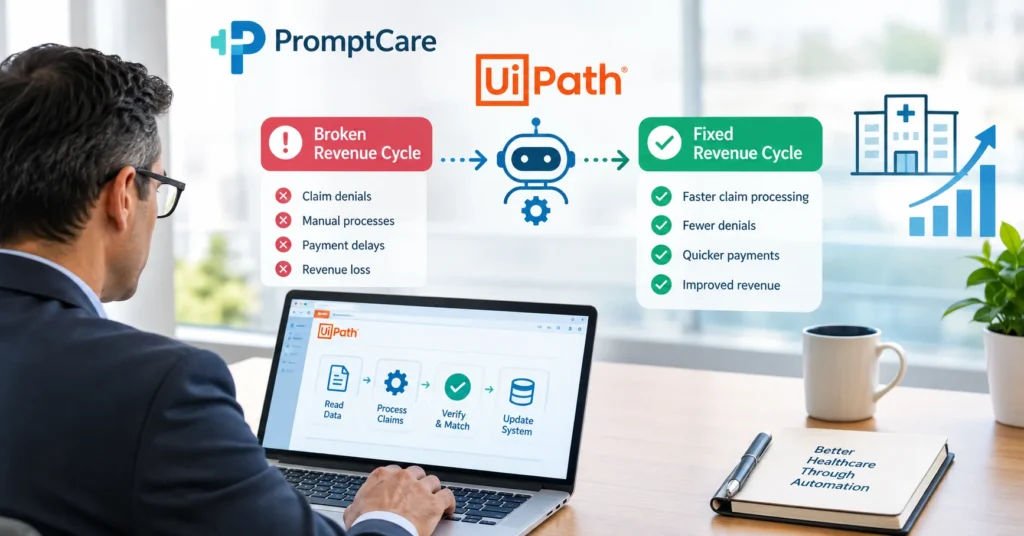
Referrals sitting for 15 days before a patient ever got scheduled. Staff manually keying explanation-of-benefits data into billing systems. Prior authorizations tracked by hand across a company serving thousands of chronically ill patients nationwide. That was the starting point for PromptCare, a home infusion and respiratory therapy provider, before it turned to automation to fix its revenue cycle.
The result: a 50%+ cut in manual labor, a 75%+ reduction in turnaround time for new patient issues, and over 70% of explanation-of-benefits (EOB) postings now handled automatically. Here’s how PromptCare’s Chief Information Officer, Phil Merrell, got there, and what other healthcare IT leaders can take from it.
The Problem: A Revenue Cycle Buried in Paperwork
PromptCare has spent nearly 40 years bringing infusion and respiratory therapy into patients’ homes, serving people managing conditions like ALS, chronic lung disease, and complex nutritional needs. That kind of care is high-touch by design. The billing and administrative side, however, was anything but efficient.
Revenue cycle work at PromptCare involved document-heavy, repetitive tasks: reconciling remittances, confirming sales orders, chasing prior authorizations, and posting EOBs by hand. Tasks that should have taken minutes routinely stretched to 20 or 30 minutes, and some processes dragged on for days. Every one of those delays pushed back cash flow and pulled staff away from patient-facing work.
The Fix: Bots First, Then Agents
PromptCare started small and specific. Using UiPath Studio, the IT team built bots to automate the most repetitive parts of the revenue cycle: EOB-to-cash posting, remittance reconciliation, and sales order confirmations. These bots check invoices, match prior authorizations to claims, and move approved transactions forward without manual entry.
Once that foundation was in place, PromptCare layered in Agent Builder to handle more judgment-heavy work: compiling detailed work orders, running margin analysis, and managing prior authorization and reauthorization requests. UiPath Maestro now orchestrates the bots and agents together, keeping processes consistent and compliant as the company scales, all within a HIPAA-governed environment.
The shift in speed was dramatic. Work that used to take staff 20 to 30 minutes, sometimes days, now finishes in under three minutes in many cases.
As Merrell put it in UiPath’s case study: “We started with repetitive, mundane tasks and automated them with UiPath, which freed staff to focus on more complex work.”
The Results, by the Numbers
- 50%+ reduction in manual labor across targeted revenue cycle tasks
- 75%+ faster turnaround on new patient process issues
- 70%+ of EOB postings are now processed through automation
Those gains translate directly into business outcomes. Faster, more accurate billing has accelerated cash flow and reduced claim denials, while freed-up staff time has gone toward expanding respiratory and infusion services and improving patient access. PromptCare’s work earned it a spot among UiPath’s 2025 AI25 Award winners for automation impact.
What Merrell Learned That Other CIOs Can Use
PromptCare’s rollout wasn’t friction-free. In a separate interview, Merrell described how the project ran into cultural pushback early on; staff worried automation meant replacing them, not helping them. Getting workflows ready for deployment took several rounds of adjustment.
Two lessons came out of that experience, and they’re worth borrowing for any healthcare automation project:
Communicate the human-in-the-loop model clearly. Merrell’s team never let agents make clinical decisions. An agent might scan a medical record to flag whether a patient qualifies for a therapy, but a human always reviews the output and makes the call. Spelling that out to staff, repeatedly, was central to getting buy-in.
Apply the 80/20 rule and stop over-refining. PromptCare’s team lost time trying to perfect workflows before launch; one project expected to take a month stretched to eight. Merrell’s fix was simple: get a workflow to roughly 80% complete, deploy it, then improve the remaining 20% based on real stakeholder feedback. Waiting for 100% just meant staff found workarounds instead of adopting the tool.
PromptCare also matured its approach to measuring ROI over time, moving from simple task-level time savings (a task that took a human 10 minutes done by an agent in two) to end-to-end process metrics tied directly to revenue, such as processing more patients per therapy line because onboarding time dropped from 15 days to four.
Why This Matters for Healthcare CIOs
PromptCare’s case makes a broader point about automation in regulated industries: the value isn’t just speed; it’s what speed frees up. Every minute an agent saves on EOB posting or prior authorization tracking is a minute a human can spend on patient care instead of paperwork. That’s a harder number to put in a slide deck than “50% labor reduction,” but it’s arguably the more important one for a healthcare organization’s mission.
For CIOs evaluating a similar path, PromptCare’s experience suggests starting with well-defined, high-volume, low-judgment tasks before moving into agentic workflows that require more autonomy and building in human review from day one rather than retrofitting it later.