DePIN Wearable Token Launch: A Playbook for Small Teams
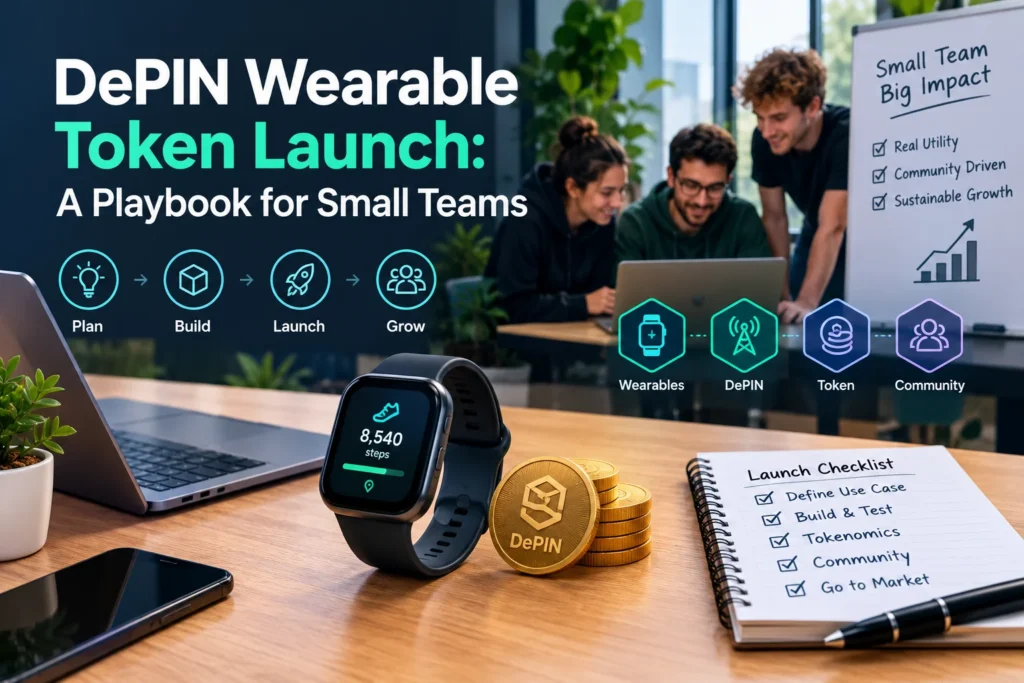
If you’re building a wearable DePIN project with three to eight people and no in-house securities lawyer, most token launch guides aren’t written for you. They assume a treasury team, a compliance department, and a marketing budget you don’t have. This playbook strips the process down to what a small technical team actually needs to do in order to launch a wearable network token without blowing up the project on legal risk, bad tokenomics, or a device-data privacy mistake.
What Makes Wearable DePIN Token Launches Different
DePIN tokens generally reward people for contributing physical infrastructure: compute, bandwidth, storage, and sensors. Wearable DePIN adds a wrinkle. The “infrastructure” is biometric and behavioral data (heart rate, sleep, movement, location) coming off a device on someone’s body. That changes three things for your launch:
Data sensitivity raises the compliance bar. Health-adjacent data triggers different regulatory questions than GPU cycles do. You’ll want a privacy review before token mechanics, not after.
Reward design needs an anti-gaming layer. Step counters and sleep trackers are trivially spoofable. If your token pays for data volume alone, someone will script fake data before your first thousand users onboard.
The device supply chain adds a second bottleneck. Compute DePIN projects can onboard node operators with software alone. Wearable projects are gated by hardware availability, which affects how fast you can grow your reward pool and how you should structure vesting.
Step 1: Decide Whether You Need a Token at Launch Yet
This is the step most small teams skip, and it’s the one that saves the most money. According to Solana’s DePIN developer documentation, many DePIN projects launch without a live token at all, running on a points system instead so the team can study supply and demand and work through major bugs before real value is on the line.
For a small team, this isn’t just caution. It’s leverage. A points phase lets you:
- Test your data-verification logic against real spoofing attempts before rewards have monetary value
- Build a waitlist and contributor base that becomes your genesis token distribution
- Buy time to get a legal opinion on your specific token design instead of rushing one
If your team has under ten people, plan for a three- to six-month points or “proof of contribution” phase before you touch a token generation event.
Step 2: Get Your Regulatory Posture Right, Early
The regulatory picture for DePIN tokens shifted meaningfully in late 2025. The SEC’s Division of Corporation Finance issued a no-action letter to DoubleZero, a DePIN project, stating it would not recommend enforcement action over its 2Z token. Commissioner Hester Peirce framed the reasoning around a simple distinction: these tokens function as incentives for building infrastructure, not as stock or a promise of profit from someone else’s work.
That distinction matters for your design. The no-action letter didn’t bless DePIN tokens broadly; it evaluated one project’s specific facts. But the underlying logic gives small teams a template to follow: tokens paid out as compensation for real work or services tend to sidestep the profit-from-others’-efforts test that defines a security, in a way that tokens sold as investments do not.
Practically, this means your token distribution should be structured as payment for verified contribution (steps logged, sleep data validated, device uptime confirmed), not as a sale to passive holders expecting price appreciation from your team’s work. Get one hour with a crypto-focused securities attorney to review your specific reward mechanics against this framework before you write a line of tokenomics documentation. It’s the cheapest insurance you’ll buy in this whole process.
Step 3: Pick Your Chain Based on Token Program Fit, Not Hype
Small teams often pick a chain because it’s trendy, then discover mid-build that the token program doesn’t fit their reward model. If you’re on Solana, you have two real choices: the standard Token program or Token-2022. Solana’s own guidance frames the decision around whether Token-2022’s extension features, like transfer hooks or confidential transfers, actually serve your application, rather than choosing based on which program is newer. Wearable DePIN projects handling sensitive data often do want transfer hooks, since they let you enforce contribution-verification logic at the token level rather than bolting it on in a separate smart contract.
Whatever chain you choose, evaluate it against three criteria specific to wearables:
- Micropayment cost. Wearables generate small, frequent data events. If gas fees eat your reward margin, redesign your batching before launch, not after.
- Oracle or attestation support. You need a way to get device-signed data on-chain without trusting a centralized server too heavily.
- Existing DePIN tooling. Chains with active DePIN ecosystems (Solana, IoTeX, and Helium’s stack) have SDKs and precedents you can borrow instead of building from scratch.
Step 4: Design Tokenomics Around Your Actual Constraints
A five-person team cannot run the token operations of a fifty-person project. Design for that reality:
Keep the initial reward pool simple. One primary reward mechanism (verified data contribution) beats five overlapping incentive programs a small team can’t monitor for abuse.
Vest your team and early contributors longer than feels comfortable. Three to four years with a one-year cliff is standard for a reason: it forces your team to still be building when the tokens unlock, which is itself a credibility signal to your early users.
Build anti-sybil checks into distribution, not as an afterthought. Wearable data is easy to fake at scale. Tie rewards to device attestation (hardware-backed keys where possible) plus behavioral consistency checks, not just raw data submission counts.
Size your treasury for a multi-year runway, not a one-year marketing push. Small teams that front-load treasury spend on exchange listings and influencer campaigns tend to run out of operating capital before the network has enough real usage to matter.
Step 5: Sequence the Launch Itself
For a small team, the actual generation event should be the least eventful part of the process, because everything risky happened in steps one through four. A reasonable sequence:
- Closed device pilot with a few hundred users on the points system
- Publish tokenomics and legal framing publicly, at least 30 days before any token event
- Open points/waitlist phase to a wider cohort, refining anti-gaming logic against real behavior
- Token generation event with contribution-based distribution to verified early users
- Listing on decentralized exchanges first; centralized exchange conversations come only once there’s real trading volume to show
Skipping straight to step 5 without the earlier steps is the single most common reason small DePIN teams end up with a token nobody uses and a treasury spent on liquidity nobody needed yet.
Common Mistakes Small Teams Make
Treating the token like a fundraising event instead of a coordination tool. The regulatory and reputational risk both go up sharply if your public messaging leans on price rather than network utility.
Underestimating device-spoofing sophistication. Assume someone will try to fake data from day one, and design verification accordingly rather than patching it after an exploit.
Launching compliance work after tokenomics instead of alongside it. Legal review is cheaper and faster when it happens in parallel with token design, not as a final gate that forces a rewrite.
No plan for what happens if hardware supply lags demand. If your reward pool assumes device growth that your supply chain can’t deliver, your token’s utility promise breaks before it starts.
FAQ: DePIN Wearable Token Launch Questions
Q: Do we need a token to launch a wearable DePIN network at all? A: No. Many teams run months of operation on a points or contribution-tracking system first, then convert that history into genesis token distribution once the network and verification logic are proven.
Q: Does the DoubleZero no-action letter mean our wearable token is automatically not a security? A: No. The letter applied to DoubleZero’s specific facts and token design. It signals a workable framework (tokens as compensation for verified contribution, not investment), but every project still needs its own legal review.
Q: What’s the biggest technical risk specific to wearable DePIN, versus compute or bandwidth DePIN? A: Data spoofing. Steps, heart rate, and sleep data are far easier to fake at the software level than compute cycles or bandwidth usage are, so verification design deserves more attention up front.
Q: How long should vesting be for a small team’s own token allocation? A: Three to four years with at least a one-year cliff is standard practice and signals long-term commitment to early users and any potential exchange partners.
Q: Should we pursue a centralized exchange listing at launch? A: Generally no. Sequence decentralized exchange liquidity and real usage first, then approach centralized exchanges once there’s trading volume and network activity to point to.
Q: What chain is best for a small wearable DePIN team? A: There’s no universal answer, but weigh micropayment cost, oracle or attestation support, and existing DePIN tooling. Solana’s Token-2022 program, for example, offers transfer hooks that can help enforce contribution verification directly at the token level.
The Bottom Line
A small team doesn’t need a bigger playbook than a large one; it needs a shorter path through the same risks: unclear compliance posture, data verification gaps, and tokenomics sized for a team that isn’t there yet. Get the points phase right, get one real legal review before the token event, and sequence your launch so the generation event is a formality rather than a gamble.