
Currency Converter: How Exchange Rates Work and How to Convert Money Correctly
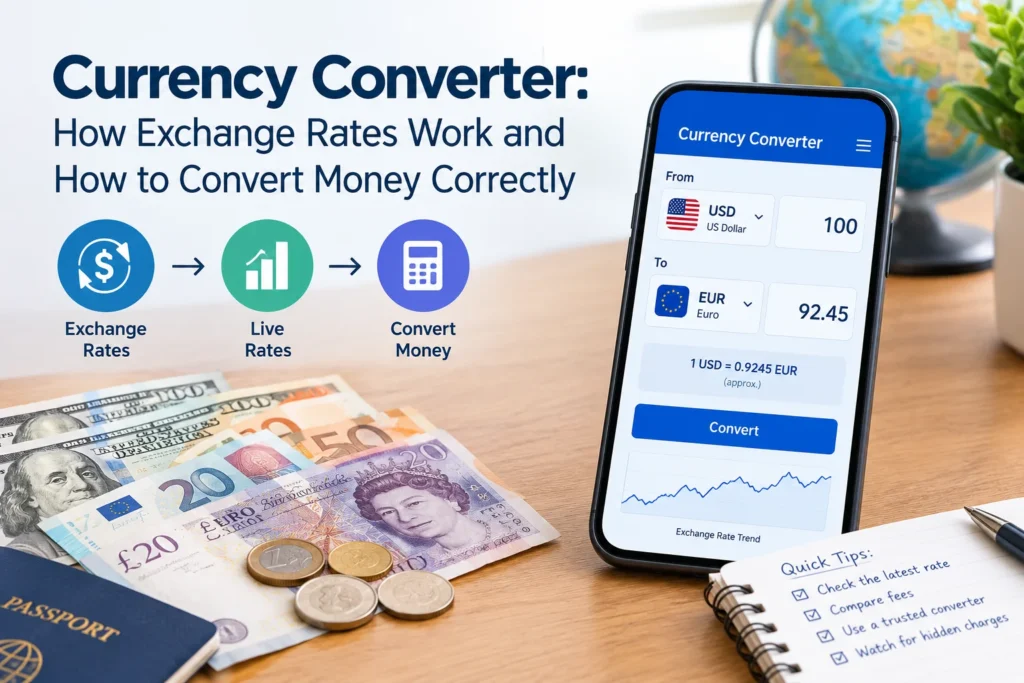
If you’ve ever booked a flight, shopped from an overseas site, or planned a trip abroad, you’ve probably typed “currency converter” into Google at some point. It seems simple: put in an amount, pick two currencies, and get a number. But that number hides a surprising amount of moving parts, and understanding them can save you real money.
What a Currency Converter Actually Does
A currency converter takes an amount in one currency and translates it into another using the current exchange rate. That rate is just the price of one currency in terms of another. If 1 US dollar equals 0.92 euros, then $100 converts to €92.
Most online converters pull rates from financial data providers that update throughout the day. This is called the mid-market rate, sometimes referred to as the interbank rate. It’s the midpoint between what banks buy and sell a currency for, and it’s the most accurate reference point for “what your money is actually worth” right now.
Here’s the catch: the mid-market rate is not the rate you’ll actually get when you exchange money. Banks, airport kiosks, and payment apps add a markup on top of it. That markup is where most currency exchange profit comes from, and it’s often not disclosed clearly.
Why Exchange Rates Change Constantly
Exchange rates float based on supply and demand in the foreign exchange market, which trades trillions of dollars daily. A few things push rates up or down:
- Interest rates. When a country’s central bank raises rates, its currency often strengthens, since higher returns attract investors.
- Inflation. Currencies in countries with high inflation tend to lose value against currencies in more stable economies.
- Economic data. Jobs reports, GDP growth, and trade balances all move markets.
- Political stability. Uncertainty, elections, or conflict can cause a currency to weaken quickly.
- Market sentiment. Sometimes rates move simply because traders expect something to happen, not because it already has.
This is why a rate you see in the morning might be different by evening, and why locking in a rate for future travel or a big purchase is sometimes worth doing.
How to Convert Currency the Smart Way
- Check the mid-market rate first. Use a converter (or search “1 USD to EUR” directly in Google) to see the real rate before you exchange anything.
- Compare that rate to what you’re offered. If a bank or kiosk quotes a rate noticeably worse than the mid-market rate, you’re paying a hidden fee even if they advertise “no commission.”
- Watch for dynamic currency conversion. When paying by card abroad, you’re sometimes asked whether you want to pay in your home currency or the local one. Always choose the local currency. Letting the merchant convert it usually applies a worse rate.
- Use cards built for travel. Some debit and credit cards charge no foreign transaction fees and apply close to the mid-market rate automatically.
- Avoid airport exchange counters when possible. They’re convenient but almost always have the widest markups of any option.
A Quick Example
Say you’re converting $500 to British pounds. The mid-market rate might sit around 0.79, giving you £395. An airport kiosk might quote 0.74 instead. That’s a difference of about £25, roughly 6% of your money, gone before you’ve even left the terminal. Multiply that across a family’s vacation budget, and it adds up fast.