
What is $TRONB (Tron on Base)? A Plain-English Guide
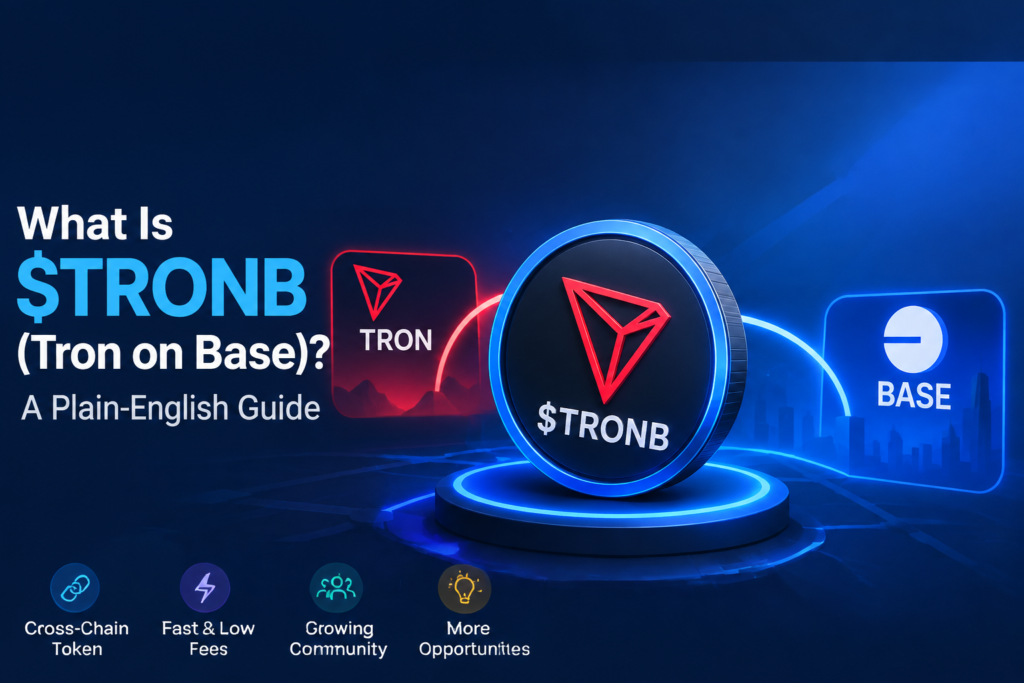
If you’ve come across “$TRONB” or “Tron On Base” while browsing a wallet app or a token tracker, it’s easy to assume it’s connected to the well-known TRON blockchain. It isn’t, at least not officially. Here’s what $TRONB actually is, how it works, and what to know before you interact with it.
The Short Answer
$TRONB is an ERC-20 token that lives on Base, the Ethereum layer-2 network built by Coinbase. It’s a community-run token with a fixed total supply of 1 billion units, and it’s currently held across roughly 9,600 wallet addresses. Its price is a tiny fraction of a cent, and the token has changed hands mostly on decentralized exchanges rather than major centralized platforms.
Importantly, $TRONB is not an official product of TRON DAO, the organization behind the TRON blockchain and its native TRX token. The naming overlap is intentional, borrowing recognition from a bigger brand, but the two projects are separate.
Don’t Confuse It With TRX or the Real TRON-Base Integration
This mix-up matters because there’s a legitimate, unrelated story involving the actual TRON network and Base. In late 2025, TRON’s team announced an integration that lets TRX, TRON’s native coin, become accessible through Base and Coinbase. That announcement came from TRON DAO itself and involves a network that processes tens of millions of transactions a day and holds tens of billions of dollars in value.
$TRONB has nothing to do with that integration. It’s a separate token contract deployed independently on Base, and its name appears to reference TRON purely for branding purposes rather than any technical or organizational link.
Where $TRONB Came From: A “Community Takeover”
According to token-tracking sites, $TRONB is now described as being under “community-led leadership after developer abandonment.” In crypto slang, this is often called a CTO, short for community takeover. Here’s what that typically means in practice:
- A token launches with an anonymous or pseudonymous developer.
- At some point, that developer stops posting updates, sells their holdings, or simply disappears.
- Rather than let the token die, a group of remaining holders takes over the project’s social accounts and tries to keep interest alive through marketing and community coordination.
CTOs are common in the meme-coin corner of crypto, especially on fast, cheap-to-launch networks. Some communities do manage to build lasting value this way, but many CTOs fade out once the initial excitement wears off, since there’s no original team steering development or fixing issues in the underlying contract.
How the Token Works Technically
On-chain data shows $TRONB is a standard ERC-20 contract, verified and deployed on Base with a fixed supply of 1,000,000,000 tokens. Being an ERC-20 token means it follows the same basic rulebook as thousands of other tokens on Ethereum-compatible chains: it can be sent, received, and traded through any wallet or exchange that supports the standard, like MetaMask or Coinbase Wallet.
Because the supply is fixed rather than inflationary, no new $TRONB can be minted beyond the original billion, at least based on what’s publicly verified in the contract.
Why the Price Looks So Small
If you’ve seen $TRONB priced at a tiny fraction of a cent, that’s normal for tokens with a billion-unit supply and a small market. A low price per unit doesn’t tell you much about whether a token is a good or bad holding. What matters more is total market capitalization, trading volume, and how concentrated ownership is among a handful of wallets, information that’s worth checking on a block explorer before assuming anything about the project’s health.
Risks Worth Knowing About
None of this is financial advice, but a few things are worth flagging for anyone researching $TRONB:
- No original development team. Since the founding developer reportedly left, there’s likely no one actively auditing or improving the contract.
- Thin liquidity. Small-cap tokens like this can have wide price swings on relatively small trades.
- Brand-adjacent naming. Tokens that borrow a well-known name (like TRON) without official ties can create confusion, sometimes deliberately, about legitimacy or backing.
- Verify the contract address. Because token symbols and logos can be copied, always confirm you’re looking at the correct contract address on a trusted explorer like BaseScan rather than trusting a name or ticker alone.





1 thought on “What is $TRONB (Tron on Base)? A Plain-English Guide”