
MoveQuest (MQT) Price: Why It Depends on Which Token You’re Looking At
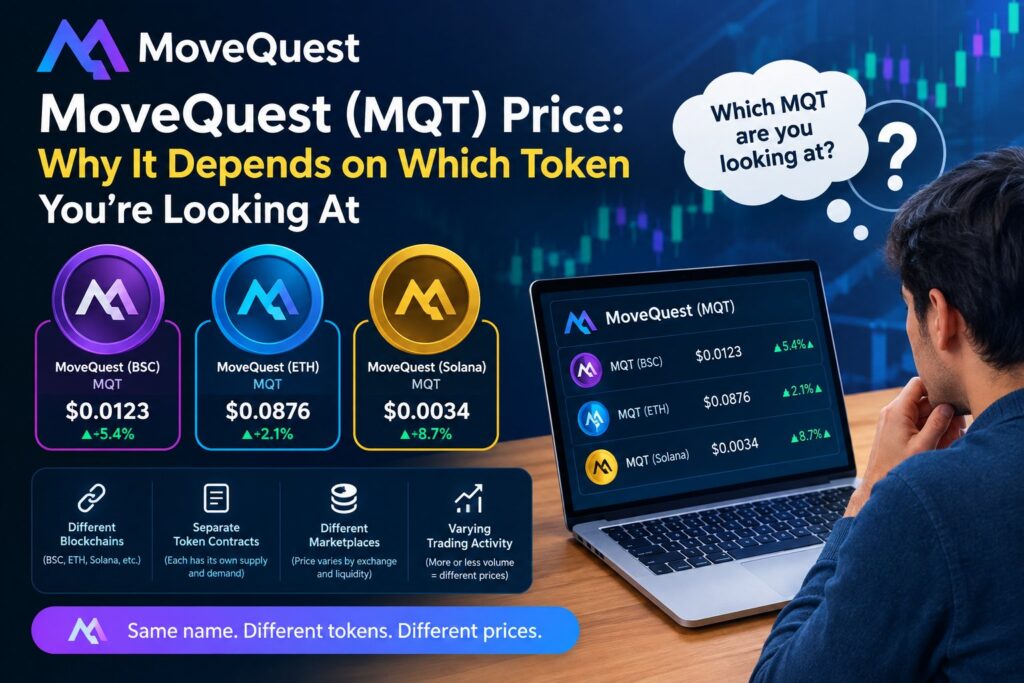
If you searched “MQT price” and got confused by wildly different numbers, you’re not losing your mind. There isn’t one MoveQuest token. There are several, on different blockchains, using the same name and the same ticker. One shows a price near $0.00002. Another shows $46. Both call themselves MoveQuest (MQT).
That’s the first thing to sort out before anything else matters.
The Short Answer
As of this month, here’s what the data actually shows across the tokens trading under the MQT ticker:
| Chain | Approx. Price | Market Cap | Liquidity | Notes |
|---|---|---|---|---|
| BNB Chain | ~$0.70 | ~$14.6M | Moderate, 516 holders | Oldest, most established listing (798 days) |
| BNB Chain (2nd pool) | ~$0.0385 | ~$809K | Very low (~$47) | High volatility risk, thin liquidity |
| Avalanche (pool A) | ~$3.27–$6.16 | $68M–$129M | Varies by hour | Prices moved sharply between checks. |
| Avalanche (pool B) | ~$46.30 | ~$972M | Only ~$1.3M | Market cap looks inflated relative to liquidity. |
| Base | ~$0.0000199 | Not listed | Minimal | Newest, thinnest data trail |
Notice the mismatch: some of these market caps run into the hundreds of millions, yet the actual liquidity backing the price is a few thousand or a few million dollars. That gap matters. It means the quoted price can be moved a lot by a single trade, and it’s easy for a chart to look impressive while the pool behind it is nearly empty.
Why One Ticker, Several Tokens
MoveQuest describes itself as a “move-to-earn” project: a proof-of-physical-activity system where users log steps, workouts, or sleep data to mine tokens, built around miners, hatcheries, and challenge mechanics. That’s the pitch behind the brand.
The problem is that anyone can deploy a token contract with the name “MoveQuest” and the symbol “MQT” on any chain, with zero connection to the original team. This happens constantly with tokens that get any attention. Some of the contracts above may be legitimate multi-chain deployments by the same project. Others may be unrelated copies riding on the name. Nothing in the public data conclusively separates them without going to the project’s own channels.
How to Check Which Token You’re Actually Looking At
Before you trade or quote a price, do this:
- Get the contract address from MoveQuest’s official site or verified social accounts, not from a random aggregator link.
- Match the contract address exactly, character by character, against whatever exchange or wallet you’re using. Copy-paste it; don’t retype it.
- Check liquidity, not just market cap. A token with a $900M “market cap” and $1.3M in liquidity is not a $900M asset in any practical sense. Market cap is just price times supply, and price on a thin pool is easy to distort.
- Look at holder count and pool age. The BNB Chain listing with 516 holders and 798 days of trading history has more of a track record than a pool created recently with a handful of transactions.
- Be wary of $0 trading volume. A couple of the listings above show no trades in the last 24 hours, which usually means the “price” is more theoretical than tradable.
What Actually Moves the Price
For a low-cap, low-liquidity token like this, price moves are driven less by broad market sentiment and more by:
- Individual large trades. In a pool with only a few thousand dollars of liquidity, one buy or sell order can shift the price double digits.
- New listings or wallet integrations. When a token gets added to a new wallet or swap interface, a burst of new buyers can spike price temporarily.
- Project announcements, such as MoveQuest’s stated plans for a dedicated blockchain and multi-chain expansion later this year.
- General crypto market conditions, especially moves in Avalanche or BNB Chain activity, since these tokens trade against pairs on those networks.
None of this means the price will keep moving in any particular direction. Thin liquidity cuts both ways.
Is MQT a Good Investment?
This isn’t something anyone can answer for you, and it’s worth being direct about why: assets with liquidity this low carry real risk of sharp, fast losses that have nothing to do with the project’s long-term merits. If you’re considering it, treat the different MQT listings as separate research problems, verify the contract independently, and only risk money you could fully lose without it changing your financial situation. This isn’t financial advice, and you should look at your own risk tolerance and, if needed, talk to a financial professional before trading illiquid tokens.



2 thoughts on “MoveQuest (MQT) Price: Why It Depends on Which Token You’re Looking At”