
Behr Dry Plus vs. Drylok: Which Basement Waterproofer Should You Buy?
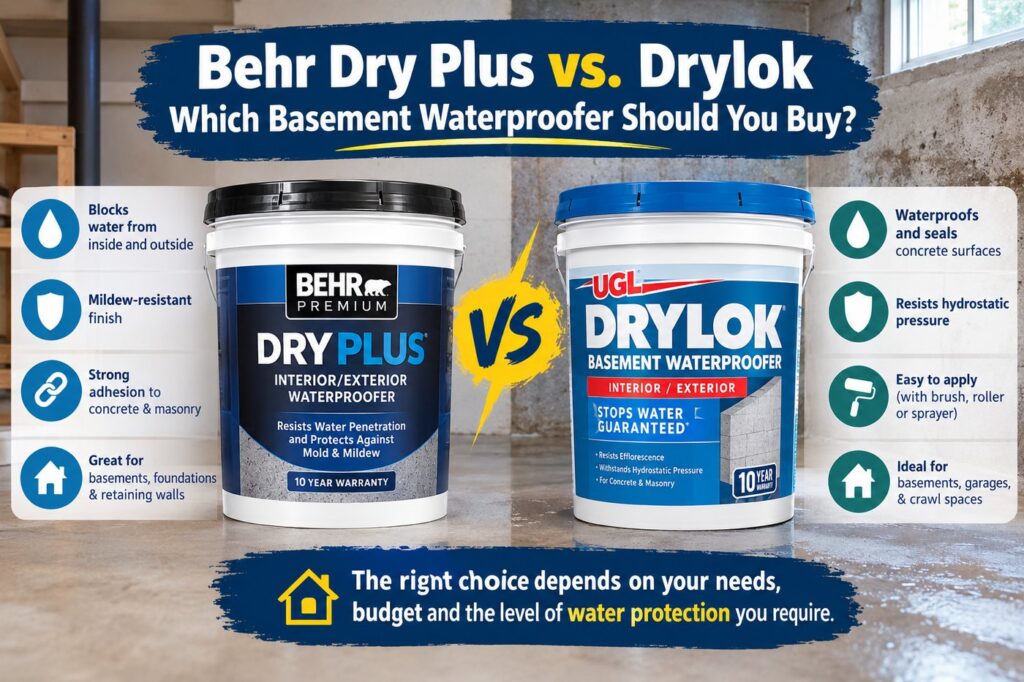
If you’re staring at two nearly identical white buckets at the hardware store, trying to decide between Behr Dry Plus and Drylok, you’re not alone. Both are latex-based masonry waterproofers, both go on with a brush or roller, and both promise a dry basement. The differences that actually matter come down to hydrostatic pressure resistance, warranty length, and how each product behaves on the specific wall you’re painting.
Here’s how they stack up, based on manufacturer specs and real buyer feedback.
Quick Comparison
| Feature | Behr Dry Plus (No. 875/876) | Drylok Original | Drylok Extreme |
|---|---|---|---|
| Hydrostatic pressure rating | 12 PSI | 10 PSI | 15 PSI |
| Equivalent water column | ~27 ft | ~22 ft | ~33 ft |
| Wind-driven rain resistance | 98 mph | 98 mph | 140 mph (Cat 4) |
| Warranty | 10-year limited | 10-year transferable | 15-year transferable |
| Base | 100% styrene acrylic | Latex, encapsulated polymer | Latex, encapsulated polymer |
| Coverage per gallon | 75–125 sq ft | Roughly 75–100 sq ft | Roughly 75–100 sq ft |
| Coats required | 2 minimum | 2 minimum | 2 minimum |
| Active leaks? | Not rated for them | Not rated for them | Not rated for them |
Hydrostatic Pressure: The Number That Actually Matters
Hydrostatic pressure is the force groundwater puts on your foundation walls, and it’s the spec worth paying attention to before color or price. Behr Dry Plus is rated to withstand 12 PSI, roughly equal to a 27-foot column of water. Drylok Original sits lower at 10 PSI, while Drylok Extreme leads the field at 15 PSI, equivalent to about 33 feet of standing water.
For most finished basements without a history of water problems, any of the three will hold. If your water table is high, your yard slopes toward the house, or you’ve had visible seepage after heavy rain, that 3-5 PSI gap between Behr and Drylok Extreme is the difference that keeps the coating from bubbling and peeling a year or two later.
One thing neither brand will tell you upfront: none of these products are designed to stop an active leak. If water is running through a crack or the cove joint where your wall meets the floor, no surface coating, Behr or Drylok, is going to solve that on its own. That calls for crack injection or an interior drainage system first, and waterproofing paint second.
Warranty and Longevity
Behr Dry Plus and Drylok Original both carry a 10-year warranty. Drylok Extreme extends that to 15 years and is transferable to future homeowners, which matters if you’re waterproofing before a sale. Warranty length is a reasonable proxy for how confident the manufacturer is in its own formula, though in practice, failures on any of these products are overwhelmingly caused by surface prep, not the paint itself.
That’s a consistent theme in customer reviews for both brands: efflorescence, dust, grease, or old peeling paint left on the wall before application accounts for the vast majority of complaints about “the product not working.” Buyers who wire-brushed the surface, removed old coatings, and let new concrete cure a full 30 days before painting report far fewer problems than those who painted over dirty or damp walls.
Application and Coverage
Both products go on with a roller or brush, and both need two coats minimum on porous concrete or block. Behr Dry Plus lists coverage of 75-125 square feet per gallon, and multiple reviewers note that cinder block and rough masonry soak up far more of the first coat than the label suggests, so budget an extra gallon for uneven or heavily porous walls. Drylok performs similarly; its thicker consistency means some painters get by with a slightly lower spread rate, but the practical advice is the same for both: buy more than the calculator says.
Behr’s formula uses nano-sized particles designed to fill the microscopic voids left by larger paint particles, which the brand markets as tighter pore-sealing. Drylok relies on what it calls encapsulated polymers for a similar sealing effect. In side-by-side reviews, both go on smoothly with a roller, though a handful of Behr buyers have reported inconsistent batches with lumps or stringy texture that needed to be strained or picked out during application, an issue worth checking for at the point of purchase rather than assuming it’s typical.
Price and Availability
Drylok is the more widely stocked option, sold in nearly every major hardware chain and often positioned as the default recommendation from contractors. Behr Dry Plus, sold primarily through Home Depot given Behr’s retail partnership, tends to run a bit less per gallon than Drylok Extreme, though pricing shifts by region and container size. If cost per gallon is your deciding factor, compare current per-gallon pricing at your local store rather than relying on list prices, since both brands run frequent promotions.
Which One Should You Choose?
Choose Behr Dry Plus if you’re sealing a basement with no history of active seepage, want a smooth decorative finish in a wider range of ready-mixed colors, and are already shopping at Home Depot.
Choose Drylok Original if you want the most widely available option with strong contractor familiarity and don’t need the extra pressure headroom.
Choose Drylok Extreme if your basement has had water intrusion before, you’re in a high water table area, or you want the longest warranty and highest PSI rating on the shelf.
In every case, surface prep decides the outcome more than the brand on the can. Strip old paint, wire-brush efflorescence, let new concrete cure, and apply two full coats. Skip any of those steps and even the higher-rated product will likely fail early.






1 thought on “Behr Dry Plus vs. Drylok: Which Basement Waterproofer Should You Buy?”