
AFP 2025 Boston: What Happened and Why It Matters
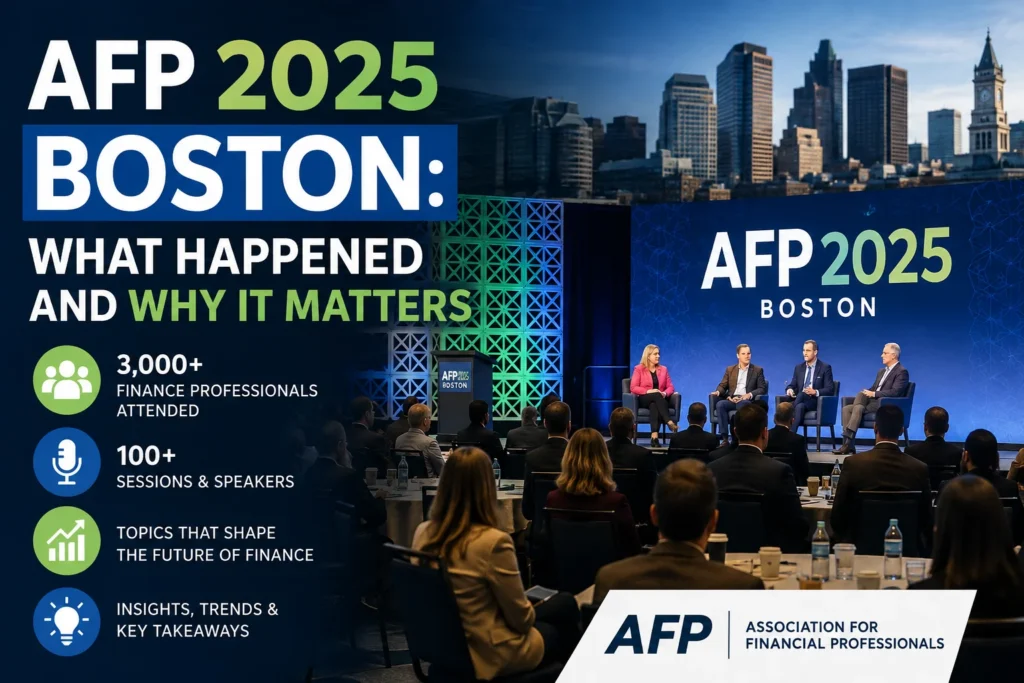
Boston hosted the Association for Financial Professionals’ 2025 Annual Conference from October 26 to 29, and for four days, the Boston Convention and Exhibition Center turned into the unofficial capital of corporate treasury. If you couldn’t make it, or you’re trying to figure out whether next year’s trip is worth the flight, here’s what actually happened.
Quick Facts: AFP 2025 at a Glance
- Dates: October 26 to 29, 2025 (some listings show the main program running through October 28, with the 29th reserved for wrap-up sessions and travel)
- Location: Boston Convention and Exhibition Center, 415 Summer Street, Boston, MA
- Attendance: Estimates put the crowd at 6,500 to 7,000+ finance and treasury professionals, making it one of the largest gatherings in the industry
- Theme: “Ideas into Impact”
- Sessions: 140+ education sessions, keynotes, and networking events across multiple tracks
- Exhibit hall: 200+ solution providers, from global banks to fintech startups
The Theme: Ideas Into Impact
This year’s organizers leaned into a simple premise: good ideas don’t matter much until someone puts them to work. That framing showed up everywhere, from the main-stage keynotes down to smaller breakout sessions on cash forecasting and treasury policy. Instead of abstract trend talk, a lot of the programming pushed toward “here’s how we actually did this at our company,” with practitioners walking through real projects rather than theoretical frameworks.
That practitioner-first approach isn’t new for AFP, but it felt more pronounced this year. Sessions were pitched as sales-free by design, and the peer-review process behind the agenda meant most speakers were corporate finance and treasury professionals rather than vendors reading from a pitch deck.
Keynotes and Main-Stage Moments
The conference opened with a mix of industry insight and, honestly, some unexpected inspiration. Bert Jacobs, co-founder of the clothing brand Life is Good, gave a keynote on optimism and leadership that had little to do with spreadsheets and everything to do with mindset. It’s an odd pairing for a treasury conference, but that contrast tends to be the point. AFP has made a habit of bringing in speakers from outside finance to shake up a room full of CFOs and controllers.
On the more technical side, the FP&A keynote featured Summa Simmons, CTP, Associate Vice President of Treasury at Victoria’s Secret and Co., speaking to a packed breakfast crowd about where planning and analysis functions are headed.
What Attendees Were Actually Talking About
A few threads came up again and again across sessions and hallway conversations:
Bank account rationalization and liquidity structure. Multiple sessions covered how corporate treasury teams are consolidating banking relationships to simplify forecasting and free up scale. One widely attended session had practitioners sharing first-hand experience streamlining accounts to build more flexible liquidity structures.
Embedded banking and ERP integration. As more companies push financial services directly into their existing systems, sessions on embedded banking drew strong interest. The pitch: fewer manual handoffs between treasury and the rest of finance, and faster access to cash positions.
Real-time and cross-border payments. Between blockchain, central bank digital currencies, and faster payment rails, this remains one of the more unsettled corners of corporate finance, and it showed in how many sessions touched on it from different angles.
Personal brand and career development. Not every session was about systems and structure. A well-attended talk on building a professional presence, on LinkedIn and elsewhere, reflected a broader shift: treasury professionals are thinking as much about their own visibility as they are about the balance sheet.
The Exhibit Hall
With over 200 solution providers on the floor, the exhibit hall functioned as its own event within the event. Major banks, including J.P. Morgan and Citi, had a heavy presence, running their own speaking sessions alongside booth demos. Smaller fintech vendors used the floor to show off treasury management systems, payment platforms, and forecasting tools aimed at teams still running processes through spreadsheets.
For a lot of attendees, the exhibit hall is where the real comparison shopping happens. It’s one thing to hear a vendor pitch in a scheduled session; it’s another to walk the floor and see five competitors’ tools side by side in an afternoon.
Boston as a Backdrop
AFP leaned into the host city more than usual this year. The opening night “Cheers to Boston” kickoff party, held in the exhibit hall itself, was built around neighborhood-themed stations: North End for Italian bites, Seaport for seafood, Beacon Hill with a nod to the old sitcom, and a Salem-inspired stretch for the Halloween timing. It’s a small detail, but it’s the kind of thing that shapes whether people actually enjoy four days of finance sessions or just tolerate them.
What’s Next
AFP’s flagship conference moves to Las Vegas for 2026, running November 8 to 11 at the Mandalay Bay Convention Center. Organizers are already promoting more sessions, six keynote speakers, and continued focus on AI, payments, and leadership. If Boston was any indicator, expect the practitioner-led, sales-free format to stick around.






1 thought on “AFP 2025 Boston: What Happened and Why It Matters”