
Joolies Supply Chain Challenges: What Investors and Buyers Need to Know
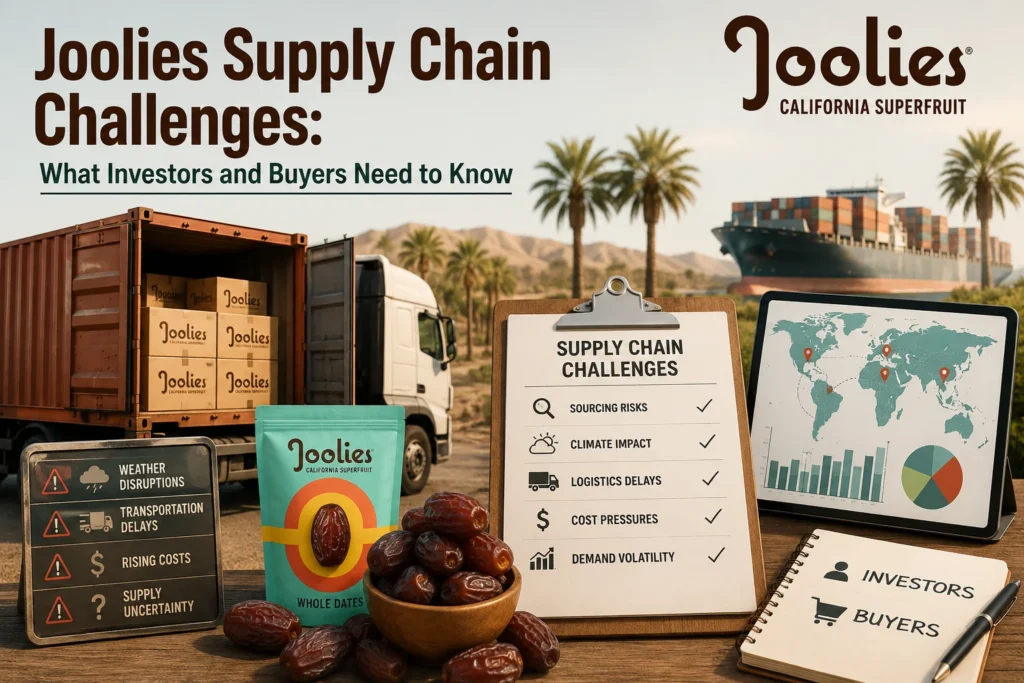
Joolies has built its brand story around one idea: control. The Santa Monica-based Medjool date company grows, packs, and ships from a single Coachella Valley operation, and its leadership points to that setup as the reason the business can move fast in a category most people still associate with dusty bulk bins. That’s a compelling pitch. It’s also not the whole picture. Vertical integration solves some supply chain problems and creates others, and anyone evaluating Joolies as a supplier, acquisition target, or investment needs to understand both sides.
The Vertical Integration Model and Its Limits
Joolies traces its roots to a family farm that has grown Medjool and Deglet Noor dates in Coachella since 1985, with the consumer brand launching in 2019. The company has since folded in Desert Valley Date, a bulk ingredient supplier, and expanded its grower network across the Coachella Valley to keep pace with demand.
Owning the farm, the packing facility, and the packaging supply chain gives Joolies something most food brands don’t have: traceability from tree to retail shelf and fewer intermediaries who can pass along cost increases or quality problems. That’s a genuine advantage in a category where supply has historically been opaque.
But vertical integration also means geographic concentration. Nearly all of Joolies’ supply sits within roughly 140 miles of its Santa Monica office, in one desert valley, dependent on one water source. A single bad harvest, labor disruption, or infrastructure failure in that region doesn’t get diversified away. It hits the whole business at once. That’s the tradeoff buyers and investors should price in: resilience through control, offset by concentration risk that a multi-region supplier wouldn’t carry.
Water Rights and Climate Exposure in Coachella Valley
Coachella Valley agriculture runs on Colorado River water, delivered through the Coachella Valley Water District under century-old allocation agreements. That river system has spent much of the past two decades under drought stress, and interstate negotiations over Colorado River allocations remain a live policy issue heading into 2026. For a farm operation built around date palms, which need consistent irrigation through a multi-month harvest cycle, any tightening of water allocations is a direct production risk rather than a cost-line item that can simply be absorbed.
This is the kind of risk that doesn’t show up in a pitch deck’s growth chart but matters enormously to due diligence. A prospective retail partner or investor should ask specifically about water allocation contracts, drought contingency planning, and whether Joolies or its grower network has explored irrigation efficiency investments to reduce exposure.
Labor and Harvest Timing
Medjool dates are hand-picked across three separate harvest rounds, a labor-intensive process that depends on a skilled, available seasonal workforce. Agricultural labor in California has faced years of tightening supply, driven by immigration policy shifts, competition from other crops, and rising minimum wage requirements. A vertically integrated grower carries this exposure directly. Where a brand that outsources growing can, in theory, shift sourcing if a labor shortage hits one farm, Joolies’ single-region model means a harvest labor shortfall shows up straight in yield and cost.
Co-Packing, Packaging, and Product Innovation Risk
Joolies has expanded well beyond whole pitted dates into date syrup, snack bars, and other value-added products, and job listings for supply chain and product development roles reference active work with contract manufacturers and packaging suppliers. That expansion is a growth signal, but it also introduces a dependency the core vertically integrated model doesn’t have: co-packers and packaging vendors sitting outside Joolies’ direct control. Each new product line adds a supplier relationship, a quality control checkpoint, and a potential bottleneck that isn’t covered by the “we grow it ourselves” story.
The company has also made a public commitment to plastic-free packaging, which narrows its pool of eligible packaging suppliers and can raise input costs relative to competitors using conventional plastic tubs.
Tariff Exposure: A Genuine Structural Advantage
Here Joolies has real insulation that’s worth calling out plainly. Because the farm, packing operation, and packaging supply are domestic, Joolies avoids the import tariff volatility that has dominated supply chain planning across nearly every other consumer goods category through 2026. Trade groups have reported that a majority of supply chain professionals now rank tariff volatility as their top regulatory concern, with many companies absorbing cost increases rather than passing them to customers. Joolies’ domestic-only model sidesteps that entire category of risk, which is a meaningful differentiator against imported dried fruit and snack competitors sourcing from the Middle East or North Africa, the traditional centers of global date production.
Growth Rate Versus Supply Capacity
Joolies has reported year-over-year growth well above 50% in some periods, with leadership describing supply growth targets near 20% annually and distribution expanding into thousands of retail locations. That’s the tension worth watching most closely: a single-region, vertically integrated farm can only expand acreage and harvest capacity so fast, and date palms take years to reach full production after planting. If retail demand continues outpacing what the Coachella grower network can supply, Joolies faces a choice between slowing distribution growth, bringing in outside growers who dilute the vertical integration story, or stretching harvest and packing capacity in ways that raise quality and labor risk.
What This Means for Buyers and Investors
None of this suggests Joolies’ supply chain is fragile. Vertical integration, full traceability, and domestic-only sourcing are real strengths, particularly given how much of the food industry is currently exposed to tariff and import volatility. But a supply chain built on geographic concentration carries different risks than a diversified one, and those risks (water allocation, seasonal labor, co-packer dependency, and capacity-versus-demand growth) deserve specific due diligence questions rather than being waved away by the brand’s control narrative.




1 thought on “Joolies Supply Chain Challenges: What Investors and Buyers Need to Know”