
Deterministic Replay and Immutable Audit Logs for AI Agents
An AI agent does something wrong in production. A tool call returns the wrong data, the model picks an unexpected branch, and a customer gets a bad answer. You pull up the logs. You try running the same input again. It behaves differently this time, and the bug you’re chasing simply refuses to show up twice.
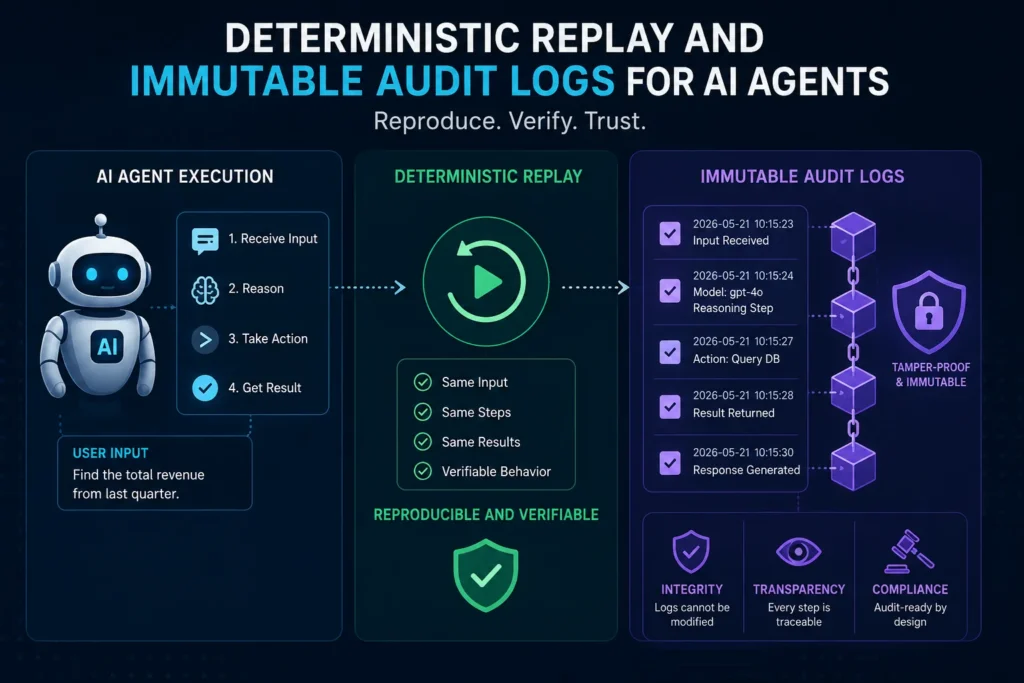
That’s the core operational problem with agentic systems: they’re not deterministic, and they’re increasingly expected to be accountable anyway. Two engineering patterns have emerged to close that gap, and they work best together. Deterministic replay lets you reconstruct exactly what an agent did, step by step, after the fact.
Why Non-Determinism Breaks Traditional Debugging
Conventional software is reproducible by nature. Feed it the same input twice, and you get the same output, so you can recreate a bug by recreating the conditions that caused it. Agent systems don’t work that way. Every run pulls in live API responses, wall-clock time, and a language model that samples from a probability distribution rather than executing fixed logic.
A common misconception is that setting temperature=0 solves this. It doesn’t, not fully. Temperature only governs token sampling; it doesn’t freeze the tool outputs, retrieved documents, or timestamps an agent depends on. And because agents are chained, small divergences compound fast. A slightly different phrase in step two can trigger a different tool call in step three, which feeds different data into step four. By the tenth step, two “identical” runs have nothing in common. Post-mortem debugging turns into forensic guesswork.
What Deterministic Replay Actually Does
Deterministic replay borrows a well-worn idea from systems engineering: record everything external during a live run, then feed those recordings back during a later session instead of calling the real world again.
In practice this splits into two modes:
- Record mode runs the agent normally, against real models and real tools, while intercepting and logging every external interaction: model responses, API calls, tool outputs, timestamps, and even random seeds.
- Replay mode takes that log and plays it back in exact sequence, substituting recorded responses for live ones. Nothing external gets called again, so replay is fast, has no side effects, and lands on the same end state every time.
That last point matters more than it sounds. A re-run executes everything fresh and may produce a new outcome, since the model is still non-deterministic. A replay reconstructs a past run from what was already recorded, so it answers “what happened then,” not “what would happen now.” Confusing the two is an easy way to accidentally double-send an email or double-charge a customer while trying to debug why the agent sent it the first time.
Beyond one-off debugging, this same recording mechanism enables replay-driven regression testing (the agent equivalent of snapshot testing) and crash recovery, where a fresh worker resumes an interrupted run by replaying its checkpointed history instead of starting over.
What Immutable Audit Logs Add
Deterministic replay tells you what an agent did. It doesn’t, on its own, prove that the log you’re replaying is the log that actually happened. If a stored log can be edited after the fact with no trace, a compliance record isn’t a record at all. That’s the gap immutable, tamper-evident logging closes.
Rather than mutable database rows that anyone with admin access can silently rewrite, tamper-evident audit systems typically rely on a few building blocks:
- Hash chains: Each log entry includes a cryptographic hash of the previous entry, so altering any past record breaks every hash that follows it, making tampering mathematically detectable rather than merely policy-forbidden.
- Merkle trees: Batches of entries get aggregated into a single root hash, letting an auditor verify the integrity of thousands of events by checking one small value.
- External anchoring: Periodically publishing that root hash somewhere outside your own infrastructure (a public ledger, a notarization service, or a separate organization’s system) so even someone with full database access can’t rewrite history undetected.
- Hardware attestation: For higher-stakes deployments, trusted execution environments (Intel TDX, AMD SEV-SNP, ARM TrustZone) can cryptographically prove which exact code produced a given log entry, not just that the entry wasn’t edited afterward.
Recent proposals go further, structuring audit data as an “action provenance graph” that links prompts, plans, tool calls, and outcomes into a connected, queryable record rather than a flat list of log lines, which makes it possible to trace responsibility for a specific decision instead of just skimming a timeline.
Where the Two Patterns Meet
Used separately, deterministic replay is a debugging convenience, and immutable logging is a compliance checkbox. Used together, they form what’s sometimes called a system of record for agent behavior: a log that is both reconstructable and provably untampered.
The combined architecture generally looks like this:
- Every non-deterministic input an agent touches (model output, tool response, retrieved document, timestamp, random seed) gets captured at the moment it happens, not reconstructed later from memory.
- Each captured event is hashed and chained to the previous one before it’s written to storage, so the write itself is tamper-evident from the start.
- The chain (or its periodic Merkle root) is anchored somewhere the operator of the agent doesn’t fully control, so a compromised or dishonest insider can’t quietly rewrite history.
- Any of those events can later be replayed, step by step, to reconstruct the exact execution path, and an auditor can independently verify that the replayed path matches the sealed record rather than a doctored one.
This is the difference between “here are some logs we kept” and “here is a cryptographically verifiable record of exactly what our agent did, that nobody, including us, could have altered afterward.” For an agent handling money movement, medical triage suggestions, or automated moderation decisions, that distinction is the whole point.
Why This Is Becoming a Compliance Requirement, Not Just Good Practice
This isn’t purely an engineering preference anymore. Article 12 of the EU AI Act requires that high-risk AI systems technically support automatic event logging across their lifetime, specifically to help identify emerging risks, support post-market monitoring, and enable oversight of how the system operates. Article 19 requires providers to retain those logs for a minimum of six months, and Article 21 gives regulators the right to request access to them on demand.
Notice what the regulation asks for: automatic recording and retrievability. It doesn’t specify a tamper-evidence mechanism. That’s left to engineering judgment, and a plain database table that an administrator can quietly edit technically satisfies “logs exist” while failing the spirit of “logs you can trust.” Hash-chained, externally anchored logs close that gap without waiting for a future revision of the regulation to spell it out.
Common Pitfalls
A few mistakes show up repeatedly in early implementations:
- Capturing the log after the fact instead of at the moment of execution. If an agent’s tool call result gets logged from a downstream cache or a reconstructed summary rather than the raw response as it arrived, the “record” is already an approximation, and replay built on it won’t match what actually happened.
- Treating a hash chain as sufficient without external anchoring. A hash chain proves internal consistency, but if the entire chain lives on infrastructure one party controls, that party can regenerate a consistent-looking chain from scratch. Anchoring the root hash externally is what makes tampering detectable rather than merely inconvenient.
- Version drift between record and replay. If the tool, model version, or dependency used during replay differs even slightly from what ran originally, the replayed session isn’t actually reconstructing the original event; it’s producing a plausible-looking substitute. Pin and record environment versions alongside the interaction data itself.
- Logging everything at full fidelity forever. Full-fidelity capture of every model call and tool response gets expensive fast at scale. Most production systems apply tiered retention: full detail for a compliance-mandated window, then compressed or hashed summaries afterward that still preserve verifiability.







1 thought on “Deterministic Replay and Immutable Audit Logs for AI Agents”