How the Canadian Golf Handicap System Works
Golfer checking a handicap app on their phone at a Canadian golf course, green fairway and autumn trees in the background, natural afternoon light, warm color palette (green, gold, blue sky), professional lifestyle photography, shallow depth of field, sharp focus on phone screen showing a scorecard app, realistic style, 1200x600px, landscape orientation.
If you’ve ever asked someone their handicap and gotten a blank stare, you’re not alone. A lot of Canadian golfers know the term but couldn’t explain the math behind it if you asked. That’s fair. The Canadian handicap system isn’t complicated once you break it down, but nobody hands you a plain-English version when you sign up at your club.
Here’s the short version: your handicap is a number that estimates your scoring potential, not your average. Golf Canada runs the show in this country, using the World Handicap System (WHS) that also governs play in the U.S., U.K., Australia, and most of the golfing world. This guide walks through what the system actually does, how the numbers get calculated, and how to get your own index up and running this season.
What Is a Golf Handicap, Really?
A handicap is a single number that reflects how well you play relative to a course rated at standard difficulty. Lower number, stronger player. A beginner might sit at 30 or higher (54.0 is the ceiling), while a scratch golfer hovers near zero.
What trips people up is the word “average.” Your handicap isn’t your average score. It’s built from your best rounds, not your typical ones. The logic is simple: on your best day, you show what you’re capable of. That’s the number the system tracks, because it represents your true potential rather than a bad-weather round or an off day with the putter.
Golf Canada and the World Handicap System
Golf Canada, formerly the Royal Canadian Golf Association, administers handicapping nationwide in partnership with provincial associations like Golf Ontario, Golf BC, and Golf Québec. Since January 2020, Canada has used the WHS, a unified framework developed jointly by the USGA and The R&A after years of comparing six regional handicap systems, including the old Canadian model.
The point of unifying everything was portability. Before WHS, a Canadian handicap didn’t always translate cleanly overseas. Now your index travels with you. Play a round in Arizona or Scotland, and the same math applies. This matters more than it sounds like it should, especially for golfers who snowbird south for winter or take golf trips abroad.
[Body Image Prompt]: Simple flat-design infographic titled “Handicap Index to Course Handicap,” showing three connected boxes: Score Differential, Handicap Index, and Course Handicap, with arrows between them, a blue and orange color scheme, clean sans-serif labels, minimalist icons (golf ball, flag, and calculator), a white background, and 1200x500px.
How Your Handicap Index Gets Calculated
This is where most explanations lose people, so let’s slow down.
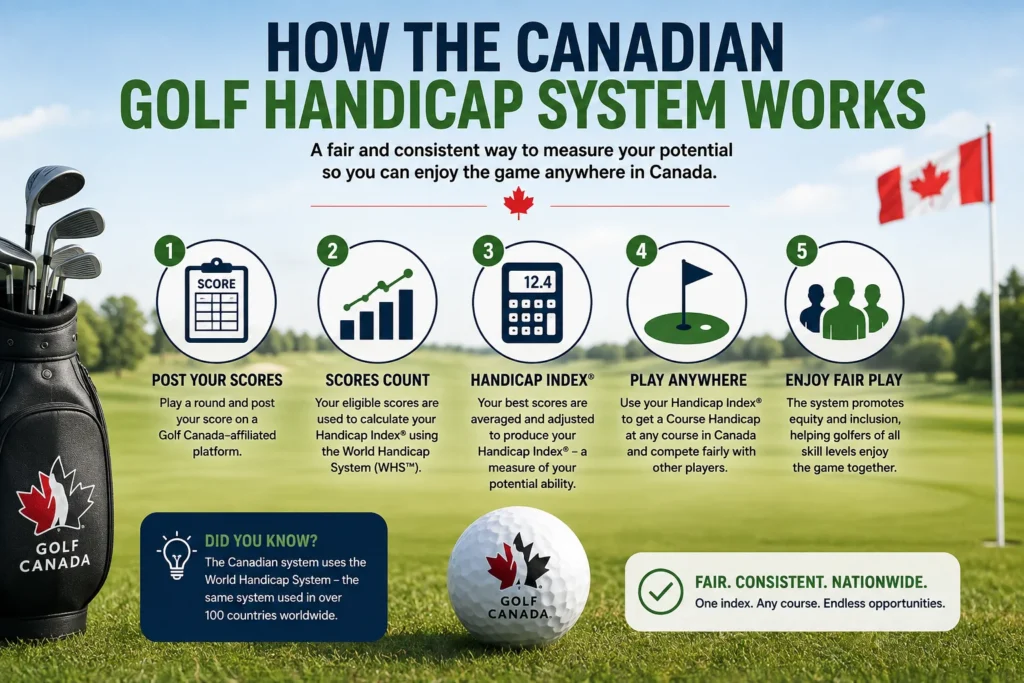
Step 1: You post a score. Every round you play, you enter it into the Golf Canada Score Centre, the mobile app, or a kiosk at your club. Hole-by-hole entry is more accurate, but a net-adjusted total works too.
Step 2: The system converts it into a score differential. This adjusts your raw score for the course’s rating and slope, essentially translating “what you shot” into “what that means on a course of standard difficulty.” The formula looks like this: (113 ÷ Slope Rating) × (Adjusted Score − Course Rating).
Step 3: Your handicap index is calculated from your best 8 of your most recent 20 differentials. Not the average of all 20. Just the best 8. That’s the detail that surprises most new golfers, and it’s the reason your index tends to sit lower than your typical scoring average.
Step 4: A small adjustment factor is applied. The average of those 8 differentials gets multiplied by 0.96, a built-in cushion that accounts for the fact that scores tend to creep up under pressure or in a real round versus a relaxed one.
You only need 54 holes of scores to get your first index. That could be three 18-hole rounds or a mix of nine-hole rounds. After that, your index updates automatically each time you post a new score.
Handicap Index vs. Course Handicap: What’s the Difference?
People use these two terms interchangeably, but they’re not the same thing, and mixing them up leads to confusion on the first tee.
Your handicap index is your portable number. It doesn’t change based on which course you’re playing that day. Think of it as your overall skill rating.
Your course handicap is what you actually use on a given day, at a given course, from a given set of tees. It adjusts your index for how difficult that specific layout plays. The formula: Handicap Index × (Slope Rating ÷ 113) + (Course Rating − Par).
So if you’re a 15.0 handicap index playing a tough course with a high slope rating, your course handicap for that round might jump to 17 or 18. Play an easier course, and it could drop to 13. Same golfer, same index, different number on the card. Most clubs post a conversion chart near the pro shop, or you can pull it up instantly in the Golf Canada app.
Getting Your First Official Handicap
Getting started is more straightforward than most beginners expect.
- Join a Golf Canada member club or sign up through the Golf Canada Public Player Program if you’re not affiliated with a specific club.
- Post scores from 54 holes of golf, played in any legal combination of 9-hole and 18-hole rounds.
- Use the Golf Canada Score Centre (online) or the free mobile app to log each round, choosing the correct tee and date.
- Let the system apply built-in safeguards automatically, including the net double bogey cap, which limits how much a single blow-up hole can hurt your differential.
Once you’re established, keeping your index current just means posting scores regularly. Provincial active seasons vary. Ontario, Quebec, and the Prairie provinces generally run from mid-April to late October, while B.C.’s window stretches from March through mid-November.
Why Bother Having a Handicap at All?
Some golfers assume handicaps are only for tournament players chasing a club championship. Not true. A handicap makes casual rounds fairer between friends of different skill levels, gives you a real way to track improvement season over season, and is required for entry into most amateur events across the country.
It also does something less obvious: it flags where your game actually needs work. A steadily climbing index after a strong stretch often points to something specific, whether that’s a putting slump or a string of penalty strokes off the tee, rather than just “bad luck.”
[Body Image Prompt]: Photo of a Canadian golf scorecard with a pencil resting on it, close-up shot showing handicap and net score columns, warm natural light, shallow depth of field, realistic photography style, green grass slightly visible in the blurred background, 1200x600px.
Common Mistakes New Golfers Make
A few patterns show up again and again with first-time handicap holders:
- Not posting every eligible score. Skipping bad rounds to protect your index defeats the purpose and usually gets flagged as a pattern the system’s Handicap Review process is designed to catch.
- Confusing gross and net scores. Gross is what you actually shot. Net is your gross score minus your handicap strokes for that round, and net is what most match-play formats settle up on.
- Assuming the index won’t move much early on. It’s normal to see noticeable swings in your first 20 rounds before the number stabilizes.
- Playing the wrong tees for their course handicap. The system only works fairly if you’re teeing off from the set that matches the rating being applied.
FAQ: Canadian Handicap System Questions
Q: Who administers the golf handicap system in Canada? A: Golf Canada administers it nationally, working with provincial associations, and the World Handicap System framework is shared with the USGA and The R&A.
Q: How many scores do I need for my first handicap? A: You need 54 holes total, which can come from any mix of 9-hole and 18-hole rounds.
Q: Is my Canadian handicap valid at courses outside Canada? A: Yes. Since the World Handicap System is used globally, your index is portable to any participating country.
Q: What’s the maximum handicap allowed? A: The ceiling under WHS is 54.0 for all golfers, regardless of gender.
Q: How often does my Handicap Index update? A: It recalculates automatically each time you post a new score, using your best 8 of the most recent 20 differentials.
Q: Can I calculate my handicap manually? A: You can estimate it using the Score Differential formula, but only scores posted through an official Golf Canada-affiliated club or program produce a certified index.
Q: Does a bad hole ruin my handicap? A: Not entirely. The net double bogey cap limits how much any single hole can inflate your score differential.
The Bottom Line
The Canadian handicap system exists to make golf fair across wildly different skill levels, and once you see the mechanics, it’s honestly pretty logical. Post your scores, let the system pull your best 8 of 20, and convert that index into a course handicap every time you tee it up somewhere new. Whether you’re chasing single digits or just trying to see real progress this season, an official handicap through Golf Canada is the tool that makes that tracking possible.