Marketing Fundamentals: A Beginner’s Guide to Building a Strategy That Works
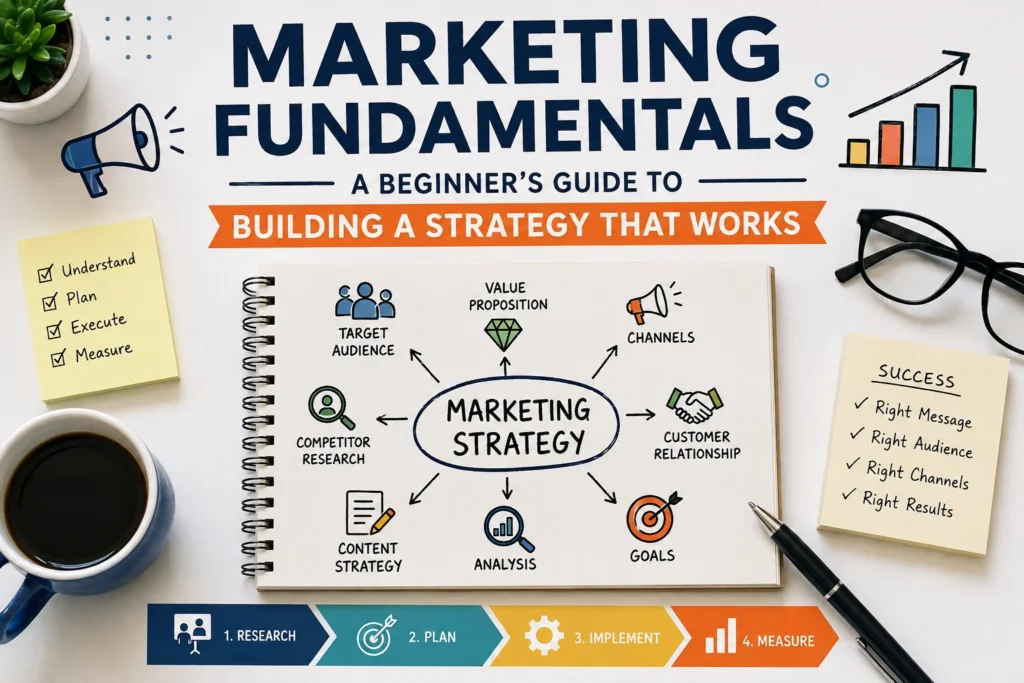
Most people who are new to marketing start in the wrong place. They pick a channel first, maybe Instagram or Google Ads, and figure out the audience later. It usually shows. The campaigns feel scattered, the message changes every few weeks, and nothing quite sticks.
The fix isn’t a new tool or a bigger budget. It’s going back to the fundamentals: who you’re talking to, what you’re offering them, and how you’ll get that offer in front of the right people consistently. Once those pieces are in place, the channels and tactics become a lot easier to choose.
This guide walks through the core building blocks of marketing, in the order most working marketers actually use them.
What Marketing Actually Means
The American Marketing Association’s official definition centers on creating, communicating, and delivering value to customers and society, not on any specific channel or tactic (source: ama.org). In plain terms, marketing is how a business identifies what people need, builds something that meets that need, and gets the word out in a way that earns trust.
Notice what’s missing from that definition: no mention of ads, funnels, or social platforms. Those are tactics. Marketing itself is the discipline of matching value with the people who want it.
Start With the Audience, Not the Product
Here’s a mistake I see constantly, even from experienced founders: they fall in love with what they’re selling and assume the audience will feel the same way. Sometimes it works. More often, the product sits there while the marketing budget quietly disappears.
Before touching a single channel, get specific about who you’re for. That means going beyond “women aged 25 to 40.” Try to answer:
- What problem keeps this person up at night?
- What have they already tried that didn’t work?
- Where do they go for advice or information right now?
- What would make them trust a new brand enough to buy?
You don’t need a six-figure research budget to answer these. Customer interviews, support tickets, competitor reviews, and even a few honest conversations will surface most of what you need. The businesses that skip this step tend to build louder marketing. The ones that don’t skip it tend to build marketing that converts.
The Marketing Mix: 4 Ps (and 7 Ps for Services)
Once you know who you’re talking to, the classic marketing mix gives you a framework for shaping the offer itself.
Product: What you’re selling and the specific value it delivers. This includes features, quality, design, and how it’s positioned against alternatives.
Price: What you charge, and just as important, what that price signals. A low price can suggest accessibility, or it can suggest low quality, depending on context.
Place: Where and how customers can actually get the product. Online store, retail shelf, app store, direct sales team—the “where” shapes the “how.”
Promotion: How you communicate the offer: advertising, content, PR, email, social, or a sales conversation.
If you’re marketing a service rather than a physical product, three more Ps round things out: People (who delivers the service and how they represent the brand), Process (the steps a customer goes through to get value), and Physical Evidence (the tangible cues, like a website, an office, or packaging, that make an intangible service feel credible).
You don’t need to obsess over all seven at once. Most small businesses get the most traction by nailing product and promotion first, then tightening price and place as they learn more.
Building a Simple Marketing Strategy
With audience and offer in place, strategy is really just answering three questions on paper:
- What’s the goal? Awareness, leads, sales, or retention. Pick one primary goal per quarter instead of chasing all four.
- What’s the message? One clear sentence describing the problem you solve and why you solve it better than the alternative. Resist the urge to list every feature.
- Which channels earn the message? Not every channel deserves your time. A B2B software company probably gets more from LinkedIn and email than from TikTok. A local coffee shop probably gets more from Instagram and local search than from a national ad buy.
Write this down. A one-page plan that gets referenced weekly beats a fifty-page deck that gets built once and filed away.
Digital Marketing Basics Worth Knowing
Traditional channels (print, TV, direct mail) still work in the right context, but most beginners will spend the bulk of their time and budget online. A few fundamentals to have on your radar:
Search engine optimization (SEO) helps your website show up when people search for the problems you solve. It’s slow to build but tends to compound over time.
Content marketing is the practice of publishing genuinely useful material (guides, videos, tools) that earns attention before you ever ask for a sale. It also feeds your SEO efforts.
Email remains one of the highest-return channels available, largely because you own the list instead of renting attention from a platform.
Paid social and search ads can get you in front of the right audience quickly, but they stop working the moment you stop paying, so they work best alongside owned channels like content and email, not instead of them.
You don’t need to run all four at once. Pick one or two that match where your audience already spends time, get good at them, then expand.
Measuring What’s Actually Working
Marketing without measurement is guessing with extra steps. At minimum, track:
- Where your traffic or leads come from
- What it costs you to acquire a customer
- How many of those customers stick around
Small businesses often over-invest in vanity metrics like follower counts or impressions. Those numbers feel good but rarely predict revenue. Tie every metric back to a business outcome, even if the tracking is rough at first. A spreadsheet updated monthly is more useful than a fancy dashboard nobody checks.
Common Mistakes Beginners Make
A few patterns show up again and again with people just getting started:
- Chasing every new platform. Being everywhere with a weak presence usually loses to being somewhere with a strong one.
- Changing the message too often. Consistency builds recognition. Switching your positioning every month resets that progress.
- Skipping the audience work. Tactics built on assumptions instead of research tend to underperform, no matter how well-executed they are.
- Ignoring existing customers. It’s typically cheaper to keep a customer than to find a new one, yet retention gets far less attention than acquisition in most beginner plans.
FAQ: Marketing Fundamentals
Q: What are the fundamentals of marketing? A: The core fundamentals are understanding your audience, shaping your offer through the marketing mix (product, price, place, promotion), building a clear strategy around one goal at a time, and measuring results against real business outcomes.
Q: What’s the difference between marketing and advertising? A: Advertising is one tactic within marketing, specifically paid promotion. Marketing is the broader discipline that includes research, product decisions, pricing, distribution, and communication as a whole.
Q: Do small businesses need all 7 Ps? A: Not immediately. Most small businesses see the fastest results by focusing on product and promotion first, then refining price, place, and (for service businesses) people, process, and physical evidence as the business grows.
Q: How long does it take to see results from marketing? A: It depends on the channel. Paid ads can produce results within days. SEO and content marketing typically take three to six months to gain traction but tend to compound over time.
Q: What’s the single most important marketing fundamental? A: Understanding your audience. Every other decision, product, pricing, channel, and message depends on knowing who you’re trying to reach and what they actually need.