
Portugal’s Graphene Stealth Coating: Claims vs. Evidence
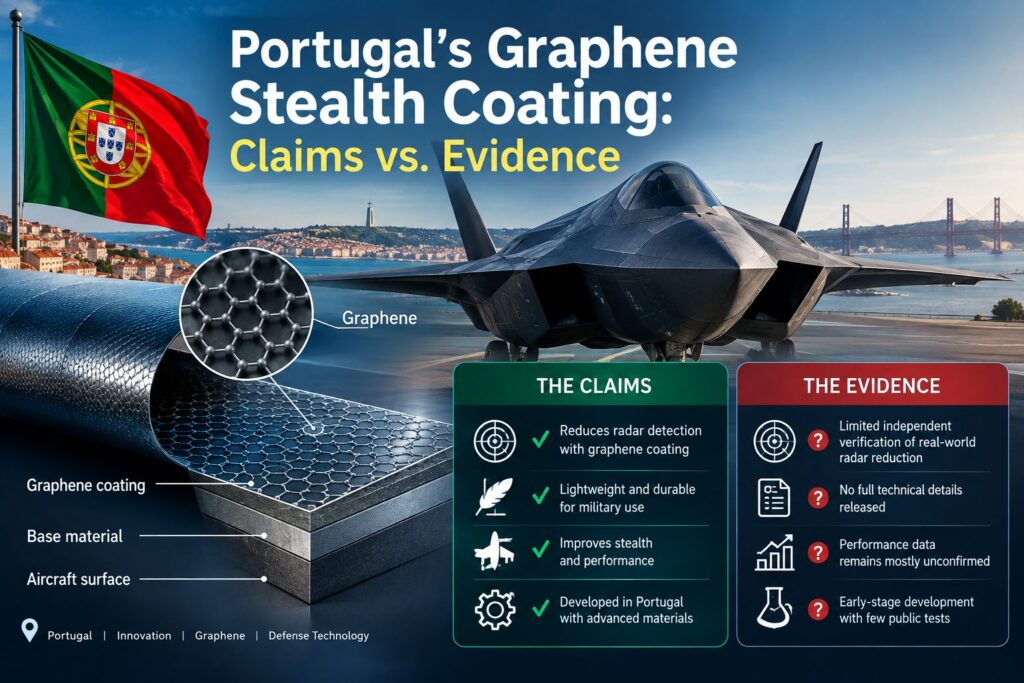
In late June 2026, a Lisbon startup told Euronews that its graphene powder could make a fighter jet look like a bird on radar. Headlines across Europe ran with “almost undetectable.” The company’s actual numbers are much smaller, and I couldn’t find any independent test data. So here’s what Portugal’s graphene stealth tech really is, what’s documented, and what’s still a promise.
Who Is Building It?
GTechPlasma is a spin-off from the Plasma and Nuclear Fusion Institute at Instituto Superior Técnico in Lisbon. Its plasma-based system produces graphene from carbon-based precursors such as methane or ethanol. Graphene is a sheet of carbon one atom thick. Co-founder Bruno Soares Gonçalves says the team can tune the material at the atomic level and that the device is patented in the United States, Japan,, and Europe.
Output is modest. The company reports about 40 milligrams per minute, which works out to roughly 2.4 grams an hour. It has already supplied 260 grams to a Portuguese drone manufacturer, and Plasmaphene, a Vila Viçosa firm with Compete 2030 funding, will industrialize the machine. By my arithmetic, 260 grams equals about 108 hours of one device running nonstop. That’s a trial batch, not a supply chain.
How Do Radar-Absorbing Coatings Work?
Radar sends out radio waves and listens for the echo. An absorbing coating soaks up part of that energy and releases it as heat, so a weaker echo returns. Graphene suits the job because it conducts electricity and can be built into porous structures that dissipate electromagnetic energy. A 2025 peer-reviewed review in Nanomaterials describes laser-induced graphene as promising for electromagnetic loss in the microwave band, 2 to 18 GHz.
Two caveats. That’s a different production method from GTechPlasma’s plasma process, and the authors include researchers at AVIC Chengdu Aircraft, a Chinese aircraft maker. So the review backs the general science, not this specific product.
What’s Claimed, and What Isn’t Verified
The headline claim is that a treated F-16 would appear on radar more like a bird. That’s the company’s estimate. Graphene-Info, one of the few outlets to flag it, says such figures remain to be independently validated. Gonçalves also says no other solution exists in Europe, and worldwide only the United States has one. I can’t check that either.
I’m not a radar engineer, so weigh this accordingly, but the bird comparison leaves a lot out. Stealth aircraft combine carefully shaped surfaces, internal weapons bays, tight tolerances, and absorbing materials, so a coating is one piece of a much larger design. An F-16 wasn’t built with that shaping, which is why paint alone shouldn’t be expected to match a purpose-built stealth jet. And today the product is a light black powder, with ready-to-apply coatings still a goal.
What Would Prove It?
Four things, honestly. Radar cross-section measurements in a certified test chamber, across several frequency bands, published or confirmed by a third party. Durability data for heat, rain, vibration, and flexing wings. A repeatable way to make kilograms, not grams. And a customer willing to say publicly that it works.
As of October 3, 2026, I found no published test results or follow-up reporting. Silence isn’t failure, since defense suppliers often keep results private. But it means the bird comparison is a forecast.
Why It Still Matters for Europe
Gonçalves says the material that coats the F-35 can’t be exported. If a European-made absorber qualifies, buyers gain a supplier outside tightly controlled foreign channels. The first delivery went to a drone maker, which fits. The team also points to uses beyond defense, including hydrogen storage and separating rare earths and uranium. My take: the supply-chain story is more believable than the invisibility story.
FAQ: Portugal Graphene Stealth Tech
Q: Is Portugal’s graphene stealth material proven?
A: No. The company has shown small-batch production and delivered a trial powder, but I found no independent radar test results.
Q: Who developed it?
A: GTechPlasma, a spin-off from the Plasma and Nuclear Fusion Institute at Instituto Superior Técnico in Lisbon, with Plasmaphene as its industrial partner.
Q: Can graphene make a plane invisible to radar?
A: Not alone. A coating reduces reflected energy, but real low observability also depends on aircraft shape, internal carriage, and manufacturing precision.
Q: How much can the company produce?
A: About 40 milligrams per minute, according to the company, which is roughly 2.4 grams an hour.
Q: Is it a paint yet?
A: Not yet. It’s a powder today, and coatings are the stated next step.
The Bottom Line
Portugal has a credible research origin, working equipment, and a real trial delivery. It doesn’t yet have public proof of the stealth performance. Watch for independent radar data, a coating that’s ready to apply, and production at the kilogram scale.






1 thought on “Portugal’s Graphene Stealth Coating: Claims vs. Evidence”